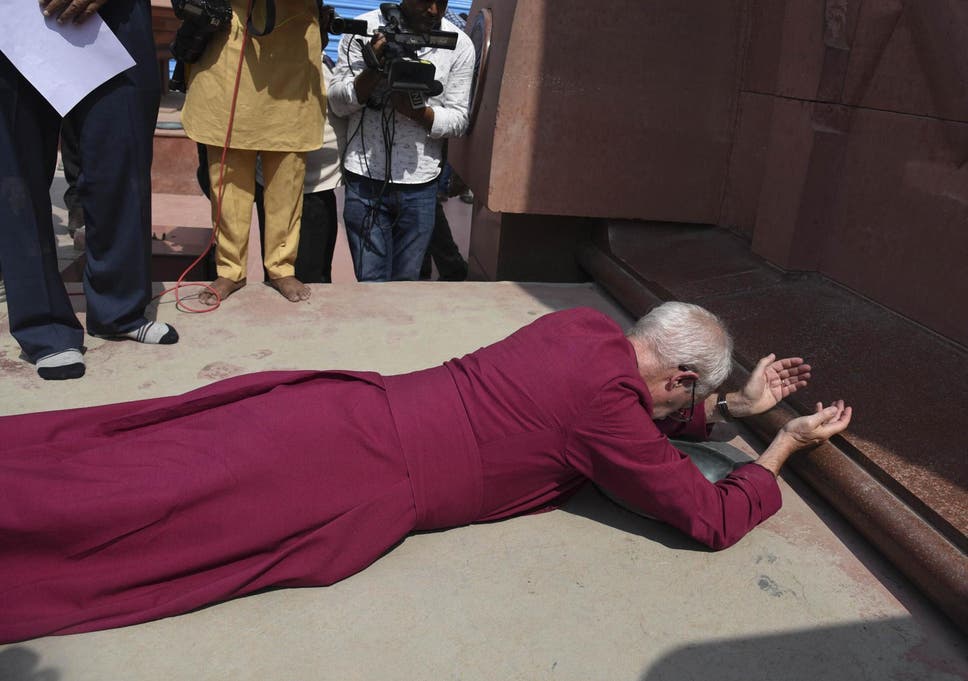
The Archbishop of Canterbury said he was “personally very sorry” as he prostrated himself before memorial to the victims of the Amritsar massacre in the Indian state of Punjab.
Justin Welby said he recognised “the sins of my British colonial history” as he lay down flat to pray in front of the memorial in the heart of the Jallianwala Bagh park, where at least 400 unarmed Indian men, women and children were slaughtered by soldiers from the UK.
Its ideology “too often subjugated and dehumanised other races and cultures”, the most senior bishop in the Church of England added.
“I have no status to apologise on behalf of the UK, its government or its history. But I am personally very sorry for this terrible atrocity,” he said.“Coming here arouses a sense of profound shame at what happened in this place. It is one of a number of deep stains on British history. The pain and grief that has transcended the generations since must never be dismissed or denied.”
The visit marks the last leg of his 10-day pilgrimage to the Indian subcontinent, which has seen him visit churches to “listen and learn from Christians in India”.
The Amritsar massacre took place in the same public garden in 1919, when Acting Brigadier-General Reginald Dyer called on troops to fire on a crowd who had met for the Sikh festival of Baisakhi.
The officer had previously banned public meetings fearing the people would riot against the British. Word about his ruling is not believed to have reached the many who had gathered.
Blocking the exits to stop people escaping, Dyer and his troops also injured more than 1,000 people in 10 minutes of gunfire.
Children as young as six-weeks-old were among the dead and 120 bodies were retrieved from a well in the garden which people had jumped into to escape the carnage.
The massacre dealt a crushing blow to Indian perception of the British colonists, and divided Britain.
Some praised Dyer in the House of Lords, while many in the House of Commons denounced him.
Winston Churchill, who was minister for war at the time, said it was “without precedent or parallel in the modern history of the British Empire”, describing it as “an extraordinary event, a monstrous event, an event which stands in singular and sinister isolation”.
In India meanwhile the barbarism of the event sparked the non-cooperation movement, led by Mahatma Ghandi, which called for the withdrawal of labour from anything that sustained the British government. The movement is considered by historians to be a significant step towards India’s independence.
Writing on Facebook, Mr Welby said: “We have a great responsibility to not just lament this horrific massacre, but most importantly to learn from it in a way that changes our actions. A true repentance involves me listening and learning to the voices of Indians, celebrating their cultures, and determining to work for the common good in ways that enable the flourishing of all people.
“The past must be learned from so nothing like this ever happens again.”