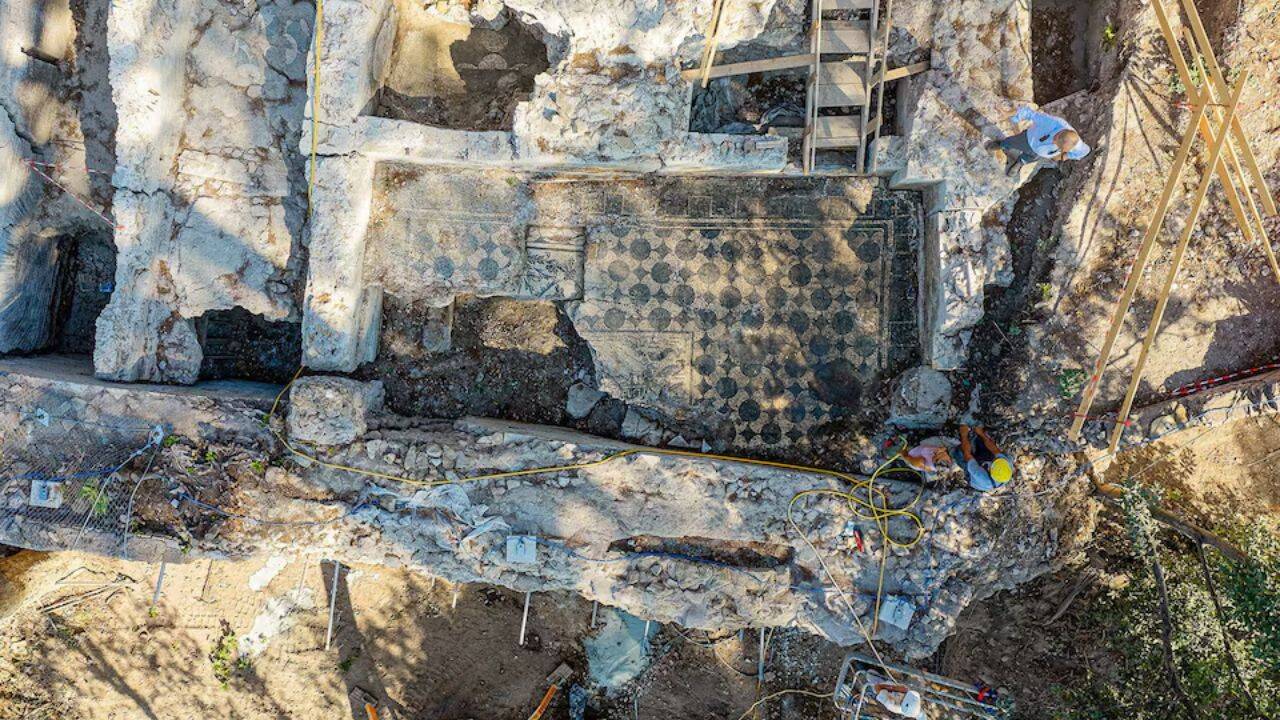
Archaeologists in Rome have uncovered a second-century building featuring mosaics and painted ceilings in the Villa Celimontana park, close to the Colosseum, that may once have served as barracks for the city's ancient firefighters. Five of the structure's eight rooms have now been fully excavated on the Caelian Hill, one of Rome's seven historic hills, within a park that was originally a noble residence dating to the 16th century.
The finding has drawn attention because of its striking similarities to known firefighters' barracks elsewhere in the Roman world, though experts caution that an alternative explanation remains possible until further study is completed.
Get breaking news anytime, anywhere. Download the TOI app now!
How did archaeologists uncover the ancient Roman building near the Colosseum
The excavation, carried out by Rome's Special Superintendency, has revealed a substantial second-century structure with decorative elements that point to a building of some significance. Among the finds is a mosaic depicting a dolphin, a fish, a lobster and a crab arranged around a large two-handled vase, alongside the remains of a painted ceiling adorned with large red and blue circles.
According to Reuters, the site sits within Villa Celimontana, a park with its own layered history stretching back to the 16th century. Its location on the Caelian Hill places it near other significant archaeological remains from ancient Rome, adding context to how this newly uncovered building may fit into the wider urban fabric of the imperial city.
Why do archaeologists think the building was a Roman firefighters' barracks
The strongest evidence for the firefighters' barracks theory lies in the mosaic's design, which closely resembles one found previously in a firefighters' barracks in Ostia, the ancient port city roughly 30 kilometres from Rome. This resemblance has led the archaeological office to propose that the building may have been connected to the barracks of the Fifth Cohort of the Vigiles, the corps responsible for firefighting in ancient Rome.
The Vigiles held a dual role under the Roman Empire, tasked with both extinguishing fires and maintaining public order during the night. Their barracks in this area are known to have drawn water from a nearby aqueduct, a detail that lends practical support to the theory that the newly found building served a related function.
What evidence suggests the building may have been a luxury Roman residence
Despite the parallels with Ostia, archaeologists have not ruled out an entirely different explanation. An alternative hypothesis suggests the building could instead have been a patrician residence, or domus, a type of dwelling that has been uncovered elsewhere on the Caelian Hill. The sophistication of the decorations found at the site would be consistent with this interpretation as well.
According to the superintendency's statement, confirming the firefighters' barracks theory would help reassess the extent of one of the most important military complexes of imperial Rome. Distinguishing between the two possibilities will require further work, as the surface-level findings alone are not sufficient to settle the question either way.
What could this discovery reveal about ancient Rome's firefighting force
The superintendency has been clear that only detailed study of the excavated materials and structures will provide a definitive answer. This next phase of analysis is expected to examine the building's layout, construction techniques and any further artefacts recovered from the remaining unexcavated rooms.
The excavation itself has been funded through EU post-COVID economic recovery funds, reflecting a broader pattern of European support for heritage and archaeological projects in the years following the pandemic. Should the firefighters' barracks theory be confirmed, the discovery would add meaningfully to historians' understanding of how the Vigiles operated and where their network of barracks extended across the city.