Most of us don’t give much thought to the ground beneath a road. But in Nottinghamshire, England, a planned highway expansion has just revealed one of the most multi-layered archaeological sites the region has seen in a long time, and the discoveries are the kind of thing that makes history feel surprisingly close.
A team of 30 archaeologists spent 22 weeks digging through more than 23 acres of farmland before work could start on the A46 Newark Bypass, a plan to ease traffic congestion around Newark. What lay under the surface spanned almost 8,000 years of human life, from about 6000 BCE to the early modern period. In the same patch of English countryside lived and died Stone Age farmers, Roman settlers, Anglo-Saxon families and communities from the Civil War era, all stacked like pages in a book nobody knew was there.
Ancient burials, a Roman well, and a surprisingly rare building
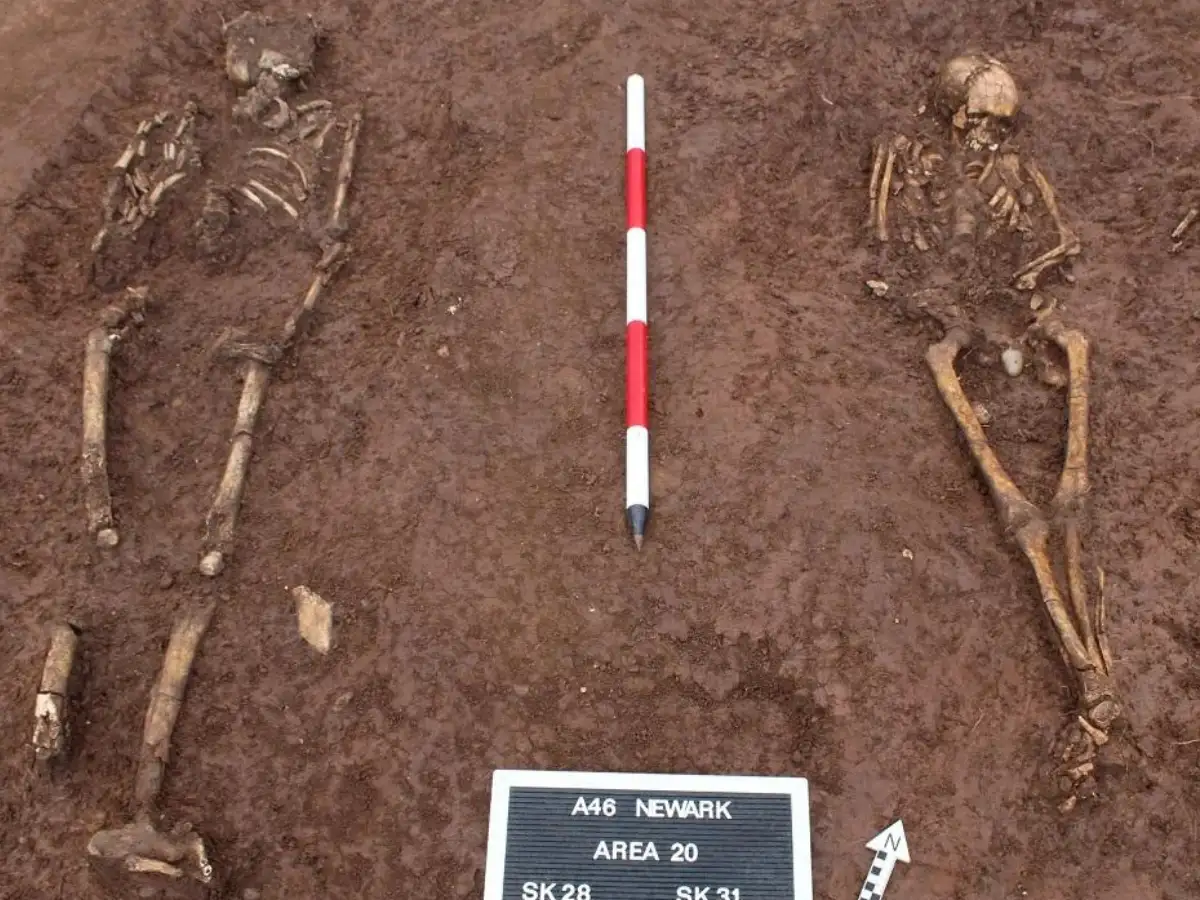
Among the most important of the finds was a burial with the remains of seven people. The burials are thought by researchers to date back to the Iron Age, Roman, or Anglo-Saxon periods, and specialists are still working to narrow this down. A 2012 study in the Oxford Journal of Archaeology argues that burial practices in southern Britain during the Iron Age were far more varied and intentional than previously thought, with remains often placed in relation to specific ritual beliefs, meaning that each new burial site could reveal much about how ancient communities understood life and death.
Elsewhere, to the south west of the village of Kelham, the team discovered a Roman enclosure, a Roman well, and what appears to be the foundation of an old farmhouse. These are not just cool artifacts; they indicate the same land was actively farmed and settled across multiple centuries.
That sunken-floor building is a pretty big deal
One of the rarest finds on the site was the remains of a probable grubenhaus, a sunken-floored building typical of early Anglo-Saxon settlements. They were the homes and workplaces of ordinary people living in early medieval England, from about the 5th to the 11th centuries. As Jess Tipper writes in her landmark work on Anglo-Saxon grubenhäuser, published in Medieval Archaeology, these buildings are among the most archaeologically distinctive structures of the period, and the discovery of one in Nottinghamshire, where they are rare, represents a valuable addition to the historical record of the region.
Simply put, this is more than a ruined building. It’s a glimpse into the home life of people who lived there more than a thousand years ago.
The smaller finds tell the story of everyday life
In addition to the major structural discoveries, the excavation yielded 163 pieces of pottery, much of it decorated or glazed and mostly dating to the Roman and Iron Age periods. Archaeologists also found prehistoric arrowheads made of flint and a saddle quern, a flat stone used for grinding grain into flour, from the Neolithic period. This is the sort of thing that reminds you that farming is not a new invention; it is ancient, unglamorous, and everywhere.
The site even produced material associated with the English Civil War of 1642, showing that the land remained in use well into the early modern period.
Why this matters beyond Britain
For American audiences, it is easy to think of history as starting around 1776, but discoveries like this remind us that the human story is impossibly long, and that much of it remains buried underground, waiting for a road project to bring it back to light.
Sean Tiffin of Archaeological Management Solutions, the company leading the dig, said the finds add considerably to our knowledge of prehistoric, Roman, and Anglo-Saxon activity in this part of England, activity which has been largely unknown until now.
Some of the artifacts recovered will be put on display in Newark. No details have been announced yet, but when they are, it will be interesting to see. History this layered doesn’t surface that often.