Your support helps us to tell the story
Archaeologists have unearthed the grave of a “barbarian” who died on the frontier of the Roman Empire in the fourth century AD.
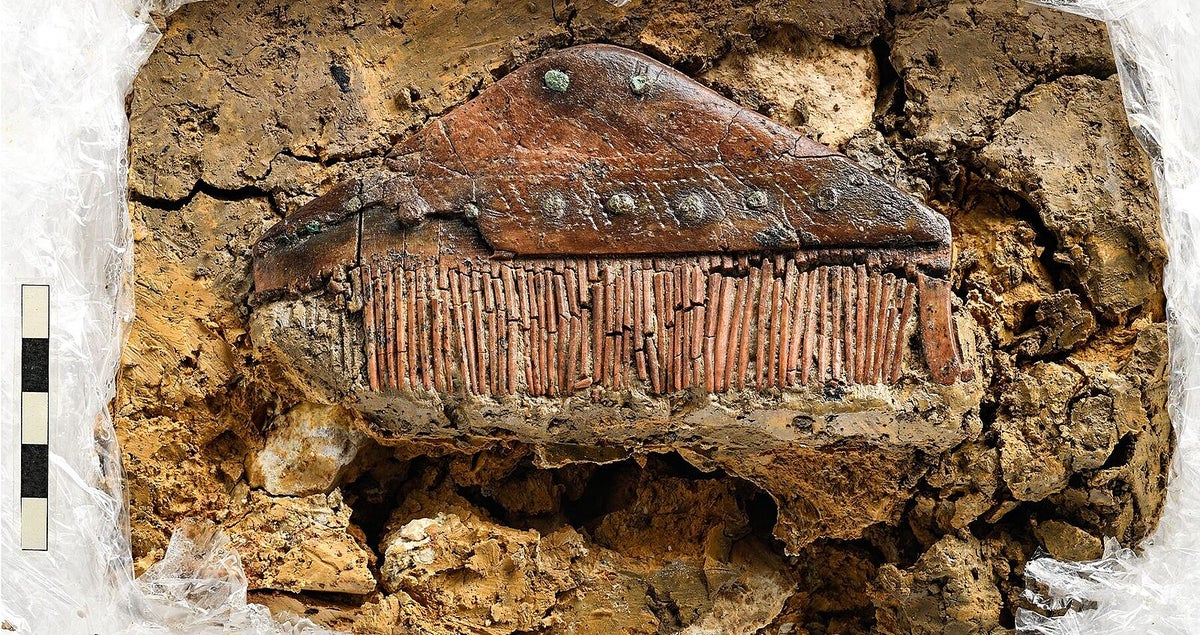
The man, about 60 years old, was buried 1,700 years ago along with valuable goods such as pottery, glassware, and a small fine-tooth comb.
Researchers found the burial during the construction of homes at the village of Gerstetten, 65km east of Stuttgart in Germany.
The elaborately built grave was enclosed in a wooden chamber and was situated at a prominent, solitary location, they said.
The Romans called Germanic tribal people “barbarians”, literally meaning “people who speak differently”, a term they also used for non-Roman people living outside the empire’s territories.
Archaeologists said the man likely belonged to the Alemanni Germanic tribes that lived on the Upper Rhine river.
Germanic barbarians invaded the Western Roman Empire to the south towards the end of the fifth century, causing its downfall.
The period from the 4th to 8th centuries was a time of major socioeconomic and cultural transformation in Europe. But not much is known about it in the absence of reliable written accounts.
Archaeological studies of barbarian cemeteries provide valuable insights into this time, called the Migration Period, which laid the foundation of modern European society, but few early German graves have previously been discovered.
Most of the graves uncovered so far are in the southwestern German state of Baden-Württemberg bordering France and Switzerland.
Archeologists said finding more graves would shed further light on this epoch of history.
“The excavation on Bismarckstraße, where the burial was discovered, was completed a week after the tomb was discovered at the beginning of May,” the Stuttgart Regional Council said in a statement.
Two ceramic vessels found at the site have been restored by the State Office for Monument Preservation at the Stuttgart Regional Council.
A rib from the grave, sampled for carbon dating, confirmed that he died between 263 and 342 AD.