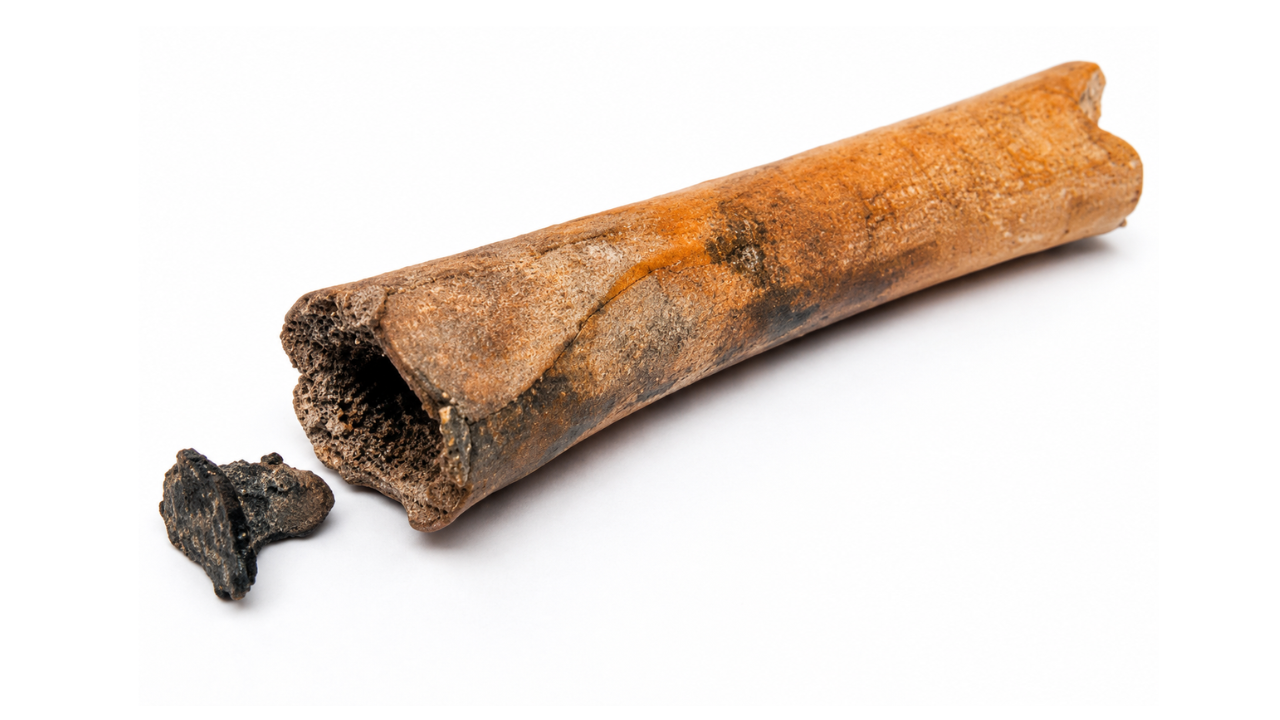
A small hollow bone recovered from an ancient Roman archaeological site has offered an unexpected window into medical practice nearly 2,000 years ago. For years, the object attracted little attention and was catalogued as an ordinary artefact. Modern laboratory analysis has now revealed that it preserved the remains of a carefully prepared medicinal mixture, providing rare physical evidence of how remedies were stored and transported during the Roman period.
Get breaking news anytime, anywhere. Download the TOI app now!
Researchers from Cambridge University , using advanced chemical techniques, detected traces of plant extracts, fats and other organic compounds that point to a deliberately formulated medicine rather than a household substance. Among the ingredients identified was black henbane (Hyoscyamus niger), a powerful medicinal plant prized in antiquity for its pain-relieving and sedative effects. The discovery not only sheds fresh light on Roman healthcare but also demonstrates how biomolecular science is helping archaeologists uncover hidden stories preserved inside even the smallest ancient objects.
What was hidden inside the 2,000-year-old Roman bone container
The artefact is a hollow animal bone that had been carefully fashioned into a small cylindrical container. Although modest in appearance, its interior still preserved microscopic traces of an ancient medicinal preparation after nearly two millennia.
Chemical analysis revealed a complex mixture of organic compounds associated with Roman pharmacology. Researchers identified residues of plant-derived substances, animal fats and black henbane (Hyoscyamus niger), a toxic but medically valuable herb containing the alkaloids hyoscyamine and scopolamine. Ancient Greek and Roman physicians used the plant in carefully controlled quantities to relieve pain, induce sleep and reduce muscle spasms, while recognising that excessive doses could be dangerous.
The combination of ingredients suggests the container once held a deliberately prepared therapeutic remedy rather than food, perfume or cosmetics. Researchers believe the hollow bone served as a lightweight, portable vessel that protected valuable medicine until it was needed.
How scientists identified the remains of ancient Roman medicines
As mentioned in the study, ‘ Evidence of the intentional use of black henbane (Hyoscyamus niger) in the Roman Netherlands ’ to investigate the residue, researchers employed advanced analytical techniques, including gas chromatography–mass spectrometry (GC-MS), which can detect minute traces of degraded organic molecules thousands of years after they were deposited.
These methods allowed scientists to identify plant compounds, lipids and other biomolecules that would have been impossible to recognise through visual examination alone. Instead of relying solely on the appearance of the artefact, researchers reconstructed its contents from the chemical fingerprints left behind.
The study highlights how archaeological science has expanded far beyond excavation. Today, microscopic residues preserved inside containers can reveal how medicines were manufactured, stored and administered, offering direct evidence of ancient healthcare practices that written records alone cannot provide.
What the discovery reveals about healthcare in the Roman Empire
Roman medicine drew upon centuries of accumulated knowledge from Greek, Egyptian and local healing traditions. Physicians routinely prescribed remedies made from herbs, oils, resins, waxes, minerals and animal-derived ingredients, blending them according to the condition being treated.
The identification of black henbane is particularly significant because ancient medical authors, including Dioscorides and Galen, described the plant's therapeutic value while also warning of its poisonous nature. Its presence inside the bone container suggests the medicine was prepared with considerable care and may have been intended to treat pain, inflammation or other conditions requiring potent ingredients.
The find also challenges assumptions about how medicines were stored. While glass and ceramic vessels are commonly associated with Roman pharmaceuticals, this discovery indicates that hollow bones could serve as durable, lightweight containers for carrying valuable remedies.
Why tiny archaeological finds can transform our understanding of history
Some of archaeology's most revealing discoveries are not monumental buildings or spectacular treasures but ordinary objects that survived by chance. A small bone tube preserving microscopic traces of medicine can reveal details of ancient pharmaceutical knowledge that no surviving text records with the same precision.
As analytical techniques continue to improve, researchers are extracting new information from residues, fibres and other invisible remains once considered scientifically inaccessible. These advances are transforming archaeology into a discipline capable of reconstructing not only what ancient people made, but also what they ate, drank, manufactured and used to treat illness.
In this case, an unassuming bone container has preserved a remarkably personal story: evidence that nearly 2,000 years ago, Roman healers were carefully preparing complex herbal medicines and carrying them in practical containers designed for everyday use.