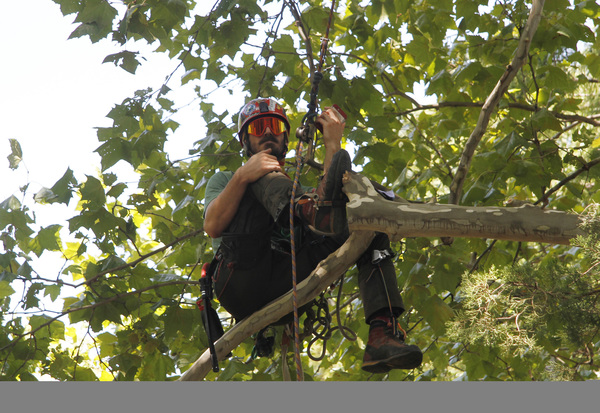
BARTLETT ARBORETUM, Kan. _ There was terror in Kaleb Locke's scream when he fell 15 feet from a cedar. But partway to the ground, that yell turned to laughter as a rope attached to a harness around his waist tightened.
Back and forth Locke swung through the trees and over a lake. Six friends, some of which watched and shouted encouragement from perches 30 feet up in sycamores, anxiously awaited their turns.
Though best known for open prairie, Kansas has many dedicated arborists.
Sometimes they can cut limbs from the confines of a bucket truck. Many times they climb high into trees to trim thumb-sized limbs with handsaws or thick limbs with chainsaws.
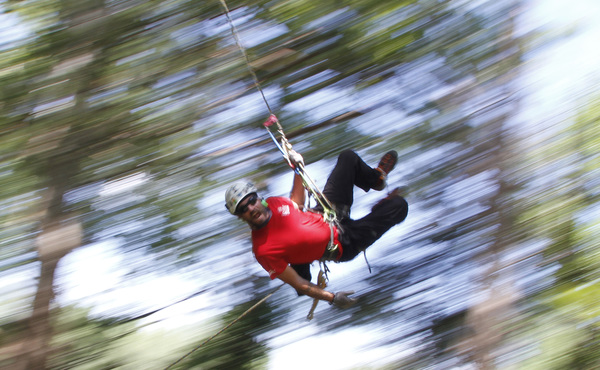
A couple of times a month, they get together to climb, swing and play in trees.
"We do this, work up in trees, every day, but this gives us a chance to get together and have some fun," said Locke, an arborist from Sedgwick, Kan. "We all like working up in trees, obviously, but this is how we like to play."
Working or playing, they take climbing serious.
"It's all up to you," Bryan Brock said about the thickness of limbs they'll trust for their climbing ropes or to stand on. He was using live sycamore limbs 4 inches or more in diameter.
"A lot has to do with the kind of tree," said Elias Richman, another arborist. "I don't trust a cottonwood nearly as much as I would an oak." Locke commented that hedge (a.k.a. Osage orange) trees also were especially sturdy. Dead limbs are never trusted.
Safety was the group's common theme. Nobody got in a rush. Even amid the pros, second opinions were often sought.
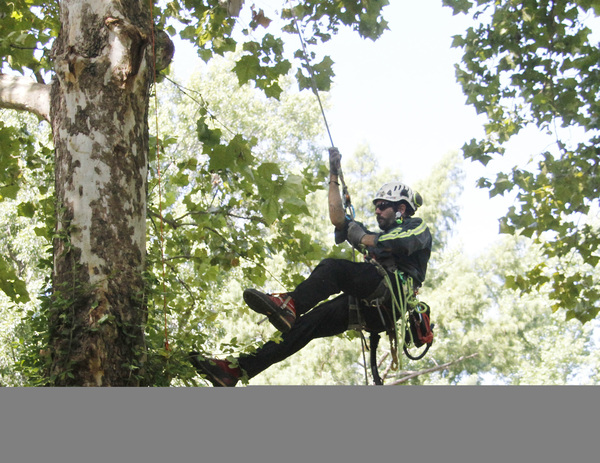
Richman used a small bag of weights attached to light string tossed upward to access a particular limb. A thick rope was attached to the weights when he lowered them to the ground, and it was hauled back up and over the limb. When that end of the climbing rope came back to Richman, he ran it through a metal ring on the rope's other end and pulled the loose end until the ring and rope were snug against the limb.
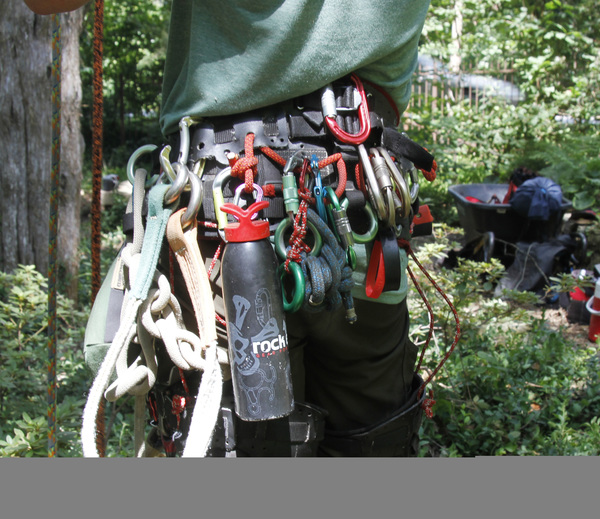
Climbing ropes were passed through several fail-safe catches attached to harnesses that would keep a climber from falling. Stirrup-like attachments allowed the arborists to climb the ropes step after step. Helmets were mandatory.
First they trimmed dead limbs to repay the arboretum for access. Next they created a rope swing. Two of the climbers ran a section of rope between two towering sycamores, 40 feet above the ground. Brock described how the rope should be rigged and showed the best knot to attach a metal ring used for attaching the rope on which they'd swing.
He said arborists use about 100 different knots. Several times he showed others how an extra loop here or a twist there strengthened a knot.
"That's one of the neat things about getting together," Richman said. "We're having a blast while we're learning from each other." One climber brought a new saw that was sharper, and less expensive, than those used by others. Several said they'd soon get their own.
Each arborist had a story about what got them into the trade. Some just always had a love of tree climbing. Locke got a taste for it on a monthlong job with the U.S. Forest Service in Colorado and made it a career when he returned to Kansas. For Richman, it seemed a natural occupation, because he loves rock climbing.
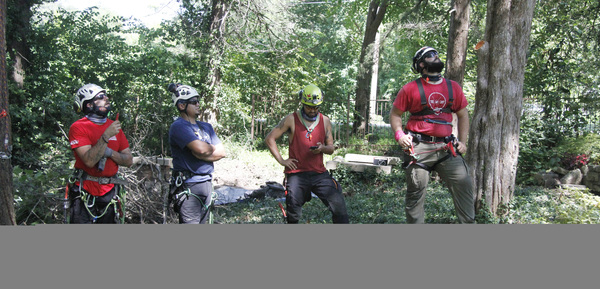
All took at least one turn swinging from a rope that connected their harnesses to the rope high between the sycamores. Rather than just swing, most did aerial twists, grabbed leaves as they passed branches and swung upside-down.
Some watched from high enough in the sycamores to actually be looking down on the men who were swinging. Some swung from tree to tree, like Tarzan, on their synthetic grapevines.
Locke said they try to gather a few times a month. Some travel to national competitions.
"It's more to be around a great group of people," he said. "The guy you're competing against may be giving you advice on how to do something better. You learn a lot and have fun, too. Most of us just like to have fun and climb trees."