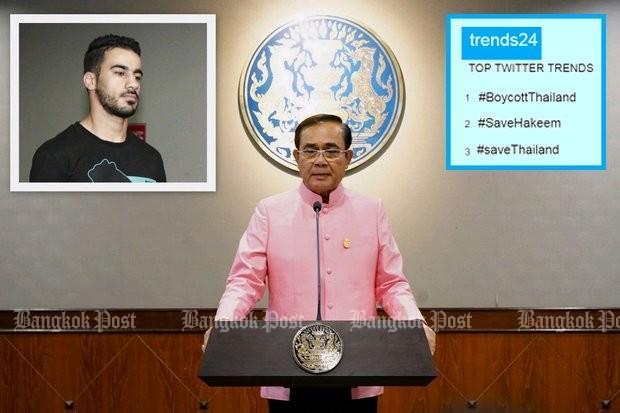
The government insisted Tuesday that the justice system must be allowed to run its course in the case involving the extradition of Bahraini footballer Hakeem al-Araibi, as a social media campaign against his extradition using the hashtag #BoycottThailand gathers steam.
Prime Minister Prayut Chan-o-cha said the case would be tried in court and the government is not in a position to interfere.
He said the Ministry of Foreign Affairs has been seeking cooperation from Bahrain and Australia to engage in talks so a solution can be found.
Talking about the campaign, Gen Prayut urged people not to get involved.
His appeal had no effect. If anything, it inflamed the Twitter posters even more.
On Tuesday evening, three hashtags dominated the social media site: #BoycottThailand, #SaveHakeem and a counter-punch by mostly Thai tweeters - #SaveThailand.
The #SaveThailand hashtag consisted mostly of tweets that either defended the "fair" Thai court system or put the blame back on Australia. Interpol Australia issued the Red Notice request to detain Mr Araibi, although that notice was later withdrawn as it turned out it never should have been issued.
On Monday, Mr Araibi was taken from Bangkok Remand Prison to the Criminal Court, where public prosecutors sought an order to extradite him to Bahrain. The pictures of Mr Araibi walking into court in shackles sent ripples of shock around the world.
In Canberra, Prime Minister Scott Morrison said he was "disturbed" by the photos, and protested to Gen Prayut.
Pol Col Naras Savestanan, director-general of the Corrections Department, said the use of shackles was a carefully weighed decision. Section 21 of the Corrections Act authorises warders to use shackles on detainees when they are brought out of a prison.
“Warders considered the detainee is of interest to society and could impact international relations. As a result they decided to put anklecuffs on him,” Pol Col Naras said.
The Corrections Department risked facing human rights criticism, Pol Col Naras said, but the public should understand that officials had to ensure the safe transportation of detainees and prevent any attempt at escape.
On Monday, Mr Araibi told the Criminal Court he refuses to be voluntarily extradited to Bahrain, which has asked for his return to serve a prison sentence for a crime he denies committing.
His rejection means a hearing will be held to determine his fate. He claims he would be tortured if sent back to the country of his birth.
The Bangkok court has set an April 22 date for its next hearing.
Shortly after the court set the April 22 date, the Australian ambassador to Thailand issued a statement saying the Bahrain government knew that Mr Araibi had lived in Australia since 2014.
During those four years, it did not attempt to ask Australia about him. It waited until he went to Bangkok, the statement said.