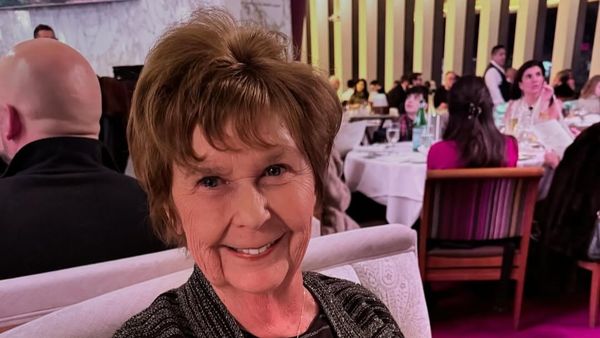
Even close to the end of her life, Arabella Weir’s mother was still concerned about her daughter’s weight. “Literally two days before she died,” says Weir, with a grim laugh. “I said: ‘You’re dying and you’re worried about how fat I am?’ She went: ‘Oh God, look at you, though.’ And I said: ‘We’re not doing this shit now.’ And she didn’t back down, nor did she apologise.” Ten years on, there is revenge of sorts – or catharsis, or a kind of exorcism, or merely some giddy laughter that comes from the triumph of surviving such a dysfunctional childhood. Weir is now going to Edinburgh with her one-woman show, in which she unpicks – or rather picks at – her childhood and her relationship with her mother.
The show is called Does My Mum Loom Big in This?, which fans of the 90s BBC comedy sketch series The Fast Show will recognise as a play on one of her character’s catchphrases, “Does my bum look big in this?” That also became the title of her bestselling book. It seems as if Weir has been a fixture in British comedy for decades – she was also in the spoof cookery show Posh Nosh, which she co-wrote – and she has worked steadily in dramas and sitcoms, including the BBC Two series Two Doors Down. But this is her first one-woman show, co-written with the novelist Jon Canter, and the first time she has performed at the Edinburgh fringe; she will be taking it on tour next year. It feels like the right time, she says. Both of her children are at university. “There’s a been a sort of: ‘Oh right, so it’s just me now. So what am I going to do?’” says Weir, who is 61. “I don’t want to be watching Judge Judy all day, which I could very easily do.”
Her show is funny, she insists several times, when we meet at her home in north London; she’s worried it might sound grim and self-pitying. “I take my shit and make it funny,” she says. That was how she survived. “I developed a very acute sense of humour that would make a joke out of anything.” And she is excellent company – funny, with a gift for easy intimacy, and eager to be entertaining.

Did she always want to write about her mother? “Yes, I think so,” she says, slouching in an armchair with her legs slung over the side. “The way I have recovered, and what I did at the time, was to be combative. Experiencing the neglect and emotional abuse I did, at the time I was constantly saying: ‘Why are you doing this, why are you saying this, why can’t I eat, what’s wrong with the way I look?’ and that’s what my mother found so difficult. Looking back, I think that is why I am who I am and I’ve written the stuff I’ve done. In a way, my combativeness was my saving grace and the thing that kept me buoyant.”
Weir was born in the US, where her father, Sir Michael Weir, a diplomat, was posted, then the family lived in Cairo before moving to London when Weir was about seven. Her parents separated a few years later and she was brought up by her mother, Alison, with her two older brothers and younger sister (she has talked to them about her show, but she’s not expecting them to come and see it). “The thing I was very aware of was she was much more aggressive with me than she was with my siblings. She said: ‘That’s because you’re more annoying than anyone else.’ She often used to say that.” When she was about nine, Weir was sent to live with her father in Bahrain, while her siblings remained in the UK. “In my memory, she got rid of me – and I’m afraid pretty much that’s what happened.”
Although she says this gave her a bond with her father, he was emotionally reserved, and when he moved to New York – and Weir was sent back to her mother – the children would only see him during the school holidays. “He was a pretty remote figure,” she says. “They were both absolutely classic Scots: chin up, grin and bear it, never put yourself first, don’t complain.”
Alison was obviously unhappy, but aggressively so, says Weir. One of her memories, from when she was about seven or eight, is when her mother “completely lost it because I couldn’t tell the time. She said: ‘We are not leaving this fucking house until you can.’ I remember thinking I’ve got to guess right because I had no idea how to read the time. Then I remember thinking I was frightened of her.”
Weir yearned, she says, for her mother to be “ordinary”. The first time she realised she had to look out for herself was when she was about eight and she asked her mother what there was for supper. “How the fuck should I know?” was Alison’s reply, and when you don’t think you’re going to get fed, says Weir, “you get panicky about food”. To her parents’ disappointment – they thought girls should be thin and pretty – she was naturally rounded, made worse by disordered eating. Her meals, when they appeared, were monitored. “[My mother] went in for: ‘You can’t eat that – you’re fat.’ My brothers were eating it and she would say: ‘They’re boys.’”
Was Alison ever kind to her? Weir thinks for a while. “We could have a laugh together but she was always critical. When she was ill and dying, I would read from the London Review of Books and those would be nice moments, but if I pronounced somebody’s name wrong there would be five minutes of: ‘I can’t believe you thought her name was …’ If she could get the jab in, she’d do it. She wasn’t kind.”
Alison had been brought up in the Scottish borders, the only child of emotionally repressed intellectuals. Her father was the headmaster of a small boys’ boarding school, where it wasn’t unusual for the pupils not to see their parents for years. “Mum was essentially brought up as one of the boy pupils, and not as their child,” says Weir. “Her parents said to her: ‘You are not to feel special.’ She was, I think, quite badly neglected. Her mother, within earshot, would apologise to her father that she was a girl.”
She was bright and got into Oxford, where she met Weir’s father. “There were these women of that class, expected to go to university and do brilliantly and then expected to be diplomats’ wives. What was the point of educating them if they were just going to have to look nice in a cocktail dress?” Forced into taking on virtually all of the domestic work, Alison rejected it. She considered cooking “beneath her”, says Weir. “Her favourite thing was: ‘That’s just so fucking bourgeois.’ You’d go: ‘Can we have something to eat?’ and she’d go: ‘Don’t be so fucking bourgeois.’ It is funny looking back, but it was crazy and it was frightening at the time, and there was no stability. She was very grand and incredibly bright and she just thought anything domestic was beneath her intellect and beneath her socially.” She was funny and witty, very well-read, “totally without inhibitions”, says Weir. Essentially, “she was my child. What she’d created was a person who was able to mother her. She sort of said that towards the end, although she did not express any gratitude.” She did, however, admit that, as a parent, she didn’t have a clue what she was doing.

Alison became a teacher at Camden School for Girls in north London, which Weir attended. She says she became the school rebel – brave and hilarious – mainly to embarrass her mother. “It was revenge. And I was very pleased.” But it also had the added effect of making Weir popular – which at the time she desperately needed. “I remember thinking I am going to be the funniest, most popular person and I don’t care what it takes.” She smiles. “What it took was not to get any O-levels.”
Performing suited her. After studying drama at North Middlesex polytechnic, she took temping jobs between small acting roles until getting her break on The Fast Show. She was in her mid-30s before she started earning a living from acting. Were her parents proud? She smiles grimly. Her mother, she says, “didn’t watch what I did, and if she did, she’d go on about how brilliant somebody else was – usually a man”.
She likens working in TV in the 80s and 90s to working on a building site. “People would talk about your tits in a ‘jokey’ way,” she says. “Not usually the cast, but maybe. The sparks and all these guys … someone would shout: ‘Oi, seen the new one with the big tits?’ and if you went: ‘Erm, guys?’ they would go: ‘You’re not one of those women’s libbers, are you?’”
None of the #MeToo revelations came as much of a surprise to Weir. “Given that men go about saying disgusting things to you on the tube and the bus, why isn’t someone who has actual power over you going to be guilty of the same shit? If you are a man with not-great attitudes to women but you want power over women, what better to be than a film producer or a TV director?”
On one job, a well-known actor locked Weir in his dressing room. She pauses. “And another very well-known actor, and another one. God, there were loads. They were obviously men with, at the very least, a sense of entitlement. To be fair to at least two of them, there was no question of them forcing themselves on me once I had gone: ‘What’s going on?’ But it was always: ‘I thought you were a fun girl, but if you’re going to be like this.’ It was about what was wrong with me; there was certainly no ‘I’m so sorry – I misread the situation’.” One man did get aggressive, she says, when she turned him down. “I did think: ‘I’m in real trouble here.’ Then somebody knocked on the door to say my ride home had arrived.” She rarely complained. “Who would you have gone to? I was on one thing where someone behaved very inappropriately and I told the producer, and he went: ‘Oh yeah, he’s a bit of a twat,’ and that was it.”
She brought a feminist slant to The Fast Show – memorably with the Invisible Woman character, whose ideas are ignored by the men who then pass them off as their own. Behind the scenes, she felt she was making a stand for working mothers. “I mean, I wasn’t Germaine Greer, but I remember thinking: ‘They can’t get rid of me, and I’ve just had a baby and she’s coming with me,’” she says. Her daughter (now 21; she also has a son who is 20) was born around the time of the show’s live tour. “I was very lucky because I was in a job where my friends were the producers, but I just took her with me and breastfed her in front of everyone. I remember thinking: ‘I’m going to do whatever I want, and I’m going to take this baby everywhere, because there are women who can’t do this and I will blaze the trail.’ I felt very gladiatorial about it.”
Despite her relationship with her mother, Weir says she was “absolutely desperate to be a mother. I have made it my life’s work to do the opposite of everything my mother did and be the best possible mother I can be.” On the whole, she thinks, she has succeeded, though part of her show is about her own shortcomings as a parent. What has been her biggest failure? She thinks for a minute then says with a smile: “They cannot bear it that I like Drake [the rapper]. They don’t like me dancing. I think they find me … I don’t believe a mother has to be self-effacing, but they might have liked it if I wasn’t quite so: ‘Wheee, look at me!’ But I think they like me.”
Has she forgiven her mother? “Oh yes,” she says, then: “Forgiven – is that the right word?” Reached a level of understanding? Weir nods. “I made it my business to understand her childhood and the context for women of that generation, and how hard it was for them. Add into that someone who was not maternal anyway. She would probably have much more support now. I understand her, but I think she was too bright and too privileged not to have done something about it. But she wasn’t interested in changing.”
Mother-daughter relationships are endlessly complex – that was why she wanted to write about it. “I hope the show is funny and real and has some messages about parenting and being a woman, and the things that are still true from my mother’s generation to mine and after.” Remarkably, these days she thinks about her mother with fondness. “I made my peace with her.”
Does My Mum Loom Big in This? is at the Assembly George Square Studios, Edinburgh, from 12 to 25 August.