The scene on the Bryn-y-Gog estate was a peaceful one. Pensioners chatted at their front gates while mothers and fathers took advantage of the warm spring sunshine to get some gardening done, and children whizzed around on bicycles.
“I think, finally, the town has moved on,” said Mike Williams, a county councillor who lives on the estate. “For the sake of the children you have to do that but, of course, moving on doesn’t mean forgetting. We will never forget and the place will never be quite the same.”
Never forget, he means, the evening, two and a half years ago, when five-year-old April Jones was snatched as she played on her pink bike here and was murdered soon after, probably in a hillside cottage on the edge of a nearby village.
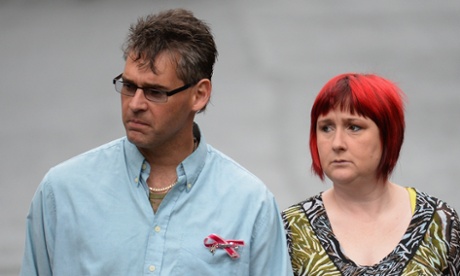
The memories of that dreadful day were in the forefront of minds as April’s parents, Coral and Paul, published a harrowing account of their ordeal. They described the relief of being able to put down on paper their grief and set out how they felt children could be better protected.
Writing about the book written by April Jones' parents Coral and Paul. Here's the cover. pic.twitter.com/MeGwqOI96v
— steven morris (@stevenmorris20) April 9, 2015
Called simply April, their book describes in awful detail the moment the parents realised their daughter been taken from their estate in Machynlleth, mid-Wales, the agonising search and the trial of the girl’s killer, Mark Bridger.
Much of the material will be familiar to those who followed the case, but for the first time there is an account of a secret visit made to Bridger’s house, Mount Pleasant, in the nearby village of Ceinws, where April was thought to have died and which has now been demolished.
Coral Jones says in the book that she was “consumed by the desire to visit Mount Pleasant”. Paul Jones said, about entering the house: “All I could focus on was the fireplace.” That was where Bridger was thought to have burned April’s body.
He said: “The carpet had been ripped out and there was a big piece of Perspex on the hearth, covering the spot where April’s blood had been found. I put my hands on the cold, black, fireplace and started to weep. My tears weren’t the gasping, throaty, sobs I often cried while walking in the hills. Instead they were respectful and almost silent.”
Coral Jones said she wanted to look upstairs in the house, though there was no forensic evidence that April had been there. “I felt the need to comb every corner just in case there was some cryptic clue as to what had really happened to my little girl. After all, I was her mum. If I couldn’t find the answers, who could?”
But she got no closure from the visit, she said. “Bridger hadn’t just snatched our precious girl from the street and murdered her in cold blood – he’d flatly refused to tell us what had really happened, or what he had done with her, and that was a whole different crime in itself.”
Despite the largest search in British police history, all that was found of April were a few pieces of bone and ash recovered from the fireplace. Coral Jones said that when she received the urn with the remains she took it to bed. “Tears rolled down my face as I lay there, cuddling all that was left of my little girl in my arms,” she said.
She has also revealed that she decided to contact Bridger in prison, to ask him to tell here what happened to April’s remains. She wrote to him: “We buried what we have of April but the rest of her is out there somewhere. I will not be able to rest until we can bury all of her, so find it in yourself to tell me what you did with her.” But in the end she decided not to send the letters.
There are moments in the book when April’s parents describe how they would have liked to have taken vengeance on Bridger. But in two BBC interviews, given to promote the book, both expressed in measured tones the idea that paedophiles should be helped.
Paul Jones said: “If you are thinking that way and you haven’t committed any crime, if you call out for help, that can only be a good thing. If you don’t call out for help you might eventually turn into a Mark Bridger yourself. Someone calling out for help deserves a chance.”
Coral Jones said she hoped the book could “save one child, one family”. She added: “If someone says to the doctor, ‘I have these feelings, can I have help?’, it would be better to try to help them before they ruin someone else’s family.”
They also said they hoped the book would force governments and internet companies to do more to stop images of child abuse being so readily available online. Bridger viewed explicit images of children suffering violent sexual abuse before he abducted April.
Paul Jones said: “It will raise questions, if people read the book, why these sort of things are still happening. The government and internet don’t seem to be doing enough to prevent it. I’m hoping it will open people’s eyes and start asking questions why things aren’t being done.”
In the book April’s parents write about how Machynlleth has begun to return to “some sort of normality”. They say: “Our daughter’s death meant our little town would never be the same again. However, slowly but surely, the local people tentatively began their attempt to pick up the pieces of a world that had been shattered beyond comprehension.”
There are few physical reminders of the tragedy nowin Machynlleth. The pink ribbons have gone though the “April tree” on the mountain behind the town is still decorated with fading scraps of material and the tiny “April’s garden” on the estate is carefully tended.
The April Jones tree on the mountain in Machynlleth. pic.twitter.com/x86gccfo3P
— steven morris (@stevenmorris20) April 9, 2015
Julieann Evans, a mother with three children, who has lived on the estate all her life, was helping take delivery of a Playbox, a large container that would be filled with craft materials and toys. It was donated partly because this is judged a deprived area, and partly to help the estate recover from the April tragedy. Evans said the town was on its way back to normality. “You have no choice. What happened was terrible. But we have to get on with life.”
The April Jones garden on the Bryn-y-Gog estate in Machynlleth, mid Wales. pic.twitter.com/pMcChmDnMh
— steven morris (@stevenmorris20) April 9, 2015