With some two dozen Republicans already either openly vying for their party’s presidential nomination in next year’s election or publicly exploring the possibility of throwing their hats into the ring, that race is shaping up to be quite the circus.
But for those with an eye on issues affecting the wallets and pocketbooks of average Americans, it’s the Democratic campaign that now looks as if it’s going to be most interesting thanks to the entry of Bernie Sanders, the independent senator from Vermont, into the race for the nomination, going up against the establishment figure of Hillary Clinton.
Nine months before the New Hampshire primary Sanders is raising campaign issues that are distinguishing him from his peers on both sides of the aisle. Sanders envisages a single-payer healthcare system and finding a way to get American corporations like Apple to repatriate trillions of dollars of profits now stashed overseas, calculating that taxes paid on those earnings could help subsidize painfully costly college education expenses.
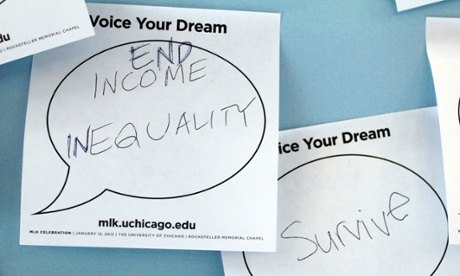
His overarching goal? To reduce income inequality, which he may struggle to understand but finds no difficulty finding words to deplore. “The billionaire class is much more aggressive now than it used to be,” Sanders told Mother Jones in an interview just before he declared his candidacy. Whereas previously, many wealthy Americans at least tolerated unions, or narrower gaps in pay between CEOs and workers, “in the last 35 or 40 years, there has been an increasingly aggressive effort on the part of the top 1% to take all the wealth”.
The latest batch of jobs data, released Friday, showed the economy added 223,000 jobs in April taking the unemployment rate down to 5.4%, its lowest since 2008. Average hourly wages, however, only grew by 3% in April, taking year-on-year gains to 2.2%.
The bottom line? We already have recovered all the jobs that we lost during the 2008/2009 recession – we passed that milestone nearly a year ago. But we didn’t manage to create enough new jobs to satisfy the shortfall: to account for what would normally have happened had the economy kept chugging along at a reasonably normal pace for all those years during which the recession occurred, and during which it struggled to replace the lost jobs. We’re still millions of jobs in the hole, since every year, newly minted college graduates arrive on the market, looking for their first positions. (And of course, inevitably, some companies will close their doors, or lay off employees.)
The wage picture is bleaker still. Many of the jobs that were lost during the recession were middle-wage jobs, or even those that could generate a high salary – paying as much as $32 an hour, according to the National Employment Law Project. Mid-wage and high-wage jobs accounted for 79% of jobs lost during the recession, the thinktank calculated; as of August 2012, they represented only 42% of those created during the recovery. The gap was filled by low-wage jobs: only 21% of jobs lost during the recession were those making less than $13.83 an hour, but they make up the majority of new jobs created during the recovery.
So, what will matter more than the number of new jobs created, the unemployment rate or even the long-term unemployment rate (another figure that niggles at many economists) is how much money those employed Americans will have at their disposal to spend. As Sanders has pointed out, it isn’t much, because the benefits of the recovery have flowed, disproportionately, to the richest citizens – those who have had the ability to invest in financial assets and profit from the rebound in the stock market.
In contrast, those of us who rely on earned income as a source of “wealth” have struggled. Perhaps it’s because, as some pundits have hypothesized, workers learned during the worst years of the downturn not to rock the boat by asking for raises or quitting to seek a new job that might pay a higher salary.
The result? Barely half of Americans now see themselves as being part of the middle class, down from 63% in 2000, and well below the 61% average in the years leading up to 2008. That’s an astonishing fact for a country whose central philosophy revolves around providing its citizens with opportunities to rise in the world. The problem is that the more unequal a society is, the more unequal it is likely to remain – and we’re actually a lot less mobile than we think we are, even if our perception is catching up to our reality.
The ugly truth is that of those born into the poorest 20% of the population, only 10% will ever make it into the top quintile; nearly three-quarters won’t even break out of that bottom tier and into the middle income. Since ultra-low wages not only harm individuals – limiting their job prospects and earnings power, their ability to both save and spend – but also their community and the broader economy, it’s in all our interests to ensure that the salaries those in that bottom quintile collect aren’t impossible to live on. Consider the plight of blue-collar workers in places such as Silicon Valley, some of whom are on the verge of being driven out even from the area’s last remaining trailer parks – the area’s last affordable “housing”.
To many mainstream politicians, the kind of arguments and solutions that Sanders advocates will sound old-fashioned. Unions? The slide in membership continued in 2014, and only 11.1% of American workers belong to one, in spite of data suggesting that union workers generally pocket higher wages. Democrats couldn’t win support for a single-payer health plan and many support new trade arrangements that American critics feel will cost more jobs.
But when it comes to Sanders’ diagnosis of the core problem, he has hit the nail squarely on the head, and any presidential candidate who can’t address the growing problem of income inequality honestly is likely to face tough questions. Because the 1% may have all the income, and be able to buy lots of advertising for their preferred candidates, but they don’t own the votes. Those still belong to the people wondering why their incomes have flatlined.