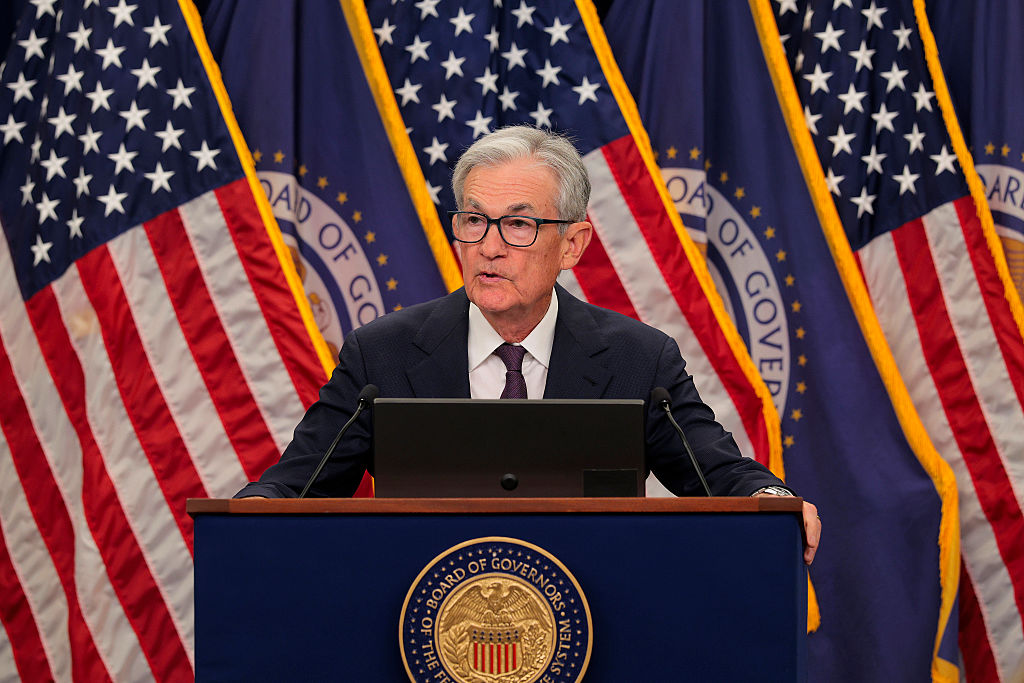
The April Fed meeting wrapped up on Wednesday, April 29, with the central bank's latest policy decision.
With spiking energy prices lifting inflation and Federal Reserve Chair Jerome Powell at the end of his term, the central bank kept the federal funds rate unchanged this time around.
But Wall Street kept a close eye on the Federal Open Market Committee's (FOMC) statement and Chair Powell's press conference to see how concerned the central bank is about the lasting impact of higher oil prices.
Powell's surprising decision to remain on the Fed's Board of Governors for the time being was also a major storyline that emerged from the meeting.
The Kiplinger team reported live on the April Fed meeting, bringing you the news and our expert analysis of what it could mean for the economy. Scroll for the latest updates.
How Does the Federal Reserve Work? | How Inflation Affects Your Finances and How to Stay Ahead | War in the Middle East Spells Higher Inflation for U.S. Consumers
Fed meeting schedule for 2026
The next Fed meeting, which runs from April 28 through April 29, marks the third gathering of 2026.
"The committee meets eight times a year, or about once every six weeks," writes Kiplinger contributor Dan Burrows in his feature, "When Is the Next Fed Meeting?".
The Federal Open Market Committee "is required to meet at least four times a year and may convene additional meetings if necessary," Burrows adds, noting that "the convention of meeting eight times per year dates back to the market stresses of 1981."
Fed meetings last two days and wrap up with the release of a policy decision at 2 pm Eastern Standard Time. This is typically followed by the Fed chair's press conference at 2:30 pm.
Here is the full remaining Fed meeting schedule for 2026:
April 28 to 29
June 16 to 17
July 28 to 29
September 15 to 16
October 27 to 28
December 8 to 9
The next Fed meeting will be Powell's last
On Friday, the Department of Justice (DOJ) dropped its investigation into Jerome Powell. The probe, launched in mid-January, threatened a criminal indictment related to Fed Chair Jerome Powell's testimony before the Senate Banking Committee last June about a multi-year project to renovate historic buildings.
Sen. Thom Tillis (R-North Caroline) said he would not vote to advance Kevin Warsh's nomination as Federal Reserve chair as long as the investigation continued, calling it "a bedrock principle of Fed independence."
Indeed, President Donald Trump has relentlessly criticized Chair Powell for not lowering interest rates, leaving many to speculate that the DOJ's investigation was a means of strong-arming the central bank.
But on Friday, U.S. Attorney Jeanine Pirro posted on X that she has directed her office to close its investigation of Powell and the Fed — clearing the way for Tillis to help move Warsh to a full Senate vote.
That vote is likely to come soon. Indeed, the Senate Banking Committee is scheduled to vote on Warsh's nomination this Wednesday, April 29, at 10 am Eastern Standard Time.
- Karee Venema
When does Jerome Powell's term as Fed chair end?
Jerome Powell's term as Fed chair is up on May 15, 2026.
In January, President Trump nominated Kevin Warsh to replace Chair Powell once his term is up. "Warsh was Fed Chair Ben Bernanke's right-hand man during the 2008-09 global financial crisis and was his primary liaison to Wall Street, which earned him credibility he still retains," writes Kiplinger investing editor David Dittman. "Markets see Warsh as a source of stability should Trump continue to pressure the central bank. He served on the Federal Reserve Board from February 2006 through March 2011."
With Warsh likely to be approved by the Senate, this makes the April Fed meeting the last for Jerome Powell as Fed chair.
Powell's term on the Board of Governors of the Federal Reserve runs through January 31, 2028. He has yet to confirm whether he will step down as Fed governor once his term as chair is up, as is customary. Rather, at the March Fed meeting, Powell said that he has "no intention of leaving the Board until the investigation is well and truly over, with transparency and finality,"
- Karee Venema
The policy backdrop is complicated right now
The Federal Reserve is widely expected to keep interest rates unchanged at the next Fed meeting. Not only is it Powell's last as Fed chair, but central bankers are trying to balance a complicated policy backdrop.
"On one hand, inflation has not yet fully returned to target, and the renewed rise in energy prices tied to the Iran conflict adds another layer of uncertainty," says Yulia Alekseeva, Head of Fixed Income at MissionSquare. "On the other hand, growth appears to be moderating, and there are early signs that the labor market may be losing some momentum beneath still-resilient headline data."
So policymakers are navigating a "narrow path," she explains — one where easing too soon could accelerate inflation, but "tightening preemptively" could create unnecessary headwinds for the economy.
"As a result, this meeting is less about whether the next move is a cut or a hike in the near term, and more about avoiding the wrong move altogether while preserving optionality," Alekseeva concludes.
- Karee Venema
Stocks are slightly lower to start Fed week
The main equity indexes are down slightly to start the week as market participants look ahead to Wednesday's policy announcement from the Fed and a busy stretch of Big Tech earnings.
After notching new all-time closing highs on Friday, the tech-heavy Nasdaq Composite and broader S&P 500 are down 0.2% and 0.1%, respectively. The blue-chip Dow Jones Industrial Average is off -0.1%.
Looking for more timely stock market news to help gauge the health of your portfolio? Sign up for Closing Bell, our free newsletter that's delivered straight to your inbox at the close of each trading day.
Oil prices, meanwhile, were last seen higher, with front-month West Texas Intermediate crude futures up 1.9% to $96.16 per barrel. Over the weekend, President Donald Trump canceled plans for in-person negotiations in Pakistan between the U.S. and Iran.
- Karee Venema
Who gets to vote at the April Fed meeting?
The Federal Open Market Committee (FOMC) has 12 total members, eight permanent and four who rotate each year.
The eight permanent voting committee members include the Fed chair and vice chair, the five Fed governors and the president of the New York Fed.
Four regional Fed presidents are rotated in each calendar year.
The 2026 FOMC voting committee consists of:
Fed Chair Jerome Powell*
Vice Chair Philip Jefferson
Fed Governor Michael Barr
Fed Governor Michelle Bowman
Fed Governor Lisa Cook
Fed Governor Stephen Miran**
Fed Governor Christopher Waller
New York Fed President John Williams
Cleveland Fed President Beth Hammack
Minneapolis Fed President Neel Kashkari
Dallas Fed President Lorie Logan
Philadelphia Fed President Anna Paulson
In 2027, the presidents from Chicago, Richmond, Atlanta and San Francisco will rotate in as FOMC voting members, according to the Federal Reserve.
* Jerome Powell's term as Fed chair is up on May 15, 2026
** Stephen Miran's term as Fed governor was up on January 31, 2026, but he will continue to serve in the role until a successor is approved
- Karee Venema
March CPI came in hot as energy prices spiked
The ongoing conflict between the U.S., Israel and Iran has caused oil prices to spike to their highest level in four years and gas prices to soar above $4.00 per gallon, putting a quick halt to the decelerating inflation trend we've seen in recent years.
This was evidenced in the March Consumer Price Index (CPI) report, which showed a big boost to headline inflation.
According to the Bureau of Labor Statistics, headline CPI rose 0.9% from February to March, and was 3.3% higher year over year. This marked the highest annual increase since May 2024.
The results came in much higher than February's figures of 0.3% and 2.4%, and exceeded economists' estimates for a 0.8% monthly increase and a 3.1% annual rise.
Rising energy costs were the main reason behind the hot headline number. "The index for energy rose 10.9 percent in March, led by a 21.2-percent increase in the index for gasoline which accounted for nearly three quarters of the monthly all items increase," explained the BLS.
"This may be the best headline inflation number we see for a while as it may only partially capture the full force of the Iran conflict, which sent U.S. crude and U.S. gas up 70% at peak," said Alexandra Wilson-Elizondo, Global Co-CIO of Multi-Asset Solutions at Goldman Sachs Asset Management. "We believe the Fed will look through the energy-driven noise so long as these factors hold. The Fed has room to be patient, and every reason to do so."
Core CPI, which excludes volatile food and energy prices, rose 0.2% from February to March, matching economists' expectations. Year over year, core inflation came in at a slower-than-expected 2.6%.
- Karee Venema
Read more: March CPI Report: Iran War Lifts Inflation to a 2-Year High
The labor market remains steady
Jobs reports have been volatile this year, but the overall picture of the labor market is one that's healthy but slowing.
In March, nonfarm payrolls jumped by 178,000, nullifying the downwardly revised decline of 133,000 jobs from February. In January, the U.S. added 126,000 new jobs.
"Gains were widespread in March. Private employment rose an even stronger 186,000," writes David Payne, staff economist and reporter for The Kiplinger Letter, in his Kiplinger jobs outlook. "Health care and social assistance was back to its usual strong hiring, adding 90,000. Leisure and hospitality added 44,000. Other hires included 26,000 in construction, 20,000 delivery drivers, 15,000 in durable goods manufacturing and 10,000 in retail."
The unemployment rate came in at 4.3% in March.
"The robust March jobs report should dissipate concerns at the Federal Reserve that the economy might be weakening," says Payne. "That means that rate cuts are off the table for the moment, at least until a new Fed chair takes over, possibly in May."
- Karee Venema
What Kiplinger economist David Payne is watching for in this week's Fed meeting
The Federal Reserve is likely to leave interest rates unchanged at its April 29 policy meeting. Inflation is a current worry, and the uncertainty of how long oil shipping will continue to be interrupted in the Persian Gulf will prevent the Fed from moving rates in either direction.
This meeting is also Powell’s last as chair, as his term ends on May 15, and the next Fed meeting is June 17. Kevin Warsh appears likely to be confirmed as the new chair by the Senate, as Sen. Tillis is dropping his opposition now that the Department of Justice suspended its criminal investigation of Powell.
The press conference on Wednesday is likely to focus on whether Powell will stay on as an at-large governor, though Powell will deflect all such questions, as usual. Powell does not have to leave the board entirely, as his term as a governor ends much later, on January 31, 2028.
It would be unusual for a former Fed chair to stay on as a governor, but not unprecedented. Martin Eccles stayed on for three more years after his chairmanship ended in 1948. Powell will likely want to stay on the board for a time to ensure that the investigation is truly over, as the Department of Justice said it reserved the right to restart it.
Powell staying on the board would mean that Trump could not immediately appoint his replacement, and would provide a counterweight to Chair Warsh's initiatives if Powell chose to do so.
- David Payne
Stocks close mixed Monday
Stocks were mixed to start a major week for earnings and interest rates. "Despite bouts of volatility," E*TRADE from Morgan Stanley Managing Director Chris Larkin observes, "for most of this month the showdown between geopolitical uncertainty and enthusiasm over AI-driven earnings growth has been a one-sided battle."
Indeed, the S&P 500 was up 9.8% from the end of March through Friday, the Dow Jones Industrial average 6.2% and the Nasdaq Composite more than 15%.
"This week could show whether the bulls' enthusiasm has been misplaced," Larkin notes. "If megacap tech leaders beat expectations, the market may continue to treat high oil prices and political tensions as more of a speed bump than a roadblock."
At the closing bell, the broad-based S&P 500 had added 0.1% to 7,173, another new all-time closing high, and the tech-heavy Nasdaq Composite had risen 0.2% to 24,887, also another new all-time closing high. But the blue-chip Dow Jones Industrial Average was down 0.1% to 49,167.
- David Dittman
Read more: Nasdaq Notches Another New All-Time High: Stock Market Today
Iran will keep the Fed in "wait and see" mode, says Johnson Investment Counsel's chief economist
The Fed is likely to continue its "wait and see" approach to interest rates that we saw to start 2026, says Brandon Zureick, chief economist and senior managing director at Johnson Investment Counsel. "While the Fed’s two key economic variables — labor market data and inflation — remain relatively unchanged from last month, the ongoing conflict with Iran makes forecasting both particularly difficult."
Zureick believes the FOMC will acknowledge that higher energy prices could keep inflation elevated. "While this would imply a lower likelihood of future rate cuts this year, economic research would also suggest higher prices at the pump may act to suppress future economic growth," he explains, adding that the Fed "will likely wait for a more decisive signal before taking any policy action."
Meanwhile, the expected confirmation of Warsh as the new Fed chair "clears a major uncertainty for investors looking for clues about future policy direction," the economist says. "If confirmed, Kevin Warsh will take over as the new Federal Reserve Chair on May 15. Most economists do not expect meaningful changes to policy under new leadership."
There will be no update of the Fed’s Summary of Economic Projections or “SEP” at the April meeting, which is often a point of emphasis for investors as it offers clues about the Fed’s assessment of the economy and predictions of future policy rates."
– Karee Venema
About the Fed's preferred inflation gauge
There's another big event on this week's economic calendar that appears to have its own leitmotif of "finality." That's the release on Thursday morning of Personal Consumption Expenditures Price Index (PCE) data for March.
For now, the Fed prefers PCE over CPI as an inflation gauge basically because it's a broader and more flexible instrument for measuring real-time change. The Consumer Price Index (CPI) is a fixed basket of goods.
As Kevin Warsh sees it, neither PCE nor CPI is a sufficient barometer of price stability. Warsh, President Donald Trump's nominee to succeed Jerome Powell as Fed chair, said during his confirmation hearing last week that his preferred instruments are "trimmed averages" that "take out all of the tail risks, all of the one-off items" to measure the "generalized change in prices."
A "trimmed-mean" average excludes a set percentage of the largest and smallest values in a dataset prior to calculation. Deutsche Bank economist Justin Weidner identifies "one clear benefit" to using them: "Inflation is measured imprecisely, so excluding some of the 'noise' of large moves in smaller categories (which do not necessarily have to be food or energy categories) can provide a clearer picture of the trend."
At the same time, as Weidner explains, "Fundamental to this is the premise that the inflation prints out in the tails are in fact noise and thus not informative about the trend."
Indeed, a May 2008 Dallas Fed staff paper (pdf) found that trimmed-mean averages are "more useful in low inflation environments, when the underlying signal is weak relative to the noise in the data." But they may not be able to capture changes in the inflation regime information in the tails may help identify.
– David Dittman
Should he stay or should he go now?
Fans of history and irony will note that the last Fed chair to linger on the Federal Reserve Board after their term in the top spot expired has their name on the building causing so much controversy up and down the Washington D.C.-Wall Street corridor these days.
According to FederalReserveHistory.org, Marriner S. Eccles served as Fed chair from November 15, 1934, through his resignation on January 31, 1948. Eccles stuck around on the board, initially at President Harry Truman's request, until July 14, 1951.
The Justice Department has ended its investigation of Jerome Powell and the Fed over cost overruns on a project to renovate the central bank's historic headquarters at 2051 Constitution Avenue NW, the Marriner S. Eccles Federal Reserve Board Building.
Powell said during his press conference following the March Fed meeting that he'd depart when the Justice Department investigation is "well and truly over, with transparency and finality." He also said he'd do “what I think is best for the institution and the people we serve.”
As Nick Timiraos of The Wall Street Journal reports, there is some question whether an ongoing investigation by the Fed's inspector general will provide the sitting Fed chair the comfort he needs to vacate the premises entirely.
"People who know Powell say that, after nearly 14 years at the Fed including eight as chair, he is more than eager to return to private life," Timiraos writes. "But agreeing to leave at a moment when the administration has been trying to push him out could, at least implicitly, validate the pressure campaign Powell has spent the past year avoiding."
Indeed, as Timiraos notes, "Each step the administration has taken in recent months has made the simple act of departing harder, not easier."
– David Dittman
Stocks are down on the first day of the April Fed meeting
Not even blue-chip strength could lift the oldest of the three main U.S. equity indexes into the green on Tuesday, and technology dragged on the relative newcomers amid questions about the durability of the market's major trend. A big earnings season is unfolding, the bottleneck at the Strait of Hormuz is unresolved and the April Fed meeting is underway.
At the closing bell, the Dow Jones Industrial Average was down 0.06% at 49,136, the broad-based S&P 500 had lost 0.5% to 7,138 and the tech-heavy Nasdaq Composite had shed 0.9% to 24,663.
That's despite good fundamentals. "We have a quarter of S&P 500 companies' reports in so far," Ritholtz Wealth Management CEO Josh Brown observes about the earnings calendar. And we're seeing the sixth consecutive earnings season of double-digit profit growth. "It's not accounting tricks. Revenue is higher for all 11 sectors."
Meanwhile, Jerome Powell has convened his final FOMC meeting as Fed chair and will host his final press conference as the leader of the world's most important central bank on Wednesday.
– David Dittman
Read more: Nasdaq Nosedives as OpenAI Is Off Target: Stock Market Today
Does the Bank of Japan's "hawkish hold" signal a trend?
The policy board of the Bank of Japan (BOJ) voted 6-3 to hold its benchmark steady at 0.75% on Tuesday. The BOJ was the first of five Group of Seven central banks to conclude its meeting this week, a rare convergence where monetary policy for about half of global GDP is up for discussion.
Based on the BOJ's discussion, it's safe to say all five will address the war between the U.S., Israel and Iran, the chokepoint at the Strait of Hormuz, interest rates and inflation.
"Japan is walking a stagflationary tightrope amid elevated energy prices," according to Yuxuan Tang, Asia head of rates and forex strategy at J.P. Morgan Private Bank, with the voting split suggesting "a high probability of a hike as soon as June."
As the BOJ noted in a statement announcing its decision, "It is necessary to pay particular attention to the impact of the future course of the situation in the Middle East on financial and foreign exchange markets on Japan's economic activity and prices."
The Bank of Canada (BOC) will conclude its meeting on Wednesday morning and announce its decision at 9:45 am Eastern Standard Time. The BOC will also release its quarterly monetary policy statement.
The Bank of England and the European Central Bank (representing France, Germany and Italy) will make their respective announcements at 7 am and 8: 45 am on Thursday.
Investors, traders and speculators basically expect all five central banks to leave their respective policy benchmarks unchanged. It's "wait and see" all over the world right now.
Markets will focus on what Fed Chair Jerome Powell, for one, has to say about the trajectory of the federal funds rate, for example, based on incoming economic data.
– David Dittman
Stocks signal a slightly higher open on Fed Day
The main equity indexes are signaling a slightly higher start this morning as market participants await this afternoon's policy statement from the Federal Reserve and a handful of Big Tech earnings due after the close.
At last check, futures on the blue-chip Dow Jones Industrial Average and the broader S&P 500 were fractionally higher, while futures on the tech-focused Nasdaq-100 were up 0.3%.
Energy prices were higher, too, with front-month West Texas Intermediate crude futures up 3.4% at $103.31 per barrel.
- Karee Venema
Big Tech earnings in focus this week, too
In addition to the Fed meeting, Wall Street will see earnings results from several Big Tech companies this week.
After tonight's close, four members of the Magnificent 7 — Alphabet (GOOGL), Amazon.com (AMZN), Meta Platforms (META) and Microsoft (MSFT) — will report, while Apple (AAPL) will disclose its March quarter results Thursday evening.
"Tech investors have taken comfort in rising earnings estimates that have toned down talk of a bubble by keeping P/E's in check even as stock prices climbed," says Dennis Follmer, chief investment officer at Montis Financial, "but any disappointing news from a Mag 7 company on Wednesday might just remind investors that there are still serious threats to the rosy future they have priced in."
And for investors, Follmer says the main question from this week's onslaught of Big Tech earnings is whether the AI train can keep the wind at the stock market's back. " Following a first quarter where the Mag 7 trailed the broader market, each of the four Mag 7 members reporting Wednesday are up approximately 20% or more since the March 30 lows," he notes.
The reactions to their earnings reports are "incredibly important to the broader market," Follmer adds.
Read more: Earnings Calendar and Analysis for This Week (April 27-May 1)
- Karee Venema
Where have all the Fed speakers been?
The Fed-speak has been nonexistent over the past week or so. That's by design. From Saturday, April 18, through Thursday, April 30, participants in the FOMC meeting have been bound by a Federal Reserve policy that limits how much they can discuss the economy and interest rates.
These two-week "blackout periods" begin the second Saturday that falls 10 days before the next FOMC meeting and end the Thursday that follows the meeting. The Fed's blackout period was an unofficial practice that began in the 1980s. It was formalized in 2011 and reaffirmed in January 2025.
Fed-watchers see the policy as a measure against corruption and the potential for information leaks to distort markets. It also provides cover for open discussion during the Fed's most intense periods of policy-making.
Here is a schedule for all blackout periods through January 2028.
- David Dittman
Consumers expect higher interest rates by year's end
The Conference Board on Tuesday released its Consumer Confidence Survey for April, which edged up to 92.8 from March's upwardly revised 92.2 reading.
"Consumer confidence edged up in April but was overall little changed, despite material concern about rising gasoline prices as the war in the Middle East prompted a surge in Brent crude oil prices," explained Dana Peterson, chief economist at The Conference Board.
Consumers' perception of the labor market and household income also improved, though expectations for business conditions declined.
And while survey respondents indicated they expect inflation to edge lower over the next 12 months, the outlook is still elevated. Additionally, nearly 50% of those surveyed believe interest rates will be higher a year from now.
This differs from market expectations. According to CME Group FedWatch, futures traders are currently pricing in an 86% probability that the federal funds rate will remain in the range of 3.5% to 3.75% through year's end. Odds are for the next move to be a quarter-point rate cut, coming in 2027.
- Karee Venema
What time will the Fed statement be released and what changes are expected?
The Federal Open Market Committee will release its updated policy statement at 2 pm Eastern Standard Time today, April 29.
"Available indicators suggest that economic activity has been expanding at a solid pace. Job gains have remained low, and the unemployment rate has been little changed in recent months. Inflation remains somewhat elevated," the committee wrote in its March statement. "Uncertainty about the economic outlook remains elevated. The implications of developments in the Middle East for the U.S. economy are uncertain."
As such, the FOMC voted to keep the federal fund rate unchanged at its current range of 3.5% to 3.75%.
This time around, Deutsche Bank economists expect the April Fed statement to "remain largely unchanged from March. The intermeeting data continue to support the Fed's description of growth as 'solid,' job gains 'low' but unemployment 'little changed' and inflation 'somewhat elevated.'"
- Karee Venema
Kevin Warsh will proceed to a full Senate vote
Earlier today, the Senate Banking Committee voted along party lines to advance Kevin Warsh's nomination for Federal Reserve Chair to a full Senate vote.
Sen. Thom Tillis (R-North Carolina) said he would not vote to advance Warsh until a Department of Justice investigation into current Fed Chair Jerome Powell was resolved. Following the DOJ's decision this past Friday to end the probe, Tillis confirmed that he was ready to vote yes.
Ahead of today's vote, Sen. Elizabeth Warren (D-Massachusetts), a ranking member of the Senate Banking Committee, said that advancing Warsh to a full vote in the Republican-controlled Senate "will bring the president one step closer to completing his illegal attempt to seize control of the Fed and to artificially juice the economy."
The full Senate vote is expected the week of May 11, with Powell's term as Fed chair ending on Friday, May 15.
- Karee Venema
Stocks fall, while oil prices and Treasury yields rise
With a little under an hour to go until the Fed releases its latest policy announcement, the main equity indexes are all in negative territory. At last check, the blue-chip Dow Jones Industrial Average is off 0.6%, the broader S&P 500 is down 0.3% and the tech-heavy Nasdaq Composite is 0.4% lower.
Among individual stocks selling, online trading platform Robinhood Markets (HOOD) is down more than 14% after its top- and bottom-line misses, while fintech firm SoFi Technologies (SOFI) is nearly 14% lower after its Q1 results.
Meanwhile, front-month West Texas Intermediate crude futures are trading up 7% at $106.91 per barrel after President Trump said the Strait of Hormuz blockade will continue until Iran agrees to a nuclear deal.
Over in the bond market, the yield on the 2-year Treasury note is up 7 basis points at 3.914%, while the 10-year Treasury yield is 4.8 basis points higher at 4.402%. (A basis point equals 0.01%.)
- Karee Venema
What time does Jerome Powell speak today?
Fed Chair Powell will host a press conference at 2:30 pm Eastern Standard Time today, April 29.
Deutsche Bank economists believe Chair Powell will likely focus on the war in the Middle East and its impact on inflation and the economy. "With uncertainty still pervasive, we expect he will emphasize that officials are unsure of the precise fallout from the war on the economy and monetary policy. However, Powell could highlight that persistent price pressures become more likely the longer oil prices remain elevated."
The economists also anticipate that Powell will comment on how the labor market has held steady and that higher oil prices are critical to the path of inflation from here.
"Powell could also be quizzed on the potential effects of AI on the economy – a topic that dominated market attention prior to the events in the Middle East," the group adds.
They do not expect Powell to comment on Kevin Warsh's nomination or confirm whether he will stay on as Fed governor.
- Karee Venema
The Fed decision is in
The Federal Open Market Committee has released its April policy statement, choosing to keep the federal funds rate unchanged at its current range of 3.5% to 3.75%.
Here's what changed in the April FOMC statement
Changes to the FOMC's latest policy statement include the following:
Recent indicators suggest that economic activity has been expanding at a solid pace. Job gains have remained low, on average, and the unemployment rate has been little changed in recent months. Inflation is elevated, in part reflecting the recent increase in global energy prices. (Previously read: Available indicators suggest that economic activity has been expanding at a solid pace. Job gains have remained low, and the unemployment rate has been little changed in recent months. Inflation remains somewhat elevated.)
Developments in the Middle East are contributing to a high level of uncertainty about the economic outlook. The Committee is attentive to the risks to both sides of its dual mandate. (Previously read: Uncertainty about the economic outlook remains elevated. The implications of developments in the Middle East for the U.S. economy are uncertain. The Committee is attentive to the risks to both sides of its dual mandate.)
- Karee Venema
FOMC members were split on today's decision
Eight committee members voted in favor of today's statement, which was mostly boilerplate about how the Federal Reserve is committed to its goals, would act if events warrant and is paying close attention to all incoming data.
One committee member (Stephen Miran) wanted to lower interest rates and three (Beth Hammack, Neel Kashkari and Lorie Logan) wanted to go on record as being opposed to lowering rates at this time.
This shows the challenges that Kevin Warsh will have in trying to lower rates in the future.
Additionally, there was no update to the Fed's economic forecast at this meeting. An update will be published at the next meeting on June 17.
- David Payne
Where can I watch Fed Chair Powell's press conference?
Fed Chair Jerome Powell's press conference will begin at 2:30 pm Eastern Standard Time this afternoon.
The presser can be viewed on the Federal Reserve's website or on the Fed's YouTube channel.
Prediction markets are split when it comes to Powell staying on as a Fed governor
Prediction markets are split on Powell staying on as a Fed governor in the short term. Kalshi bettors give Powell a 16% chance of stepping down before June, but Polymarket bettors give him 87% odds of leaving the Federal Reserve in May.
While his term as Fed chair is over on May 15, he has the option to stay on as Fed governor through early 2028.
- Karee Venema
Powell says he will stay on as Fed governor for now
"I will continue to serve as a governor for a period of time, to be determined," Fed Chair Jerome Powell announced in a surprising addition to his normal opening statement about the economy and the direction of monetary policy.
He said explicitly that he will not leave the Fed's Board of Governors until the suspended investigation into him by the Justice Department is completely over. So for now, that means that President Trump will not have another vacancy to fill at the Fed.
- Jim Patterson
Powell says his reason for staying on
When asked whether he is taking a political stand by deciding to remain on the board as a voting member of the Fed Board of Governors, and preventing the White House from appointing a replacement who would presumably be in line with the president's views on monetary policy, Powell was adamant in rejecting that premise.
He said he will work with incoming Chair Kevin Warsh, and emphasized that it's vital for the Fed to be free of political pressures.
- David Payne
Should the Fed still be signaling the potential for future rate cuts?
Turning to the outlook for future Fed interest rate decisions, Powell was asked whether it still makes sense for the Fed to indicate that it expects to cut rates at some point.
Several members of the FOMC voted to delete the language in its statement leaning toward a future rate cut, given that inflation has started to perk up again due to tariffs and rising energy prices.
Powell defended the decision to maintain the bias toward future easing, noting that most members of the committee voted to keep it. He said there is no pressing need to adjust how the Fed signals its future policy moves, given how uncertain the outlook for the blockade of the Persian Gulf's oil exports is right now.
- Jim Patterson
Should the Fed raise interest rates?
When asked by Michael McKee from Bloomberg about whether the Federal Reserve is considering raising interest rates because inflation is not coming down fast enough, Powell said the dissents were not a result of committee members supporting rate hikes.
Rather, the committee feels like it should remain neutral and doesn't need to rush to change interest rates right now.
- Karee Venema
Could high oil prices push core inflation up?
Could high oil prices push core inflation up? "We're just going to have to wait and see," Powell said.
He noted that inflation is "already kind of misbehaving," but it's too soon to know to what extent energy prices will seep into other costs, such as airfares.
"We're in a good place to wait and let things develop," he said. But the fact that he is even being asked about how much the standoff with Iran could contribute to inflation shows how unlikely it is that the Fed is going to be able to cut interest rates anytime soon.
- Jim Patterson
Powell says he won't be a shadow Fed chair
Jerome Powell is explicitly saying that he won't be a shadow Fed chair. He knows how hard it is to get the group to consensus, and he doesn't want to make it harder for Kevin Warsh.
Powell wants to feel like he's being constructive to the process, and respects the institution too much to try to throw in monkey wrenches.
He hopes that Warsh will do press conferences at every meeting, because otherwise, 18 committee members will be making their own statements.
- David Payne
"No one's calling for a rate hike"
"No one's calling for a hike" in interest rates right now, Powell said, when asked about the potential impacts of the Iran situation on inflation.
Gasoline prices are up sharply in the U.S., but other regions of the world are feeling much greater inflationary effects than the United States is. As an energy exporter, the American economy is somewhat insulated from the effects of the war and the loss of Middle East oil and gas exports. However, if the situation continues for an extended period, that could change.
- Jim Patterson
Consumer spending is the bigger risk to higher gas prices
Asked about the inflationary impacts of higher gas prices, Powell cautioned that the real risk could be to consumer spending.
When drivers spend more to fill their tanks, they have less discretionary income to spend on anything else. Spending on gas does not account for as big a share of household budgets as it used to, but when gas prices spike, it can still be a drag on both households' spending power.
Even if the actual financial hit is not that large, there can be a psychological effect that leads people to spend more carefully on other types of goods and services.
- Jim Patterson
Powell believes Fed independence will continue
When asked if Kevin Warsh will defend independence, Powell noted that is what the incoming Fed chair has said.
Throughout today's press conference, Powell has tried to avoid criticizing Trump directly, but has been blunt about the damage from legal assaults on the Fed. He is confident that Fed independence will continue. "Don't expect us to be perfect, but expect us to be politically unbiased."
- David Payne
The economy is "very resilient"
On how the economy is doing outside of uncomfortably high inflation, Powell called it "very resilient."
He did note that while unemployment is low, not a lot of new jobs are being created, and fewer people are quitting and creating openings for people who are unemployed and looking.
Those are concerns, but overall, he indicated the labor market is doing OK and the economy is growing. "Inflation is the thing we need to work on," he emphasized.
- Jim Patterson
Why is Fed independence so important?
When asked why Fed independence is so important, Powell said that the consequence of allowing elected politicians to control monetary policy is that they will always want low rates.
But lower rates would cause inflation over time, and markets would lose faith in low inflation.
You want monetary policy to focus on employment and inflation stability. The Federal Reserve works for the American people, not for a political party.
- David Payne
Despite consumer spending concerns, Americans are still spending
In his closing thoughts on the economy, Powell said that "people are still spending." The incoming data doesn't show a slowdown due to higher prices at the gas station.
He warned that that could change, though. Other parts of the world are suffering more, but that isn't having much effect on the U.S. yet, especially since trade is not a huge portion of America's economy.
And on that note, he closed the press conference, saying, for a change: "I won't see you next time."
- Jim Patterson
Markets will wait and see what Powell will do under Fed Chair Warsh
Stocks sagged ahead of the Federal Reserve's decision to maintain the current target range for the federal funds rate after President Donald Trump rejected a peace offer from Iran that would open the Strait of Hormuz. Central banks around the world are still waiting to see how the war in the Middle East will impact inflation and thus their respective policies on interest rates.
The Federal Open Market Committee (FOMC) voted 8-4 to keep the fed funds rate at 3.50% to 3.75%. "Inflation is elevated," the FOMC said in its policy statement, "in part reflecting the recent increase in global energy prices."
As for what comes next, the statement suggests the FOMC will build on its last move, a quarter-point cut in December: "In considering the extent and timing of additional adjustments to the target range for the federal funds rate, the Committee will carefully assess incoming data, the evolving outlook, and the balance of risks."
At the closing bell, the Dow Jones Industrial Average was down 0.6% at 48,861, and the broad-based S&P 500 had lost 0.04% to 7,135. But the tech-heavy Nasdaq Composite rallied late to post a 0.04% gain to 24,673.
– David Dittman
Read more: Markets Are Mixed Amid Fed Uncertainty: Stock Market Today
April Fed meeting ends with uncertainty, says Johnson Investment Counsel's chief economist
The Fed didn't shock anyone with today's decision to keep interest rates unchanged, says Brandon Zureick, chief economist and senior managing director at Johnson Investment Counsel. "The official statement left the door open to future rate cuts, citing the assessment of incoming data, the evolving outlook, and the balance of risks as factors influencing future decision making."
In a surprising move, though, four officials dissented against the Fed’s official decision, the first time this has happened since 1992, he says. Governor Miran favored a 25-basis-point rate cut. On the other hand, Governors Hammack, Kashkari and Logan dissented, citing disagreement with the "easing bias" in the Fed’s post-meeting statement, Zureick explains
The economist adds that while the door is open for Kevin Warsh to become the next Fed Chair, Jerome Powell committed to staying on as a governor after his term as chair ends next month.
"Overall, there is disagreement amongst Fed officials regarding the future direction of policy rates," Zureick points out. "Adding to uncertainty, investors will need to become acquainted with new leadership next month. As the war in Iran drags on, concern over the impact on future inflation prints will likely intensify, reducing the likelihood of near-term rate cuts."
- Karee Venema