OSAKA -- Services are spreading to encourage consumers to buy foodstuff that is about to be discarded in restaurants and retail stores in an effort to cut down on food loss.
For example, via smartphone apps, shops and restaurants can notify consumers as closing time approaches of foodstuffs and other products available at a discount as they are likely to remain unsold.
Food loss in Japan exceeds 6 million tons per year and its reduction is one of the initiatives of the United Nations Sustainable Development Goals (SDGs). Local governments are becoming increasingly aware of this, which is also helping to promote such apps.
--Saving daily bread
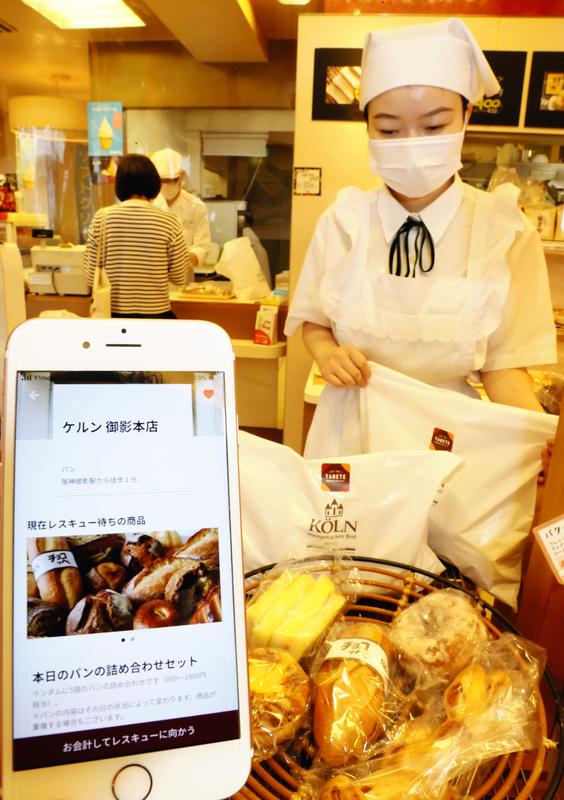
Several evenings a week, Koln, a bakery with nine branches in Kobe, sends a message via smartphone app Tabete to app users asking for help to "rescue" some bread. The "rescue" is a notice that items about to go unsold for the day can be bought at a discount.
An assortment of five pastries and assorted breads, usually worth 800 yen-1,000, yen is offered for 680 yen. App users who want to buy the bread can pay online and visit the store for pickup before closing time.
A 34-year-old woman purchased the rescue assortment at the main store in mid-July.
"I love the bakery, so I frequent it," she said. "It would be a shame to see food thrown away that is still delicious. I hope this kind of effort will spread."
At Koln, bakers begin kneading the dough at each store around 3 a.m., and the first loaves are baked around 7:30 a.m. While seeing how items sell, additional products are added. Only items baked during the day are sold, so anything unsold is discarded.
It would seemingly be sufficient to bake only the amount that sells out, but Koln President Go Tsuboi, 40, explains why this is not possible.
"If there are not enough items on the shelves when you enter the store, you may think that you will go to another store next time," he said. "In order not to miss out on a business opportunity, we have no choice but display products knowing that some might remain unsold."
Since introducing the rescue goods via the app in March, the percentage of products discarded per month has been reduced from 3.5% to 2%.
"We're happy when we don't have to throw away bread that we spent so much time and effort to make," he said.
--6 million tons
The Tabete app was launched in the Tokyo metropolitan area in April 2018 and expanded to the Kinki area this spring. According to the app's Tokyo-based operating company CoCooking, there are currently about 1,300 participating shops and restaurants across the country, with about 290,000 registered users.
CoCooking CEO Kazuma Kawagoe was inspired to develop this system through his own experience. When he was working in the restaurant industry, a large amount of leftover or remaining food was discarded on a daily basis.
"The restaurants had given up on it and we wanted to change that," he said.
According to the Agriculture, Forestry and Fisheries Ministry and other sources, food loss in Japan amounted to 6.12 million tons in fiscal 2017. That amounts to 132 grams of food per capita every day, which is the equivalent of one bowl of rice. About 50,000 meals have been "rescued" by the Tabete app, but that is only a fraction of the total loss.
"We hope that each and every consumer will use the app with the mindset of contributing to environmental issues," Kawagoe said.
--Public-private effort
Tabete is categorized as a food sharing app. There are other types of apps to fight food loss, including the appropriately dubbed No Food Loss app. This app focuses on convenience stores in the Kanto and Chugoku regions and alerts users to discounted items about to be discarded, with a portion of sales going to food aid for children in developing countries.
Kuradashi is an online shopping site that buys inventory nearing the expiration date from food manufacturers and offers the items at a discount. The company started this service in 2015 and has contributed to the reduction of food loss of more than 8,500 tons.
Reducing food loss is difficult to achieve through the efforts of stores alone.
The enforcement of the Food Loss Reduction Promotion Law in October last year has helped to spread the practice. The responsibilities of the central and local governments have been specified and there is a growing momentum among local governments to make use of the strengths of the private sector to reduce food loss.
As of the end of last year, Cocooking had concluded agreements with three municipalities to reduce food waste. This year it has newly concluded agreements with six municipalities, including the Osaka, Kobe and Fukuoka city governments.
"The city government has been working on a variety of initiatives," said an Osaka municipal person in charge of such initiatives. "We hope to be even more effective by collaborating with a private company with strong communication capabilities."
Read more from The Japan News at https://japannews.yomiuri.co.jp/





.jpg?w=600)