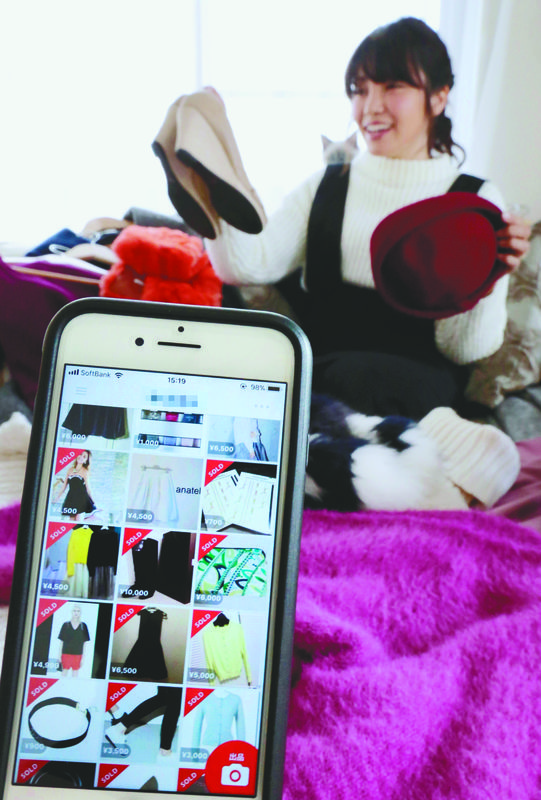
More and more people are buying and selling used items, such as clothing and home appliances, rapidly expanding the market for such items.
People are now able to easily buy and sell used items on their smartphones, accelerating the trend. In addition, many consumers, mainly young ones, have become less concerned about possessing brand-new items.
Buying goods to sell
Most of the belongings Ai Sakai uses every day, such as clothing and shoes, are used items she bought via Mercari, a major flea market app. When the 27-year-old company employee in Taito Ward, Tokyo, gets tired of what she has, she offers it for sale on the same app.
In about four years, she has bought and sold goods more than 3,000 times.
"If the quality is the same as one that's new, I like used stuff better because of how cheap it is," Sakai said.
When Sakai does buy new items, she first checks the prices of similar items on the app and then chooses new items she thinks she could sell at a good price in the future.
Manami Tsujiichi, 22, a fourth-year university student in Nerima Ward, Tokyo, who buys and sells used clothing and other goods, said, "If stuff I just bought doesn't work for me, I can sell it immediately."
She said such used-item markets have made it easier for her to buy new things.
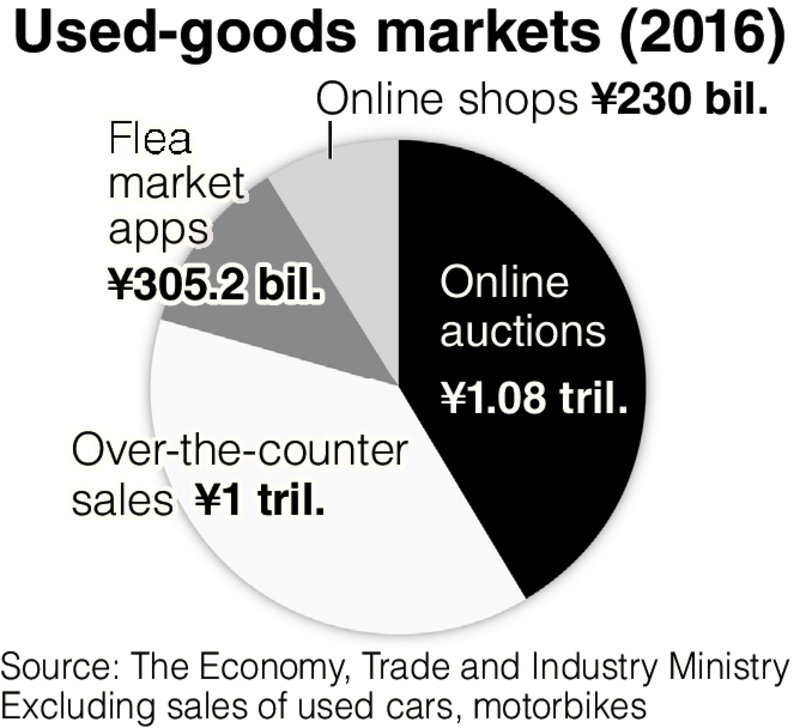
The used-item market, not counting cars and motorcycles, was worth about 2.62 trillion yen in 2016, according to estimates by the Economy, Trade and Industry Ministry. The market has vastly grown in recent years.
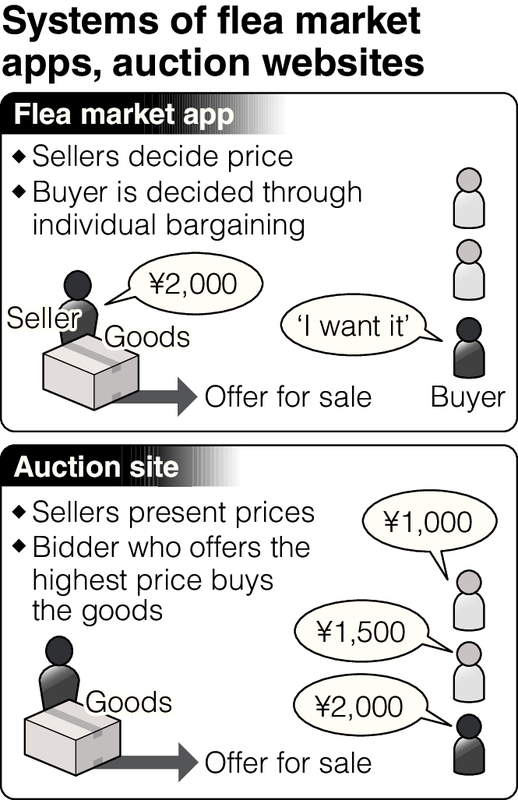
The trend was triggered by the advent of flea market apps for smartphones in 2012. With such apps, deals are made immediately when buyers accept prices offered by those who want to sell.
The easy-to-use feature of such apps makes them popular and has led to a dramatic rise in buyers and sellers using them.
Many people also use auction websites on the internet, where used goods are bought and sold. However, on the websites, two or more potential buyers may each present a purchase price, and the highest price offered becomes the official price. Therefore, a long time is needed to complete the deals.
Changing views
Consumers' changing views about commercial goods are also influencing the expansion of used-item markets.
"There is a tendency for consumers to buy only that which they need, without leaning toward buying something new," said Prof. Naozumi Nishimura of Japan University of Economics.
As wage levels have not sufficiently risen, consumers' budget-minded tendencies remain deep-rooted. Many consumers who want to avoid spending too much hunt for the lowest price available, assuming that used items are usable.
Therefore, more and more consumers prefer buying used when it comes to smartphones and other types of mobile phones.
MM Research Institute, a market research company, predicts about 2.45 million used phones will be sold in fiscal 2020, about 30 percent more than what was seen in fiscal 2016.
Revitalizing economy
Department store managers and those in the apparel industry are worried about the trend to buy used, as sales of new goods could be adversely affected.
Clothing sales in department stores in 2017 were less than 50 percent of sales seen in 1991, the peak year for department stores.
To cope with changes in consumer spending, Isetan Mitsukoshi Holdings Ltd. opened counters where people can sell used goods at five of its chain stores.
"If the need grows, we will need to consider selling secondhand clothing," said an official of a major apparel maker.
As buying and selling used items has become easier, some economists predict consumer spending will grow.
In using flea market apps, even items such as exam workbooks on which previous users wrote down notes and cosmetics in opened containers are bought.
This shows there's a market even for such items, as long as they are still usable.
"Because of the expansion of the market for used goods, even things that could not be priced before can be sold," said Shinji Yoshioka of the Economic and Social Research Institute of the Cabinet Office. "With the revenue that comes from selling used goods, spending will be reborn."
Stolen items cause headache
By Moe Tajima / Yomiuri Shimbun Staff Writer
A startling number of problems have arisen alongside the spread of buying and selling used items.
For Mercari, there have been cases in which information about a method to obtain computer viruses was sold, or in which stolen items were offered for sale.
There have also been a series of offers for people to buy currency notes, targeting people who can not borrow money from banks or other ordinary financial institutions.
The operating company of Mercari took measures to cope with such problems. In December last year, Mercari required those who want to offer items for sale for the first time to register their names, dates of birth and addresses to better confirm the sellers' identities.
Home delivery company uniforms are items that could be used for malicious purposes, such as allowing people to masquerade as the companies' employees to commit crimes.
Therefore, Mercari and operators of similar services prohibit users from offering the uniforms for sale. However, there were still cases of people buying and selling them.
"It is essential for businesses [operating used items services] to keep a better eye on what is being offered for sale on their sites," said Naoko Ogata, a senior research fellow of the Japan Research Institute.
The Secondhand Articles Dealer Law requires those who want to sell used or new items to obtain a license as a secondhand article dealer if they are going to sell items they purchased with the sole aim of making a profit instead of selling things they had finished owning.
Among users of flea market apps, it is assumed there are those who illegally earn profits without having obtained a license as a secondhand articles dealer.
If illegal buying and selling deals of this kind are found, the apps' operator companies suspend the users from the app. However, it is assumed there are cases in which high-priced deals that are dubious have still been made.
The operators of used-items market services need to ensure all users are buying and selling properly.
Read more from The Japan News at https://japannews.yomiuri.co.jp/