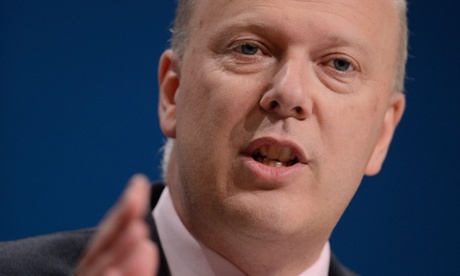
The appointment of a new chief inspector of prisons by the justice secretary, Chris Grayling, has been halted until after the general election after it emerged that two “independent” members of the four-strong selection panel are Tory party activists.
The Ministry of Justice has announced that Nick Hardwick, the current chief inspector whose term was not renewed by Grayling, has now been asked to stay on until November while a fresh hunt for a successor takes place.
Sir Alan Beith, the chairman of the Commons justice select committee, criticised Grayling’s failure to disclose that both independent members of the appointment panel were active Tory party members. They are Lord Henley, a former Conservative Home Office minister, and Amanda Sater, a member of the youth justice board who was named last year as women’s adviser to Grant Shapps, the Tory party chairman.
Beith said the justice secretary had given the MPs “no convincing reason” why he had not put forward for pre-appointment scrutiny the single “excellent” candidate that the panel had recommended.
The appointment panel was chaired by Dame Anne Pringle, the commissioner for public appointments, and the fourth member was a senior justice ministry official.
Even though half of the appointment panel were active Conservatives, Grayling appears to have rejected the single preferred candidate they recommended, despite the candidate being rated by them as “excellent”.
It is understood that Grayling believed the panel should have given him a choice of at least two or three names, despite a civil service ruling that there is no need for an appointment panel to put forward more than one name.
Instead, the justice secretary has now ordered the selection process to be re-run, putting the decision beyond the general election. Grayling has told the members of the justice select committee, who were poised to hold a confirmation hearing before the election, that “he will not be proposing a preferred candidate to them as there was not a wide enough pool of candidates from which to select”.
The justice select committee had been due to hold a pre-appointment hearing with the preferred candidate later this month, with Hardwick’s fixed term originally due to end in July 2015.
The decision means that the new independent chief inspector of prisons will be appointed by the justice secretary in the new government.
A report on the affair rushed out by the Commons justice committee concludes: “The fact that two members of the panel were members of the same party as the appointing minister is a cause for particular concern for a post in which it is vital the incumbent commands public confidence in his or her ability to resist political pressure.”
The shadow justice secretary, Sadiq Khan, said: “Not content with effectively sacking the chief inspector of prisons for daring to criticise his government’s prisons policy, Chris Grayling has stuffed the appointment panel for the new inspector full of known Tories.
“It just shows to what lengths this government will go to avoid having their failing policies properly scrutinised. This fails the smell test, and it calls into question how any chief inspector of prisons appointed by this process could ever claim to be independent.”
Hardwick has proved a rigorous critic of Grayling’s prison policies warning of a “political and policy failure” last year and voicing concern that staff shortages were causing “huge tensions” across the prison estate in England and Wales.
The job description for the new appointment said that a “strong understanding of current and recent” government reforms in relation to prisons and probation was an important part of the recruitment process.
Paul McDowell, the chief inspector of probation appointed by Grayling, stood down earlier this year after the Guardian disclosed that his wife was running the private justice company that had been awarded the largest number of probation contracts.