
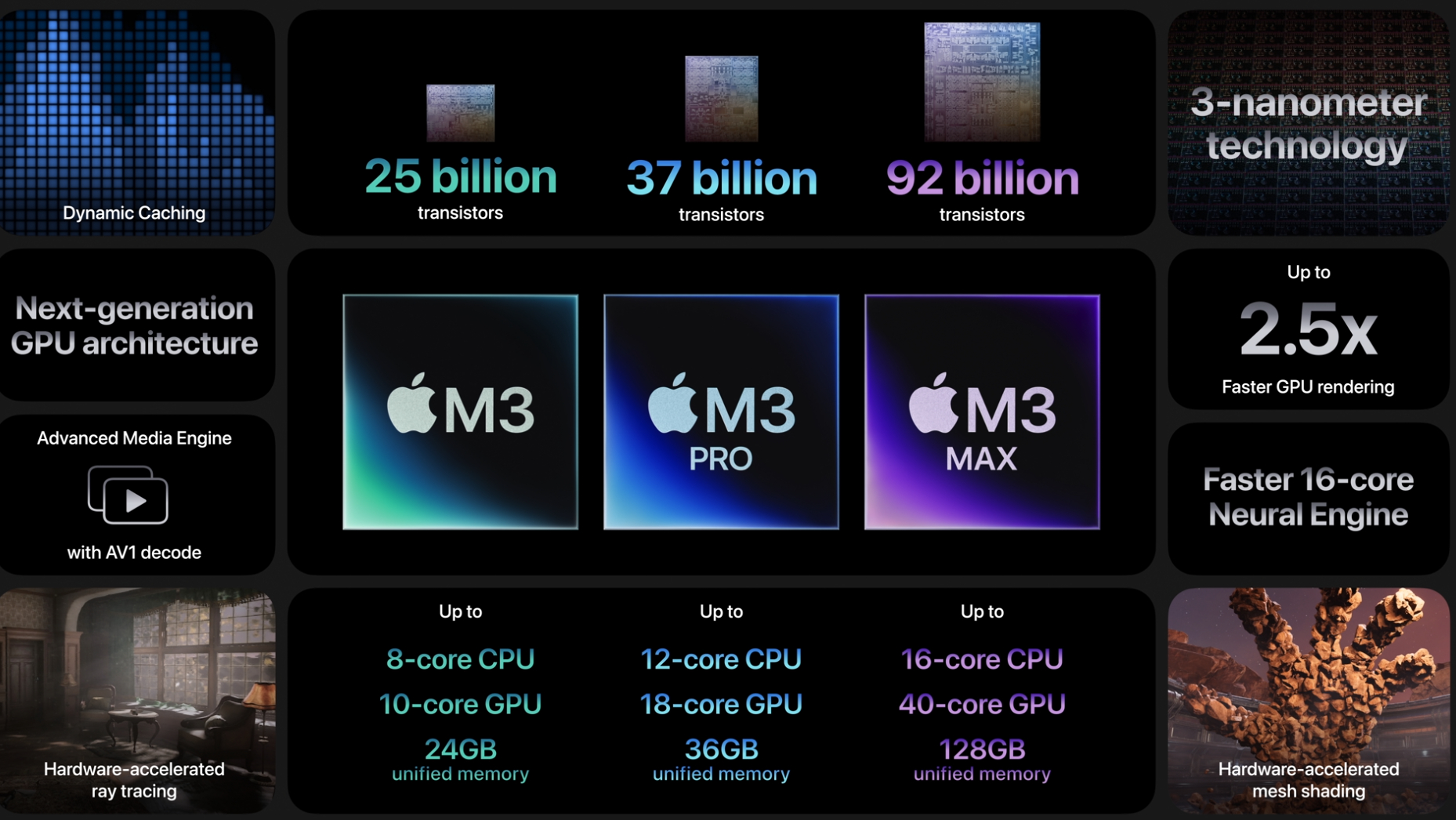
Apple's big 'Scary Fast' event brought with it just about everything we expected including new M3 chips and updated 14- and 16-inch MacBook Pros. But while that's all good news and the new chips sound great, one of them has some curious specifications that might not be immediately obvious.
The chip in question is the M3 Pro, silicon that now replaces the M2 Pro which itself replaced the M1 Pro that came before it. The new chip can be bought in the updated 14- and 16-inch MacBook Pros and is sure to be a great option for a lot of people. But its specs make for interesting reading if you're coming from one of those older siblings.
That's because while the new chip is based on TSMC's latest 3nm manufacturing process — like the iPhone 15 Pro's A17 Pro — it's actually a downgrade in a couple of key areas when compared to the M1 Pro and M2 Pro.
Fewer cores, less memory bandwidth
While Apple showed some impressive-looking graphs that claim its new chips will smoke Intel-powered Macs, the devil is, as they say, in the details. And those details show that the M3 Pro has fewer cores than the chip its replaces.
As an example, the M3 Pro comes with an 11-core CPU and 14-core GPU as standard. The outgoing M2 Pro model has 16 GPU cores, which you don't need to be a math whizz to know is two fewer.
The story continues when you move to the upgraded model, too. That comes with a 12-core CPU and an 18-core GPU, but the M2 Pro had a 19-core GPU as an option. That's one fewer, which is better than two fewer, to be sure. But it isn't quite as good as having the same number.
Fun Fact: Apple has downgraded the M3 Pro chip to only have a 14-core GPU compared to 16 cores on the base M2 Pro chip model.Also, the upgraded M3 Pro now only has a 18 GPU cores compared to 19 on the M2 Pro. Interesting choice by Apple.. pic.twitter.com/IUfGUGZazZOctober 31, 2023
The bad news continues when you consider that the M3 Pro has fewer performance cores than the M2 Pro, with Apple choosing to use more so-called efficiency cores instead. We'll need to see some benchmarks before we can judge how that affects real-world performance, though.
Another aspect that might need testing is memory bandwidth. Apple's M3 Pro sports a memory bandwidth of 150GB/s which is 25% less than the 200GB/s managed by the M1 Pro and M2 Pro. That might only impact people who are working with particularly meaty workflows of course, but considering these are Apple's best Macs and designed for professionals, it's possible people will notice the change depending on what they're doing.