WASHINGTON _ A three-judge federal appeals court on Thursday slapped the Trump administration with its biggest legal defeat so far, refusing to reinstate the president's controversial temporary travel ban affecting citizens of seven majority Muslim nations.
In a decision that immediately shifts attention to the Supreme Court, judges with the San Francisco-based 9th U.S. Circuit Court of Appeals upheld a temporary restraining order that a trial judge placed on the president's action. The appellate judges said they were unconvinced by Justice Department claims that the restraining order unduly infringed on the president's power.
"The Government has not shown a likelihood of success on the merits of its appeal, nor has it shown that failure to enter a stay would cause irreparable injury," the court stated.
Issued just two days after an hour-long oral argument conducted over telephone, the decision now sets up a fast-moving challenge for the eight Supreme Court justices. A government request for an emergency stay, needed to lift the trial judge's temporary restraining order and thereby reinstate the travel restrictions, would require the votes of five justices.
The Supreme Court is currently prone to deadlocks, with four Republican and four Democratic appointees. The ninth seat, to which President Donald Trump has nominated Judge Neil Gorsuch, is vacant because Senate Republicans last year refused to consider a Democratic nominee.
A Supreme Court decision could happen within days, and without benefit of the traditional hour-long oral argument used when cases get their traditional full-blown consideration.
The 9th Circuit's decision itself was not on the underlying merits of the case against Trump's Jan. 27 executive order, but rather on whether the Washington and Minnesota state challenges met the standard for stalling it with a temporary restraining order.
The appellate decision followed an extraordinary outpouring from legal, political and corporate interests.
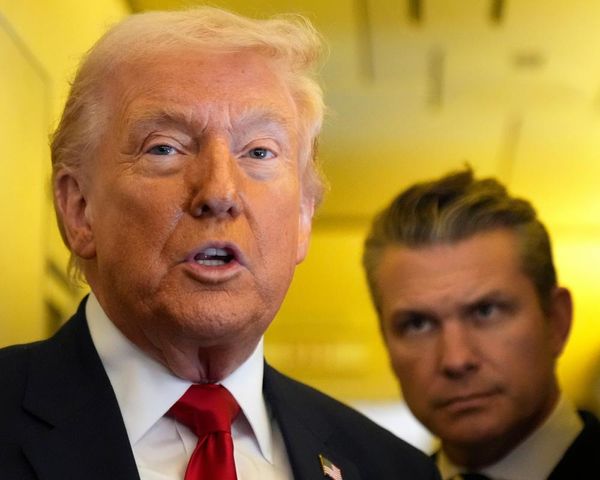
Trump, who had earlier denounced as a "so-called judge" the Republican appointee who imposed the initial restraining order, preemptively escalated his ire to the appellate judges with a declaration Wednesday that "the courts seem to be so political" and a tweet stating that "If the U.S. does not win this case as it so obviously should, we can never have the security and safety to which we are entitled."
"Politics!" Trump added in his Tweet, sent at 7:03 a.m. Wednesday.
Adopting a more conventional approach toward a federal court, 10 former top national security and foreign policy experts, including several who'd worked for the CIA or the National Security Agency, filed an amicus brief in which they said they were "unaware of any specific threat that would justify the travel ban established by the executive order."
More than 90 companies, ranging from Airbnb and Apple to Twitter and Uber, added in a brief that the order "inflicts significant harm on American business, innovation and growth" and "threatens companies' ability to attract talent, business and investment to the United States."
The Trump executive order banned entry into the United States for 90 days for citizens of Iran, Iraq, Libya, Somalia, Sudan, Syria and Yemen. It also suspended the admission of Syrian refugees indefinitely and all other refugees for 120 days.
The Seattle-based U.S. District Judge James Robart got the ball rolling with a Feb. 3 decision blocking the executive order from taking effect on a nationwide basis. Robart's decision, in response to a legal challenge filed by the states of Washington and Minnesota, was the most sweeping of a half-dozen rulings by other federal judges.
The Justice Department argued in its appellate brief that Robart's temporary restraining order "contravenes the constitutional separation of powers; harms the public by thwarting enforcement of an Executive Order issued by the nation's elected representative responsible for immigration matters and foreign affairs; and second-guesses the President's national security judgment."
Washington state, joined by Minnesota, countered that restoring Trump's executive order would "unleash chaos again," and that government officials "offer no evidence" of irreparable harm if the executive order stays blocked.
The appellate judges seemed to tip their hands during the Tuesday afternoon oral argument, as several seemed to press the Justice Department attorney with particular vigor.
Judge William C. Canby, Jr., 85, was appointed by President Jimmy Carter. Judge Michelle T. Friedland, 44, was appointed by President Barack Obama. Judge Richard R. Clifton, 66, was appointed by President George W. Bush.
Beyond its role in deciding the fate of the executive order, the 9th Circuit's decision is already having ripple effects. Gorsuch's confirmation challenge will now focus more attention on his views of executive branch authority, while Trump's heated responses to date have shed more light on his presidential temperament.
Conservatives, meanwhile, have used the occasion to reopen a long-running effort to break up the sprawling 9th Circuit, which spans nine Western states.