William A Anders: 'We had three 70mm Hasselblad reflex cameras with assorted lenses ... To my continued amazement we had no light meter, since f-stops and exposure times had been pre-caculated ... for the very detailed photographic target plan I was charged to execute. There was nothing in the plan for an Earthrise photo. Indeed, we did not actually see an Earthrise until, on our third orbit, we changed the spacecraft's orientation to heads up and looking forward. As we came around the back side of the moon, where I had been taking pictures of craters near our orbital track, I looked up and saw the startlingly beautiful sight of our home planet 'rising' up above the stark and battered lunar horizon. It was the only colour against the deep blackness of space. In short, it was beautiful, and clearly delicate. Frank Borman called for a camera … Jim Lovell also grabbed a short-lens camera and we all blazed away at this astounding vision.' Photograph: Nasa
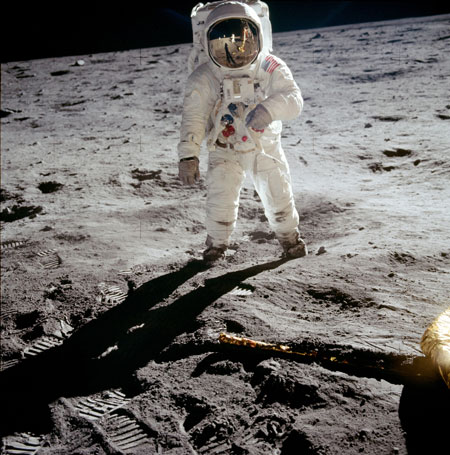
Buzz Aldrin: 'Nothing prepared me for the starkness of the moon. The barren terrain was a dusty grey with many little craters in every direction. The sky was utter blackness, void of any stars. When I stepped down onto the surface and felt each movement carried by the slow-motion sensation of one-sixth lunar gravity, I spontaneously exclaimed, 'Magnificent desolation.' As I walked away from the Eagle lunar module, Neil said: 'Hold it, Buzz.' So I stopped and turned around, and then took what has become known as the 'Visor' photo.' Photograph: Nasa
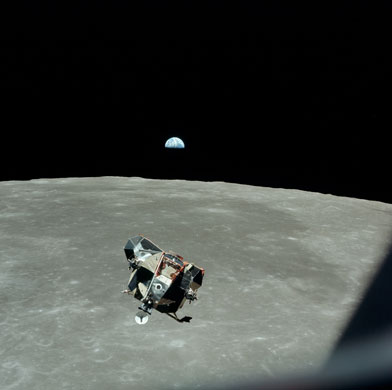
Michael Collins: 'Of the various uncertainties during the flight of Apollo 11, returning Neil and Buzz in one piece to the command module was paramount in my mind ... Just prior to my taking this photograph, they had departed Tranquility Base using the lower half of their landing craft, Eagle, as a launch platform. The upper half (second stage) appeared first as a tiny gold insect crawling across the lunar landscape, and then began to take form as a man-made object, although its angular shape still seemed strange and awkward to me. Little by little, they grew closer, steady, as if on rails, and I thought, 'What a beautiful sight,' one that has to be recorded. As I reached for my Hasselblad, suddenly the Earth popped up over the horizon, directly behind Eagle. I could not have staged it any better, but the alignment was not of my doing, just a happy coincidence.' Photograph: Nasa

The lunar module is to the left and footprints of the astronauts are clearly visible in the lunar soil Photograph: NASA
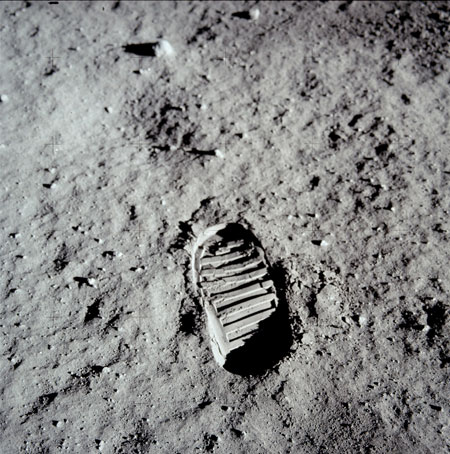
Buzz Aldrin made this imprint on the pristine surface of the moon so he could then photograph it for study by soil mechanics experts Photograph: Nasa
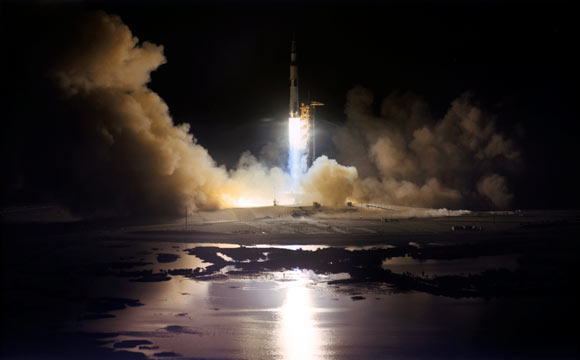
On 7 December, 1972, Apollo 17 lifts off from the Kennedy Space Centre in Florida, three and a half years after Apollo 11 made Neil Armstrong the first man to walk on the moon. Seventeen was the last of the Apollo missions to land astronauts on the the moon's surface and the last manned flight to the moon.
• This caption was amended on Sunday 7 June 2009. Apollo 17 was not the last of the Apollo missions, it was the last Apollo mission to land astronauts on the moon. This has been corrected. Photograph: PR

Gene Cernan: 'This photo, I believe, captures it all - mankind, the moon, the Earth, the blackness and endlessness of time and space, and, perhaps of greatest importance, the flag of our nation. The legacy of Apollo is not the technology you now hold in your hand, but rather the dedication and commitment of those millions of Americans who, in troubled times, made it all possible.' Photograph: Nasa