Support truly
independent journalism
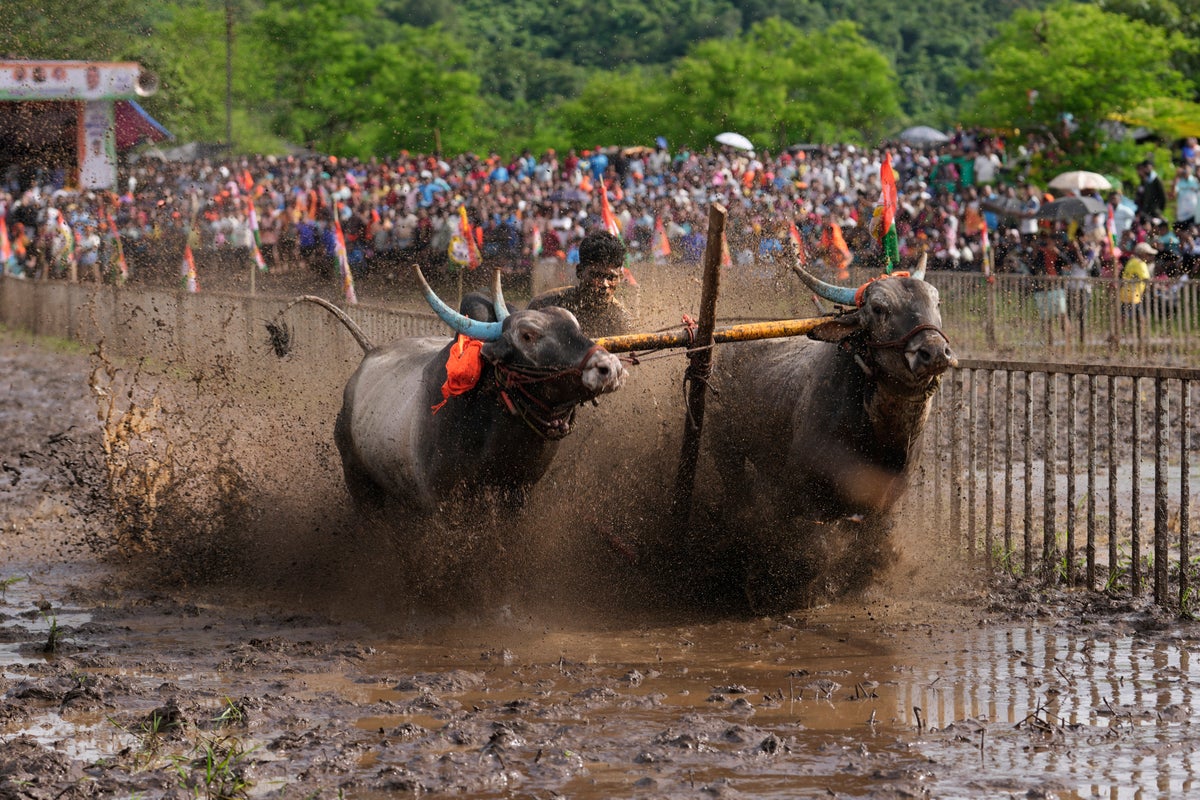
Hundreds of spectators shout and gesture as lively music blares from loudspeakers. A commentator’s breathless voice resonates over the din trying to keep up with a racing team of two oxen yoked together and a man who looks like he is being dragged through mud behind the speeding animals.
The horseshoe-shaped track has only a flimsy fence separating the action from the crowd. The setting is Dervan, a small farming village in Ratnagiri, a district famous for growing the Alphonso mango, in the western Indian state of Maharashtra.
Covered from head to toe in gray mud, the driver looks like an apparition. His skills are tested as he maneuvers the animals around a U-bend. He must hold onto the reins while controlling the oxen’s speed by pulling and twisting their tails. And he needs to achieve this while being simultaneously half-blinded by the mud hitting his face. If he drops the reins, his team will be disqualified.
One at a time, the teams race around the track vying for 10 winning slots. The winning team this year — out of more than 100 — completed the 200-meter (yard) -long track in 21.44 seconds. Seasoned drivers often compete more than once a day with different oxen.
A village committee holds the annual event, known as Nagarni Spardha, a centuries-old tradition, at the peak of the rainy season. The soft muddy ground prevents serious injury to the drivers, who compete in bare feet and without protective gear.
Many arrive in vehicles after bumpy rides over unpaved roads from nearby villages. Some oxen need to be stimulated before the competition by men who pull them with ropes and prod them with sticks. Other oxen are overexcited and must be controlled and soothed.
The oxen, which have names like Bullet, Sundar (meaning “beautiful”) and Raja (meaning “king”), are no longer used for ploughing the fields but are kept strictly for the competition. Their horns are brightly painted and their bodies sprinkled with colored powder before the race.