We will remember them
That wraps up Guardian Australia’s life coverage of the centenary of the Gallipoli landing. More than 10,000 Australian and New Zealanders attended dawn service in Gallipoli, and hundreds of thousands more attended ceremonies around the two countries.
I’ll leave you with this piece from Jon Henley in Gallipoli about the descendants of the Anzacs and the men who “sacrificed their lives at the behest of Britain.”
To the AFL, where Collingwood has just won the annual Anzac Day clash against Essendon in front of a crowd of more than 88,000 at the MCG.
Final score was the Magpies 9-15-69 to Essendon’s 6-13-49. Collingwood’s Paul Seedsman won the Anzac Day medal for the player that “best exemplifies the Anzac spirit”.
Oh so loud + very, very proud. Winners on #ANZACDay #gopies pic.twitter.com/JYf8xYDfki
— Collingwood FC (@CollingwoodFC) April 25, 2015
Updated
Dawn services in the UK are also wrapping up. This report is from the service at the Wellington Arch in London:
Sir Lockwood Smith, New Zealand’s high commissioner, told the congregation of thousands, including Princess Anne, who had begun gathering well before sunrise: “We will always remember, be always inspired” by the Anzacs.
Sir Lockwood added: “No family was left untouched. My own grandmother’s first fiancee, the first real love of her life, lies buried at Lone Pine - a Kiwi alongside his Australian mates.”
The service was staged midway between the Australian and New Zealand war memorials on the large traffic island at Hyde Park Corner.
The event is one of a series in Britain to mark the 100th anniversary, including the Duke of Edinburgh, patron of the Gallipoli Association, joining the congregation at St Paul’s Cathedral for a service of remembrance and the Queen, joined by Philip and Prince William, leading a wreath-laying ceremony at the Cenotaph, followed by a service of commemoration at Westminster Abbey - Press Association
If you’re not familiar with the traditional Australian pastime of two-up, here are a few tips.
First, grab your kip (that’s a flat bit of wood to the newbies out there, a ruler will work if you’re playing primary school rules) and place two coins on it, pennies for preference. Then flick the kip to send the coins spinning in the air - they have to go at least two metres over your head - and bet on which side they will come down, heads or tails. You’ve got to have two heads or two tails, a mixed result doesn’t count.
What I’m going to take as the authentic rules of the game, published on the Australian War Memorial website in the words of a WWII soldier, are a little more complicated and include an option of betting 3:1 that the spinner will not land heads twice in a row. It also requires bayonets to mark out the circle, although I suppose garden stakes would do in a pinch.
It is, perhaps understandably, a game that is most often played at the pub.
Updated
We’ve well into the two-up zone, which is a traditional stage of Anzac Day that occurs after the solemnity of the morning’s dawn services and marches has been stowed but before the football begins in earnest. It usually requires a beer, as evidenced below.


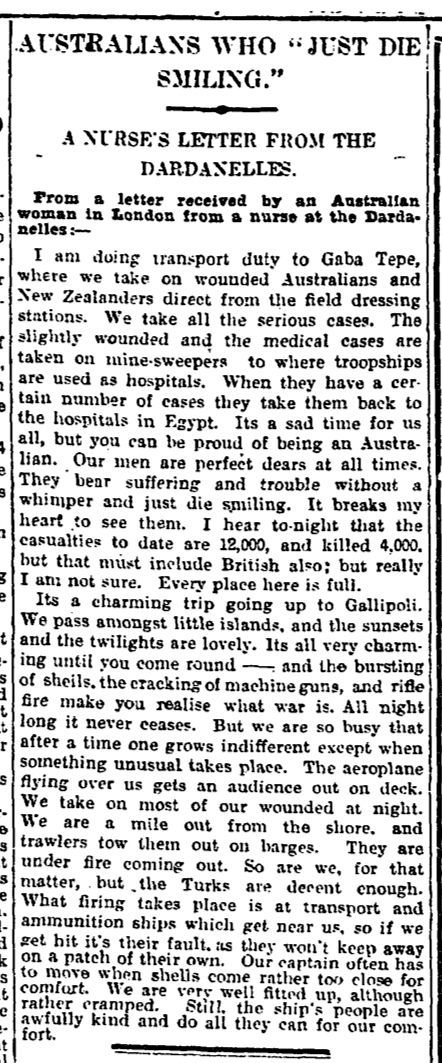
Looking back a bit now, The Guardian published an extraordinary letter on July 27,1915, from an Australian nurse working in the Dardanelles, who said the war, though horrific, was a proud time to be an Australian.
She writes:
Our men are perfect dears at all times. they bear suffering and trouble without a simper and just die smiling. It breaks my heart to see them.
This, I suppose, is what is meant by the “spirit” of the Anzacs.
You can read the full letter here and have a dig through The Guardian’s WWI archives here.
Speaking of massive dawn services, WA Police has issued a statement saying it’s investigating three small fires that it believes were deliberately lit in Kings Park between 4am and 6.30am this morning, when about 80,000 people were spread out around the war memorial.
Police spokeswoman Susan Usher said the fires, a little away from the crowd, were small but firefighters were still called to extinguish them. The arson squad is investigating.
Remember when the dawn service was just handful of veterans and an army cadet unit? My colleague, Brigid Delaney, has written about the way Anzac Day has shifted over the past 100 years to become the centrepiece of Australia’s national (and nationalist) identity.
She writes:
My father, now in his 60s and a fourth generation Irish-Australian, told me that he was never taught about the Anzacs at school. But when he was working in a school last week in an outer suburb of Melbourne, a Somalian kid – not long arrived in Australia, stood up in front of his class and told him the Anzac story.
You can read Brigid’s full piece here.
Just a reminder, if you’re at an Anzac Day service you can share your photos and stories with Guardian Witness (please do!)
This came through from Tyrone Cook, who attended the dawn service in Hamilton, New Zealand:
In case you missed it, Tony Abbott has helpfully posted a video of his address to the Gallipoli dawn service.
My address at the Gallipoli Dawn Service: https://t.co/CTTfwKqknB
— Tony Abbott (@TonyAbbottMHR) April 25, 2015
Madame Pascale Boistard, the state secretary for women’s rights, spoke on behalf of the French government, saying, “France will never forget those who came to fight on its soil.”
When the French think about the Anzacs, they think of their courage and they are eternally grateful. At Villers Brettoneaux, the Anzacs halted the enemy advance. Here your ancestors showed your courage, particularly in the second battle of Villers Brettoneaux in 1918, that we will commemorate in three years time as you commemorate your centenary of the battle of Gallipoli today.
Today France wishes to pay homage to these men. They were heroes, admirable because they were volunteers from a country where conscription did not exist.
Defence minister Kevin Andrews represented the Australian government at Villers Brettoneaux. He was visibly emotional, saying:
Whether buried here on the Western Front or back here in the lands of their birth, those Australians and New Zealanders gave us much to be proud of. The cost was much higher than anybody could have imagined when the war began.
Andrews said the Gallipoli centenary did not just commemorate a battle, it commemorated a way of life that had been practiced in Australian and New Zealand in the 100 years since.
Anzac is our shared memory, our shared legacy. Lest we forget.
Chief of the Australian Navy, vice admiral Tim Barrett, said that Villers Brettoneaux was where Australia really joined the war.
For it was here, on the Western Front, that the Australians would, for the first time in their history, confront the main enemy, on the main front, in the main theatre of war.
Barrett also paid tribute to the French, New Zealand, Canadian and French lives lost on those fields.
Now to Villers Brettoneux, where the dawn service is just getting underway at the Australian National Memorial. It’s bucketing down.
The Australian ambassador to France, Stephen Brady, told the story of Lance Corporal John Palmer, who arrived at the Western Front in June 1916, after surviving Gallipoli.
Brady said Palmer, who had been a farmer before enlisting, wrote letters home praising the fertile agricultural land in France, and its abundant fruit trees. He thought he’d be home within a year.
Brady continued:
Like many Australians who visited France then and now, he was in awe of its beauty. But by August 1916, John’s war on the western front had began in earnest.
‘This place,’ he wrote, ‘is all a quiver. Gallipoli was bad, but this is 10 times worse. If I get through this I shall take a ticket in the tats.’
More than 10,500 people made the trip to Gallipoli for the centenary dawn service. Guardian Australia photographer-at-large Mike Bowers is there too, and has filed these photos of the crowd at the commemorative site last night.


Updated
The last post has been played in Gallipoli. Now onto the national anthems of Turkey, Australia and New Zealand.
Prince Charles spoke after Abbott, reading from letters penned by soldiers who fought in the campaign.
When the ANZACs finally left this place, they are tormented by the thought of leaving their comrades behind, that their suffering and loss would be forgotten, that their graves would be unremembered.
More from Abbott:
We aren’t here to mourn a defeat or to honour success, although there was much to mourn and much to honour in this campaign.
Beginning here on this spot and on this hour, 100 years ago, they fought, and all to often, they died, for their mates, for their country, for their king, and ultimately, for the ideal that people should be free.
In volunteering to serve they became more than soldiers, they became the founding heroes of the nation we know today.
Abbott said the Anzac legacy was one of living a good, moral life.
They gave us an example, now let us follow it. They were as good as they could be in their time. Now let us be as good as we can be in ours.
Calla Wahlquist here, taking over from Helen Davidson. Let’s go to Gallipoli, where Tony Abbott is addressing the dawn service.
Abbott says the failed Gallipoli campaign shaped Turkey as much as it shaped Australia and New Zealand:
It’s 100 years since Australians and New Zealanders splashed out of the sea right here. So now we gather in the cold and dark before dawn, wondering what to say and how to honour those whose bones lay in the ground below us and whose spirit has shaped us for a century.
Updated
Gallipoli dawn service begins
The ceremony at Anzac Cove has begun. Aboriginal didjeridoo and a Maori welcome song opened the service.
As the focus for today moves to the Turkish coast, I will leave you in the capable hands of my colleague Calla Wahlquist, who will steer the rolling coverage through the afternoon.
People have gathered at the Hellfire Pass on the Thai-Burma railway route for a service commemorating Australian and New Zealander soldiers who died there in world war two.


If you’ve been with us from the start today, you’ll have seen my colleague Daniel Hurst reporting from the Canberra dawn service which had a record-breaking 120,000 people turn up.
He’s filed a report which you can read in full here.
Organisers praised the “extraordinary” turnout, which was well above the 50,000 predicted to attend and the 37,000 who paid their respects last year.
The number of people at the 5.30am service was equal to a third of Canberra’s population, although the figure included those who travelled from other states to join commemorations in Australia’s capital.
Many attendees felt a stronger duty to attend Saturday’s event because it marked the 100th centenary of the Anzac troops landing in Gallipoli, Turkey, in 1915.
...
The soon-to-retire chief of the army, Lieutenant General David Morrison, reflected on the plight of those “who had crossed a foreign shore 100 years ago this morning” and had “improbably survived” the bloody battles, returning home scarred by war.
“If war is a sin against humanity, as some would hold, then war itself is punishment for that sin, compounded by its endless repetition and its hold on those who have experienced its terrors,” he said.
Updated
Police have stopped a group of indigenous people from joining an Anzac Day parade in Canberra.
Waving flags, beating sticks and chanting “shame”, the group of about 50 had wanted to march unofficially to recognise indigenous people killed when Europeans settled Australia.
More than 2000 people marched in the official national service parade in front of dignitaries including Governor-General Peter Cosgrove and acting prime minister Warren Truss. - AAP
March commemorating the dead of the #FrontierWars halted by police almost immediately at foot of Anzac Pde, Canberra pic.twitter.com/xp0ReSvPho
— Teigan Evans (@t3igan) April 25, 2015
Melbourne has been drizzly but it doesn’t appear to have stopped people coming out for the dawn services and parade, and the Anzac Day AFL clash. The soggy scene below care of Guardian Australia’s deputy political editor, Katharine Murphy.
Bringing up the rear at Melbourne's sodden Anzac Day March @heldavidson pic.twitter.com/qI4qba0Pee
— Katharine Murphy (@murpharoo) April 25, 2015
Melbourne already transitioning to the Essendon v Collingwood blockbuster. Families out in their colours on packed wet streets @heldavidson
— Katharine Murphy (@murpharoo) April 25, 2015
For the first time Anzac parade officers have been armed, and it’s likely to become the norm, Victoria’s acting police chief commissioner Tim Cartwright has said.
Following the recent terror raids which saw five people arrested in Melbourne over an alleged plot to commit a terrorist act on Anzac Day, security has been increased across the country.
Three times as many police are on duty in Victoria as in previous years but Cartwright said it’s still not an “oppressive” number of officers.
Anzac Day march WWII veterans @theTiser #adelaide #ANZAC2015 #heroes pic.twitter.com/KrUo0n7oMP
— Tricia Watkinson (@TriciaWatkinson) April 25, 2015
Over 1,000 people attended the dawn Aboriginal and Torres Strait Islander memorial here in Canberra #LestWeForget pic.twitter.com/JGFUhb1YZZ
— Aboriginal Health (@NACCHOAustralia) April 25, 2015
The BBC has published drone footage over the hills of Gallipoli.
Some photos from Guardian Australia’s Gabrielle Chan in the NSW town of Harden.
#Lighthorse formation pulls up the rear. #Anzac100 #AnzacDay pic.twitter.com/bB8rnbcPga
— Gabrielle Chan (@gabriellechan) April 25, 2015
Sydney’s dawn service at Martin Place was interrupted at least five times by music from a nearby nightclub, including during the minute’s silence, the Sydney Morning Herald reports.
The Ivy nightclub had closed earlier than its usual 3.30am to ensure it didn’t disturb the service, but according to a spokeswoman for the Merivale Group, a contractor performed “unauthorised sound testing for an event later today.”
“That contractor was immediately terminated this morning,” she said.
Guardian editor of Comment Is Free, Adam Brereton, has written a thoughtful piece on the debate around how Australia treats and commemorates Anzac Day. It’s a conversation I note has already taken off in the comments below this live blog, and Brereton’s look at the history is well worth a read.
Here’s a snippet from somewhere around the middle:
Separating out the solemn from the raucous, the slaughter at Gallipoli from the cult that has grown around it, and deciding who gets to administer the rites of the Anzac faith, has become a national pastime. In recent years the Returned and Services League (RSL) has cast itself as the defender of Anzac solemnity, but it wasn’t always so. In the years following the first Anzac Day in 1916, returned and serving soldiers wanted to tie the day to recruitment. They also wanted to celebrate; in 1945, the Canberra Times reported calls from the president of the RSL to liven the holiday up a bit (at least in the afternoon) by opening the pubs. It should be marked by “toasts and song”, he said, in memory of the “storming of Gallipoli ... a matter of great national pride”.
Some photos of the dawn service at Currumbin have come through and are well worth sharing.


The Guardian’s Jon Henley is in Gallipoli.
He’s looked into some of the personal stories of Anzac soldiers during the 1915 campaign, and their descendants who have come to Gallipoli 100 years later.
Here’s a portion of it, but you can read the full piece here.
As dawn rose over Gallipoli 100 years ago, Cyril Batchelor of the 12th Battalion AIF was on the number two boat in to North Beach, later to be known as Anzac Cove.
Live Anzac Day 2015: centenary of Gallipoli landings - rolling coverageA century since the ill-fated campaign, thousands gather at dawn services and commemoration events to pay their respects, including prime minister Tony Abbott in GallipoliRead more
The young Tasmanian made it ashore, but was hit in the left leg by Turkish machine gun fire and collapsed; a junior officer who ran over to him caught a neat row of bullets across the stomach and was among the first of about 620 Australian troops to die that day.
Batchelor did what he could for the young officer, then dug himself in to the sand. Such was the savageness of the fighting that it was three days before a medic could get near him.
“They took him to Lemnos to operate and, back in Hobart, he went on to father 10 children – the youngest of which was me,” said Ben Batchelor. “But when they took those bullets out, you know, he kept them. Kept them all his life. Couldn’t forget.”
#Anzac100 #Dawnservice #Gallipoli racked, stacked and packed with very little room left @GuardianAus pic.twitter.com/mYsWNF00Yk
— Mike Bowers (@mpbowers) April 25, 2015
Updated
A very impressive interactive over at News Corp has been retelling the story of the Anzacs in real time for the past few weeks, through key characters on social media.
If you haven’t seen it already it is well worth a look, and obviously coming to the biggest moments. They are ‘live blogging’ the Gallipoli landing today.
Bert needed his mother's permission to enlist. Now he's about to land at Gallipoli http://t.co/pm8QoLXKX4 #AnzacLive pic.twitter.com/kLoruy2KfQ
— Anzac Live (@AnzacLive) April 24, 2015
With dawn services over, Australians are now lining the streets to watch the Anzac Day parades.
Some 20,000 veterans of current and past wars are expected to march down Sydney’s George St before crowds of onlookers.
ANZAC Day Parade - Sydney: http://t.co/ch167hadtq via @YouTube
— Mat McPhee (@matfinish) April 24, 2015
In Melbourne more than 13,000 are marching to the shrine of remembrance.
It's cold and raining in Melbourne. But nothing gets in between Melburnians and a parade #anzacday #AnzacABC pic.twitter.com/ZU7ufMXQ1j
— Mark Doman (@MarkDoman) April 24, 2015
In Darwin, a range of historic and current military aircraft fly above the crowds, and vehicles wind through the closed streets of the city.
Perth:
My colleague Calla Wahlquist has attended the Perth dawn service. SHe reports:
People are streaming out of Kings Park in Perth, Western Australia, after a record-breaking dawn service. The RSL estimates that between 70,000 and 80,000 people attended to mark the centenary of the Gallipoli landings. The crowd began arriving before 4am and were camped as far as half a kilometre back from the state war memorial.
Brigadier David Thompson addressed the service and paid respect to the 1000 Aboriginal Australians who fought in WWI, saying, “some of these people (who went off to fight) were not even recognised as Australian citizens.”
“Our indigenous soldiers, who served with distinction, side by side with white soldiers, bled and died, just like their white counterparts,” he said.”
They were not allowed to vote, and could only attend their local RSL one day of the year: Anzac Day.”
Thompson also spoke of 31-year-old Private David John Simcock, a successful Perth fruit retailer who was known as “Pink Top” for his distinctive shock of red hair, AAP reports.
As part of the 11th infantry battalion of the Australian Imperial Forces, Pink Top landed with the first wave of troops at Anzac Cove on April 25.
He died the next day, killed by shrapnel while trying to save a comrade.
“A raconteur of some regard, he could charm people with his outgoing personality, his wit and was always ready for a joke,” Brigadier Thompson said.
“Married and with two children aged eight and four, and a successful businessman, he could quite easily have left the fighting to younger men.”
#AnzacDay #Anzac100 Dawn Service Kings Park #Perth #LestWeForget pic.twitter.com/Rt2fTZiMoG pic.twitter.com/fcMwcxsiSe
— Perth Today (@Perth_Today) April 24, 2015
Now they're playing Forever Young and I *might* cry. pic.twitter.com/10RDvoLsIR
— Calla Wahlquist (@callapilla) April 24, 2015
Albany:
The West Australian town is the birthplace of the dawn service, and King George Sound was one of the last Australian places many soldiers would see before they left for world war one.
“It would be difficult to imagine an Anzac Day without a dawn service,” Colonel Mike Page said in his address to a capacity crowd of 4500 at Mt Clarence.
Colonel Page said it was a day for Australians and New Zealanders to get together to pay their respects to current and former servicemen and women.
There was something evocative about dawn breaking but it was also ominous for soldiers on a battlefield, he said.
“Any dawn was celebrated as another day survived,” he said. - AAP
Updated
There are more than 45 commemorative events happening in the UK for Anzac Day, but one site, a first world war cemetery near London, has been vandalised.
An Australian flagpole has been cut at Harefield churchyard while a memorial and an information panel have been peppered with blue spray paint, AAP reports. Once repairs are carried out the service will proceed.
About 112 Australians are buried at the small Commonwealth war graves commission cemetery in Middlesex, 30km northwest of London.
“While we are not sure of the motivation of this vandalism the report is very disappointing,” UK high commissioner Alexander Downer said.
About 6000 people are also expected to attend services at Villers-Bretonneux and Bullecourt in France in a few hours.
Today also marks the 97th anniversary of the second battle of Villers-Brettoneux in which Australian and British troops recaptured the town.
The walls of the Australian national memorial at Villers-Bretonneux carry the names of 10,765 Australians who died during world war one in France and have no known grave, according to the department of veterans affairs.
There are about 1,000 Commonwealth war cemeteries on the Western Front in France and Belgium. About 295,000 Australians served on the Western Front.
Guardian Australia’s photographer-at-large, Mike Bowers, is in Gallipoli.
He’s written about his grandfather, one of the tens of thousands wounded at Anzac Cove.
15th Battalion, 4th Brigade 859 Horace James Bowers, a boy from the Wallamba river near Nabiac in New South Wales, was just 22 years old when he landed on Gallipoli on the afternoon of 25 April 1915. He was my grandfather.
He was evacuated just days later with what his records call “GSW left arm severe”.
That gun shot wound would trouble him his whole life, as would the further wounds received in the August offensives on Gallipoli and later battles on the western front. I often wonder how close he came to joining his many colleagues left on the peninsula and gravesites around northern France.
You can read Bowers’ piece in full here, and explore his stunning photographic interactive of the historic sites in 1915 compared to today.

Darwin:
An estimated 7000 people have filled Darwin’s Bicentennial Park for the Anzac centenary dawn service, where the missing names of 15 men killed in action during the First World War have finally been added to the cenotaph.
The RSL had been aware for years that there were names missing and last year finally undertook research to rightfully recognise those men, said Don Milford of the Darwin RSL sub-branch.
He says Darwin is also the only city not to have an eternal flame or moat of remembrance at its cenotaph, something the RSL is seeking to have changed. - AAP
Around 7000 people at Darwin's dawn service this morning for #Anzac100 pic.twitter.com/lulALvgOy0
— Neda Vanovac (@nedavanovac) April 24, 2015
Newcastle:
Police estimate about 40,000 people have attended a dawn service at Nobbys Beach, eclipsing the 30,000 expected, Newcastle RSL sub-branch president Ken Fayle has told the Newcastle Herald.
A CROWD of 40,000 people has lined Nobbys at dawn on #ANZACDay2015: http://t.co/8Q1FAN1CBV #LestWeForget pic.twitter.com/kq3dUV2w6t
— Newcastle Herald (@newcastleherald) April 24, 2015
Hobart:
Organisers say Hobart’s centenary dawn service crowd was much larger than usual with many children and families turning out.
The Freebody family don’t usually attend a dawn service but mother Natalie thought 2015 was a good time to start.
“We’ve never done it before but thought that on the centenary year it wasn’t a bad tradition to start,” said Marcus Freebody, whose grandfather fought in WWII.
More than 15,000 Tasmanians enlisted for WWI and close to 3000 were killed. - AAP
1000's make their way to Hobart's Salamanca for ANZAC gunfire breakfast. Dawn service turnout surprises organisers pic.twitter.com/6YE8H3nBfG
— Deputy Ron Christie (@RonChristie) April 24, 2015
Updated
The lights have turned on at Gallipoli, rousing the thousands of people who have camped out overnight.
Security is extremely tight, and ABC has reported 4000 Turkish police and soldiers are on site.
The sleeping bags and beanies are out on #Gallipoli as Australia and New Zealand are up for dawn services #AnzacABC pic.twitter.com/jSTT8XpkN4
— Ollie Wards (@OllieWards) April 24, 2015
More pictures are coming through of dawn services and those record attendances in Australia and New Zealand. Many people have attended to honour relatives.
I’ll share more photos with you from other places as they come through.
Brisbane:
83-year-old Ronald Wylie says his thoughts on Anzac Day are often with his dad, Herbert Jackson-Wyllie, who served as a stretcher bearer on the Western Front during World War I from 1917-19.
“I had tears in my eyes when they were singing those hymns,” Wyllie told AAP as he proudly held the Australian Army badge from his father’s hat.
“It was very emotional. It’s hard to imagine the things my father saw around him as he was picking blokes up off the ground, not knowing whether they were dead or alive.”

Melbourne:
Tens of thousands of people braved a chilly start and light showers for the service.
Margaret Lugg left home at 2.30am to get a front row position to honour a relative who never made it home from Gallipoli, and her father who was a Rat of Tobruk.
“It’s the young people who have made today what it is, it was never this popular when I was younger,” she said.

Wellington:
Whitby woman Danielle Walker and her seven-year-old son Max were among many to attend Saturday’s dawn service - some clutching photos of relatives killed in battle or wearing medals handed down to them.
Ms Walker, whose brother and grandfather are in the Defence Force, said the large turnout was an eye-opener.
“I think it’s one of those things where people need to say: ‘Yes, I was there’,” said Ms Walker. - AAP

120,000 attend Canberra dawn service
There are so many reports of enormous turnouts at dawn services. Record attendance was predicted for the centenary, but even those predictions were exceeded in many places.
At many capital city events people began showing up in the very early hours of two and three in the morning in order to secure their seat.
My colleague Daniel Hurst reports the Canberra crowd stretched all the way down the mall towards parliament house.
An estimated 120,000 people attended the dawn service at the war memorial in Canberra, he reports.
Dr Brendan Nelson, the director of the war memorial, said “the extraordinary” turnout was well above the 50,000 who were predicted to attend, and the 37,000 who did attend last year.
“This morning we’ve done them proud,” said Nelson in reference to the Anzacs.
“All of these men and women, from young babies to men and women in their 90s have come here and we’ve done them proud.”
VC recipient Corporal Dan Keighran, who participated in the service, said he felt an affinity with the Anzacs. “World War One was a vast human tragedy. It had profound devastating, enduring consequences for all Australians. Fourteen years after federation, Australia was thrown out into the international stadium to prove themselves.”
Huge crowd at Canberra dawn service leaves the Australian War @AWMemorial #AnzacDay pic.twitter.com/n16N3WQz08
— Daniel Hurst (@danielhurstbne) April 24, 2015
Updated
The Canberra dawn services has ended, and the Aboriginal and Torres Strait Islander commemorative ceremony has just begun at the Aboriginal Memorial plaque on the side of Mount Ainslie, to remember Indigenous Australians who have served since 1901.
For Azra Rochester, an Aboriginal secondary education transition officer at Wirreanda secondary school in South Australia, and her students, both Indigenous and non-Indigenous, the Anzac centenary means exploring “not only the faces, but the choices [Indigenous soldiers] made” during wartime.
Rochester spoke with Guardian Australia earlier this month about her fascinating project, which you can read in here.
Rochester took her students to the war memorial and researched their families, Australia’s war history and wore the soldiers’ uniforms.
“We wanted it to be a journey, to actively live reconciliation processes, if that makes sense,” she said.
“One of the biggest achievements so far during the kids’ research is to find that the grandparents of some Indigenous and non-Indigenous kids served in the 50th Battalion together [during the first world war].
Another photo for tonight is my boy Isaiah, year 8, who researched Pte Miller Mack pic.twitter.com/l9cikLqhY0
— IndigenousX (@IndigenousX) April 9, 2015
New Zealand:
Huge numbers also gathered in Wellington and at the Auckland War Memorial Museum for the city’s dawn service, AAP reports.
Among the guests in Wellington were Australian Governor-General Sir Peter Cosgrove, acting Prime Minister Bill English, the Turkish ambassador Dam la Yesim Say and Victoria Cross recipient Willie Apia ta.
Sir Peter said commemorations in Australia and New Zealand marking a century since the Gallipoli landings was testament to the enduring friendship the original Anzacs had forged.
“That bond continues to bind our nations together,” he said.
Danielle Walker and her seven-year-old son Max were among many to attend the ceremony - some clutching photos of relatives killed in battle.
Ms Walker, whose brother and grandfather are in the Defence Force, said the large turnout was an eye-opener.
“I think it’s one of those things where people need to say: ‘Yes, I was there’,” said Ms Walker.
“It’s wonderful to see that people are holding on to the Anzac Day tradition and being so respectful.”

Services have begun in the eastern states, and people are gathering in South Australia and the Northern Territory as dawn rolls across the country.
Tens of thousands have gathered at Sydney’s Martin Place where NSW Governor David Hurley has told the crowd the Anzac spirit had three elements: it is defined by Australians who give a job their best shot, do it proudly and look after their mates, even when the job is done.
“When we do the job we will do it in a manner in which you will be proud,” he said.
“Now, the challenge is to continue the spirit and legacy with a renewed vigour.”
Brisbane’s CBD was packed for a service beginning at 4.28am to match the precise time of the Gallipoli landings.
Anzac Day 2015 Martin Place dawn service. Taken at 3.28am, it was packed pic.twitter.com/x0tV1j6CbN
— Jen Coleman (@JenColeman82) April 24, 2015
Huge crowd at #Mooloolaba Dawn Service. Surf Life Saving club boats raise oars in mark of respect. pic.twitter.com/N6BjVYJDlE
— Corinne May (@CorinneEMay) April 24, 2015
Massive crowd at North Bondi for this morning's Anzac Day dawn service #lestweforget pic.twitter.com/jGrwhfbnku
— David New (@Receipts_David) April 24, 2015
Dawn service at Bluff #Anzac2015 pic.twitter.com/HUorCnnXnE
— Nicole Johnstone (@nicolegourley) April 24, 2015
Coogee service # LestWeForget pic.twitter.com/KWiAWhIIin
— Craig Foster (@Craig_Foster) April 24, 2015
Dawn service at Pelican RSL, Lake Macquarie #AnzacDay pic.twitter.com/vxHiKhkhJM
— Damon Cronshaw (@Lakemacjourno) April 24, 2015
Updated
My colleague Jon Henley has filed this dispatch from Cape Helles, Turkey, where dignitaries have paid their respects a commemoration ceremony with about 600 others.
In attendance were the prime ministers of Australia and New Zealand, Tony Abbott and John Key; the Turkish president, Recep Tayyip Erdogan; the presidents of Ireland and Pakistan, Michael Higgins and Mamnoon Hussain; British foreign secretary, Philip Hammond; Prince Charles and Prince Harry.
To a congregation of around 600 people, Prince Charles read from Gallipoli, by John Masefield, who observed of the unfortunate men who clambered ashore on one of the five beaches around Cape Helles at dawn on 25 April 1915 that within a few hours “perhaps a tenth would have looked their last on the sun, and be a part of some foreign earth or dumb things that the tides push”.
Serving soldiers read, too, from the letters and diaries of men who fought here. The Allied troops who rushed the beaches here 100 years ago, wrote Captain Richard Willis of the First Battalion, the Lancashire Fusiliers – who went on to win a Victoria Cross that day – were little more than “target practice for the concealed Turks”.
Guardian Australia’s political correspondent, Daniel Hurst is at the dawn service at the Australian war memorial in Canberra:
It is a crisp but pleasant morning in Canberra, and some of the faces of people solemnly gathered in the darkness can still be seen in the light of flickering candles they are holding.
The services has opened with some didgeridoo playing. Earlier there were readings of extracts from diaries and letters of Australians who served in war.
Before #AnzacDay dawn service in Canberra, Corporal Dan Keighran VC reads extracts of letters of Australians in war pic.twitter.com/GEeMpth0cO
— Daniel Hurst (@danielhurstbne) April 24, 2015
Good morning, and welcome to Guardian Australia’s coverage of the Anzac centenary. Authorities are expecting many more people than usual at the traditional dawn services around the country today, with some larger events, such as at Sydney’s Martin Place predicted to reach capacity well before the sun rises.
Share your Anzac Day activities with me in the comments below, or share pictures on Twitter @heldavidson or the specially created Guardian Witness assignment.