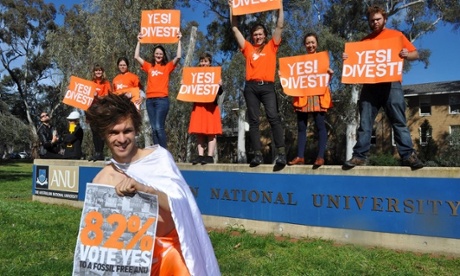
The advice behind the Australian National University’s (ANU’s) divestment from seven resource companies was sound and is not about to be changed, the head of the responsible investment advisory company has insisted after a two-week controversy over the decision.
The prime minister, Tony Abbott, has labelled the divestment decision “stupid” and five ministers have lambasted the ANU for relying on a “secret” and inaccurate report that the mining companies had not been allowed to see, allegedly jeopardising “energy security” and its own investment returns.
One of the resource companies, Sandfire Resources, claimed it was “incredibly confident” it would no longer be judged as harshly once “incorrect, false and misleading” information from the responsible investment advisory company was changed, while former Liberal leaders Malcolm Fraser and John Hewson joined thousands of others to publicly back the ANU.
But Duncan Paterson, the chief executive of the responsible advisory firm, Corporate Analysis Enhanced Responsibility (Caer), has told Guardian Australia his company was not backing away from any of the advice it had given the university, and suggested the debate about the process had become hopelessly confused.
“We categorically stand by the quality of our research process,” Paterson said. “There are no inaccuracies in our report, we have given no assurances to any company that their results will change. We will continue to talk to the companies we cover but I am aware of no instances where our advice has been based on false information.”
And he said key assumptions made by the companies, politicians and sections of the media misunderstood the entire incident.
The ANU has been criticised for retaining shareholdings in some large fossil fuel companies and not in others, but Paterson confirmed the advice had not been about fossil fuel divestment, but rather about the social and environmental operations of each firm.
“They [the ANU] did not request a fossil fuel divestment service, this was an assessment of what companies do as part of their own operations, not an assessment of the climate impact of their operations,” he said.
One of those apparently under the impression the ANU had sought to divest all energy stocks was Abbott who said “any entity which says that they’re simply not going to invest in energy companies is frankly depriving its members of the benefit of some very good investments, because Australia ought to be one of the world’s energy superpowers.”
Paterson said it appeared the university’s decision based on his company’s sustainability advice had been incorrectly “conflated” with the campaign for investors to shed fossil fuel company stocks – something student groups are also lobbying for the ANU to do.
He also clarified that there been no specific report about the companies provided to the ANU. Paterson said his company maintained a research database about all ASX 300 companies, making regular requests to those companies to update or clarify information.
“We maintain research from a broad range of companies that clients can access and sometimes we are asked for results tailored to a specific investment strategy,” Paterson said.
“We didn’t write a specific report for the Australian National University, the ANU subscribed to our normal research services and were sent a sustainability rating for companies in the ASX 300.
“It is not our responsibility to consult companies over a client’s decision to divest from them, we don’t provide divestment advice, we provide information upon which clients make those decisions.
“We do consult with companies in the course of compiling our information, and we consulted with all seven companies here, companies aren’t told what their sustainability rating is, but they are asked to provide information and we send all the information we hold on companies to them regularly to allow them to update or amend. That information is presented in such a way that areas of shortcoming would be obvious,” he said.
Sandfire’s chief executive, Karl Simich, told Guardian Australia on Thursday there were “serious inaccuracies” in Caer’s research, including that the company was connected with the nuclear industry when it was not, and that a single test drilling operation at an old mine site in Papua New Guinea was “likely to involve forest clearing”.
Paterson said the company did not seem to understand that “how responsible investors seek to use this information”.
“They don’t only want to look at what the company has done … they are also looking at what the company is intending to do, what risks that might present and how the company intends to manage those risks.”
The ANU has said it will sell shares in Iluka Resources, Independence Group, Newcrest Mining, Sandfire Resources, Oil Search, Santos and Sirius Resources.
The assistant infrastructure minister, Jamie Briggs, wrote to the ANU vice chancellor, Ian Young, on Monday criticising the decision for being taken on the basis of a secret report “without any input or opportunity to comment from the companies named, nor any direct queries made to them, and then released to the national media”.
“This behaviour indicates that … there [is] a seeming lack of concern about the possible reputational damage to the companies concerned … I find it extraordinary that a publicly funded institution, particularly one of such standing as the ANU, would make such a simplistic moral judgement on an Australian company, let alone seven, without first providing the directly interested parties with an opportunity to respond to the allegations,” he wrote.
He said the decision meant the ANU was sacrificing its own financial returns, apparently on the assumption that “these losses will be topped up by taxpayers”.