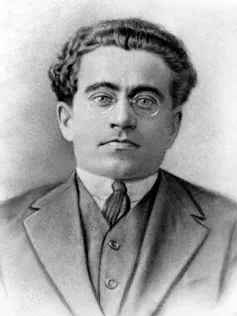
Marxist, journalist, political leader and social theorist Antonio Gramsci (1891-1937) was a small, disabled, chronically ill man from a poverty-stricken Sardinian background. He was also someone about whom the Italian fascist state famously declared: “We must prevent this brain from functioning for twenty years.”
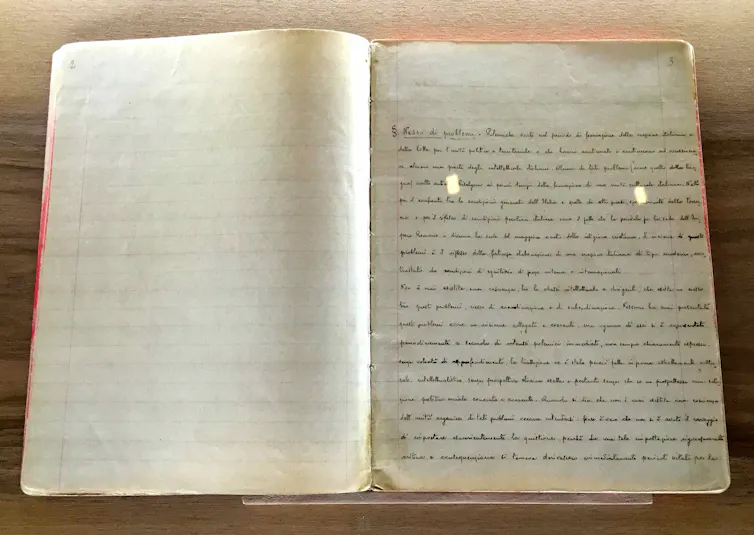
Gramsci was arrested and imprisoned in 1926 at the age of 35, ten years before Benito Mussolini declared his empire in Africa. During concentrated periods, in which he was allowed pen and paper in his cell, he wrote copious notes in 33 school exercise books. Gramsci recorded his thoughts on theory and strategy, ranging across history, politics, philosophy and culture.
These writings would become his major work, the Prison Notebooks (Quaderni del carcere). In the words of political theorist John Schwarzmantel, the “fundamentally political text” of the Prison Notebooks examines “the forces acting to preserve and to change the nature of a political and social order”.
Gramsci was writing in the face of the collapse of the revolutionary hopes of the 1920s and early 1930s. But he rejected the dominant Marxist thinking of his day. Classical Marxism, he argued, was overly materialist and fatalistic, seeing history propelled forward by the shifting structures of economic production. Gramsci proposed a more humanistic version of Marxism.
He emphasised how people could be conscious actors in the processes of history. He stressed the important historical role of the battle of ideas. These battles, he thought, could lead to cultural shifts – shifts that were necessary before a successful revolutionary transformation could occur.
In political philosophy, international relations, sociology, cultural studies and beyond, his conceptual tools have been adapted and repurposed to shed light on topics ranging from international political economy to gender power relations. As Schwartzmantel observes, Gramsci has inspired thinking about civil society as “the sphere of diversity and difference characteristic of liberal-democratic society” and “the arena for struggle against one-party rule in communist systems”.
Perhaps surprisingly, given his staunch leftist orientation, Gramsci has also become a source of ideas and strategies for a resurgent radical right.
Two red years
The young Gramsci, impressed by the Turin working-class movement, joined the Italian Socialist Party in 1913. After the first world war, he became co‐founder and editor of the influential newspaper L’ordine nuovo (The New Order), where he published polemics urging workers to educate themselves, organise and form an alliance with the peasants.
Over half a million Italians were killed in the brutal combat of the Great War. Deep dismay at these losses and the inspiration of the Russian revolution of October 1917 converged in the view that a “new order” was indeed being born.
Gramsci played a leading role in the wave of strikes and occupations of the Fiat car factories in Turin, which took place during the Biennio Rosso (the “two red years”) of 1919–20. In 1921, a new Italian communist party was formed: the Partito Comunista Italiano. Gramsci became a member of the Central Committee.
Tumultuous political upheaval was followed by fascist reaction. Mussolini seized power in 1922. “The industrialists had lost their faith in the ‘liberal state’ and had become receptive to political expedients of quite a different order,” historian John McKay Cammett observed. “The hour of fascism was at hand.”
The same year, Gramsci went to Moscow to serve as the Italian representative on the executive of the Communist International. When he returned to Italy in 1924, he was elected to parliament and became secretary general of Italy’s communist party – a revolutionary party operating in a fascist state.
Gramsci believed he was entitled to immunity as an elected member of parliament. But he was arrested and sentenced by a “Special Tribunal for the Defence of the State”. He was already frail due to a physical disability caused by a fall as an infant and chronic ill health. The harsh prison conditions would eventually stop Gramsci’s body from functioning; over the course of his 11 years in prison, his health steadily deteriorated and he died at the age of 46.
Throughout his years of incarceration, however, “this brain” continued to function at a high level.
Hegemony
Classical Marxist theory had failed to predict revolution in the largely agrarian peasant economy of Russia. Marxist theorists had also failed to foresee another new development: fascism.
In the Prison Notebooks, Gramsci tries to understand why the revolution had not spread beyond Russia and what accounted for the rise of Mussolini and fascism. Why would severely poor and exploited people, like the ones he had grown up with in Sardinia, support fascism over the enlargement of democracy from the political sphere to the economic sphere, something he believed was on offer in the model of a new “proletarian state”.
Gramsci worked out his key ideas via a careful analysis of historical events. In particular, he considered the complex process of the unification of Italy in 1861. He wrote with an eye to developing oppositional strategies that could be adopted by revolutionary parties operating in Western liberal democratic states.
A key innovation was his theory of “hegemony”, described by Marx scholar David McLellan as “one of the most important, if elusive, concepts in contemporary social theory”.
“Hegemony” is derived from the Greek verb meaning “to lead”. Gramsci used it to refer to the way a politically dominant class maintains its ruling position not simply by force, or the threat of force, but also by consent. A class that uses open or veiled coercion through state power to impose its will, he observed, can be said merely to “dominate” other social groups; it becomes “hegemonic” when it also provides “intellectual and moral leadership” over allied groups in civil society.
Gramsci argued that the education system, the news and popular media, literature and the arts, trade unions, churches and intellectuals all play vital roles in shaping people’s perceptions and understanding. Since the battle for power takes place, in part, outside the political system, would-be revolutionary parties needed to overcome the sources of hegemonic power within civil society.
The transformation of capitalist countries required a transformation of the cultural processes through which dominant groups secure their power. Gramsci viewed education, for example, as something that could become, in Schwartzmantel’s words, “a democratic force […] a means of breaking down rather than reinforcing class divisions”.
He also emphasised the role of intellectuals, whom he thought of, not as academics in ivory towers, but as knowledge workers. Intellectuals, according to Gramsci, perform a special type of job: they contribute to the climate of opinion, and thus to the maintenance and legitimation of the existing order. Some are directly connected with the state, but many others support hegemony at the level of civil society.
Although, in general, their views support mainstream perspectives, intellectuals might also help turn socialism into a “common sense” view. For Gramsci, what was usually taken as “common sense” amounted to broad acceptance of social injustice – for example, acceptance of significant wealth inequality and diminished democracy.
These bourgeois social and economic relations are internalised as “natural” via a process of socialisation. This leads to the governed actively consenting to and having a stake in their own oppression.
Such “common sense” has the effect of reducing the need for capitalist states to apply brute force – something they will, nevertheless, still use in periods of crisis. It preserves and obscures class domination behind notions of “natural order” and “social harmony”.
Gramsci for the new radical right?
Gramsci’s time in the Soviet Union led him to worry that the socialist state was not establishing consent among wide groupings in the population and was heading in an authoritarian direction. In the Prison Notebooks, he is attempting to come to grips with what social theorist Steven Lukes calls “the problem of democratic consent and how to win it for socialism”.
Gramsci believed this would require political organisation and mobilisation, as well as the development of a counter-hegemonic culture. This contrasted with several dominant 20th-century Marxist views, which, as Lukes put it, tended to “regard the suspension of ‘bourgeois’ democratic freedoms in socialist societies as not incompatible with the socialist project”.
In recent decades, the radical right has gained ground around the world with its opposition to what it calls “liberal globalism”. A recent study argues that this new right adheres to democracy, roughly speaking, but is “anti-liberal or illiberal in its worldview and transformative ambitions”.
Gramsci’s influence can be seen in Europe where, for example, Giorgia Meloni’s government in Italy has had successive culture ministers who vowed to overturn “left-wing cultural hegemony”.
In Hungary, the recently deposed illiberal government of Viktor Orbán decried the effects of what it labelled “cultural Marxism”. Orbán even wrote a master’s thesis that used Gramsci’s ideas to analyse Poland’s “Solidarity” movement in the 1980s
Gramsci’s influence is also evident in the United States, in how the Trump movement, the “alt-right” and allied groups have sought to reshape the intellectual and cultural climate of the country. Like kindred European movements, they have fought perpetual “culture wars”, mobilised people, and established think tanks, educational institutions and publishing houses.
Gramsci’s concept of hegemony and his strategies may have influenced the right’s attempts to reshape the intellectual and cultural climate. But theirs is a simplified concept of “cultural hegemony”. They act as if “battles of ideas” or “culture wars” are all there is to it.
This suggests a poor or indifferent understanding of Gramsci’s signature concept, which he viewed as something that “unfolds simultaneously across economic, political, and ideological spheres”. In other words, we always need to understand cultural power as connected to economic power.
In his recent book Hayek’s Bastards, historian Quinn Slobodian has examined the connection between neoliberalism and the populist right. He suggests that, for all the political sound and fury, one would struggle to put a cigarette paper between the new right and the corporate elite on issues like wealth inequality, corporate taxation, monopoly power and the financialisation of the economy.
In referencing Gramsci, this new right has failed to grapple seriously with what motivated him to link culture to political economy. Even in well-established democracies, the problems of yawning inequality and dizzying capital accumulation can only concentrate power in a way that disenfranchises citizens and undermines institutions, cultural and political – including the ones the radical right claims to care about.
This article was originally published on The Conversation. Read the original article.