To prevent patients suspected of being infected with the novel coronavirus from becoming "hot potatoes" passed around from hospital to hospital before finally being admitted, the Tokyo metropolitan government has designated 103 medical institutions to accept such patients.
This has been facilitated by the increasing use of antigen tests and the securing of an adequate number of private rooms. The Tokyo government intends to provide financial support, but even so, the recent surge of infections in the capital has heightened tensions on the medical front.
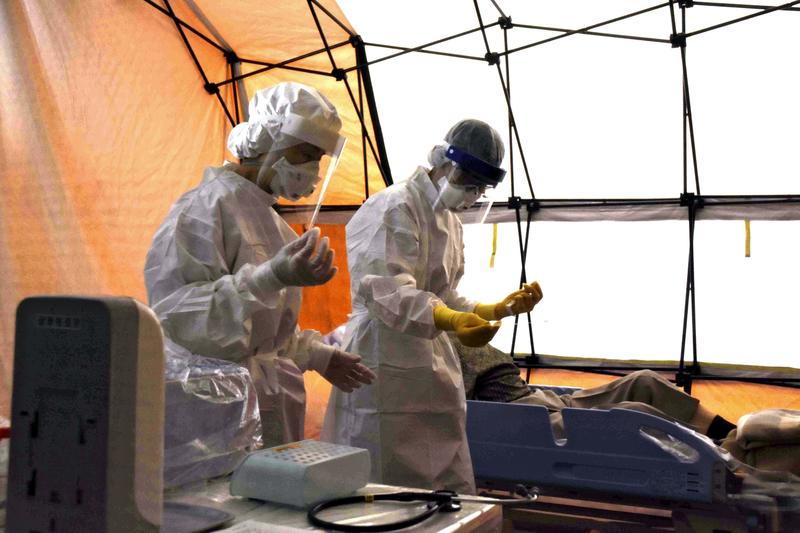
Late last month, a woman in her 90s was taken to Heisei-Tateishi Hospital in Katsushika Ward, Tokyo. As she had a fever of 39 C with low blood oxygen levels, coronavirus infection was suspected and she was taken to the hospital's outdoor tent.
A doctor in protective gear performed a nose swab and tested it for antigens, which produced a negative result in about 30 minutes. A CT scan of her lungs and medical interview led to a diagnosis that she was not infected, and she was admitted to a general hospital room.
"We might have refused to accept her if this had been in April," said Taketomo Omomo, 56, the hospital's vice president. "An antigen test is such a powerful weapon as it can provide results in a short time."
In April and May when the epidemic was raging, there were many cases nationwide in which patients were taken to hospital after hospital before one that would finally accept them. Cases in which it took more than 20 minutes or the person was rejected by five or more hospitals were particularly prevalent in Tokyo, with 2,365 in April and 1,626 in May.
According to the Tokyo metropolitan government, back then, it took several days to get the results of a PCR test, and there were not enough private rooms set aside to temporarily isolate patients suspected of being infected.
Heisei-Tateishi Hospital, which had designated an entire ward for the infected, had to turn away 266 patients suffering with fever. Until the results of PCR tests were available, patients could not be accommodated in the general ward, nor could they be put in the special ward because there was the possibility of testing negative. The five rooms set aside for patients waiting for results were constantly full, making it impossible to accept new patients.
Since antigen testing was introduced nationwide in mid-May, the decreased time in obtaining results has led to less patients having to wait in private rooms for test results. Even if the antigen test is negative, hospitals might order a PCR test if symptoms of pneumonia show up on a CT scan, or the patient continues to have a cough. They will be kept in private rooms while waiting for the PCR test results.
The antigen test checks for the presence of virus-specific proteins in nose mucus or saliva. On June 16, the health ministry issued a directive making a PCR test unnecessary if an antigen test turned up negative between the day after symptoms such as fever appeared and the ninth day. The PCR test would still become required to confirm the diagnosis if the patient took an antigen test on the day of onset or after the 10th day, even if they tested negative.
Satoru Arai, 67, director of the Tokyo Medical Association, said, "Antigen tests have been recognized as being able to determine the presence of infection, but we carefully make diagnosis by combining it with other tests to ensure there will not be an outbreak within the hospital."
In June, the metropolitan government took measures to prevent a recurrence of the "hot potatoes" problem. It designated 73 medical institutions to "actively accept" patients suspected of being infected with the virus, and, if a patient is refused at five of those places or had to wait more than 20 minutes for a destination, a further 30 were designated to "absolutely accept" patients.
The metropolitan government will advocate that the 103 hospitals secure private rooms to isolate patients suspected of being infected, while planning subsidies to offset the costs of such preparation. It is also considering bonus payments based on how many patients are actually admitted.
On Friday, the number of new cases in Tokyo hit a record of 293, and Arai expressed his concerns.
"Medical institutions are making progress in securing private rooms for suspected patients," Arai said. "However, if the number of patients continues to increase at this pace, the rooms will soon fill up. It may again become difficult to find places that will accept patients."
Read more from The Japan News at https://japannews.yomiuri.co.jp/