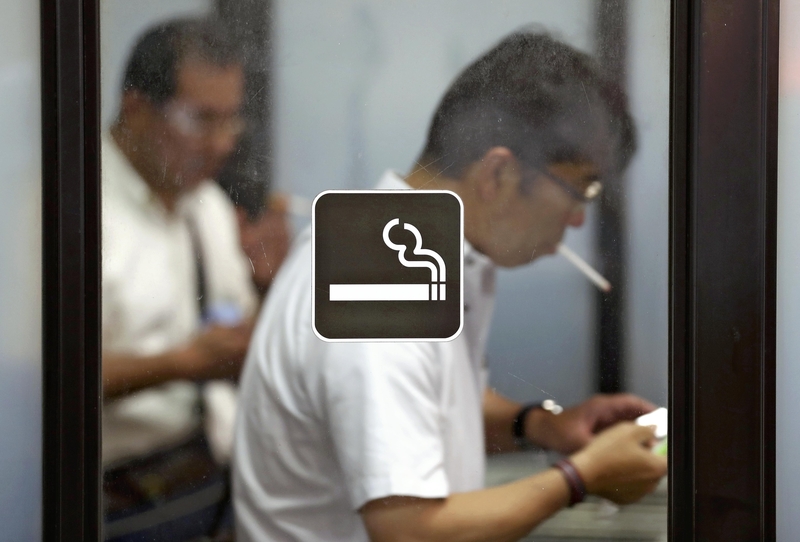
The revised Health Promotion Law passed on Wednesday requires a wide range of cooperation from relevant industries, including restaurants and bars, to be effectively implemented to reduce passive smoking.
The legislation strengthens measures against secondhand smoking, an area in which Japan has lagged behind other countries. The nation also faces outstanding issues such as loose regulations on heated tobacco.
Local govts more progressive
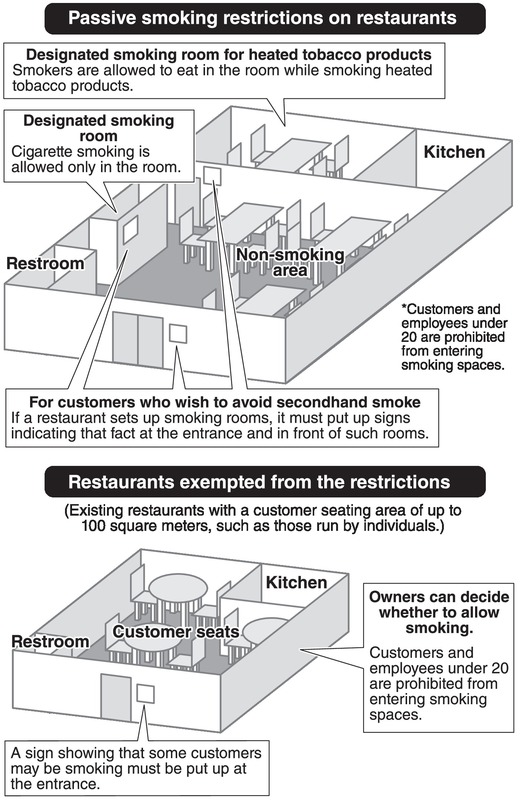
Under the law, restaurants and bars will be obliged to ban smoking from April 2020, except for existing small-sized establishments that meet certain conditions such as having customer floor space of 100 square meters or less.
In-house smoking will be allowed in sealed rooms from which no smoke can escape, but such renovations cost time and money, making it likely the law will have a wide impact across the nation.
"Customers will shift to small restaurants," a 52-year-old woman running a restaurant with a floor space of about 700 square meters in central Yamagata city said bemusedly. She said half of her customers are smokers.
The woman's situation highlights how hard the central government needs to work to avoid confusion among relevant industries.
Strengthening measures against secondhand smoking is a global trend. In 2010, the World Health Organization and the International Olympic Committee agreed to promote smoke-free Olympics. Since then, a total ban on indoor smoking at restaurants and bars has been implemented in Olympic host cities such as London and Rio de Janeiro.
"Now with the passage of the revised law, we will urge [restaurants and bars] to thoroughly work on measures against passive smoking," said an official of a national trade association of restaurants, hotels and other establishments.
In the 2020 Olympic and Paralympic host city of Tokyo, a stricter ordinance was passed in June to prevent secondhand smoking, ahead of the central government's move. Under the ordinance, all restaurants and bars hiring employees must ban in-house smoking.
Osaka Prefecture and the city of Chiba are also considering enacting ordinances on smoking that would be stricter than the national law.
Just 45% subject to ban
The central government originally planned to introduce stricter regulations than the latest law. A draft of the law presented by the health ministry in March 2017 provided an exception to the ban only for bars, including so-called snack bars, with a total floor space of 30 square meters or less.
And yet, the draft met opposition from lawmakers and other members of the ruling Liberal Democratic Party, who demanded more consideration for restaurants and bars. Through subsequent adjustments over the wording of the text, both sides reached an agreement to give the exception to establishments with a customer floor space of up to 100 square meters.
Only 45 percent of restaurants and bars will be subject to the smoking ban under the national law. But under the Tokyo ordinance, 84 percent will be required to ban smoking, illustrating a stark gap between the two regulations.
Far from intl standards
All restaurants and bars -- including small establishments -- that start business after the law enters into force will be required to ban in-house smoking, with the percentage of smoke-free restaurants expected to rise.
Even so, more than a few people are calling for further restrictions.
Junko Mihara, an LDP House of Councillors member, expressed dissatisfaction with the latest revision at a July 10 meeting of the upper house's health, welfare and labor committee by saying, "[The revision] is far from perfect."
At a plenary session of the upper house on Wednesday, Toru Azuma, a member of Nippon Ishin no Kai, criticized the law, saying, "[The law is introduced] as if to show off the insufficiency of Japan's measures [against passive smoking] to the rest of the world."
Kota Katanoda, chief of the cancer statistics integration division at the National Cancer Center, said: "Certain rules have been established [with the revised law], and I consider it a half step forward. The scope of exemptions from the law is so wide that concerns remain over its effectiveness. Starting from the latest revision, [Japan] needs to work hard to make [relevant domestic rules] closer to international standards."
Read more from The Japan News at https://japannews.yomiuri.co.jp/