The finer points of international football etiquette were eagerly disregarded when Scotland and England met at Celtic Park on Tuesday night. Perhaps the booing of Flower of Scotland and God Save the Queen was a tribute to two of the dullest national anthems around. More likely it was confirmation of predictions that this encounter would fail to meet most of the usual criteria by which we define “friendlies”.
There are some football matches where the media coverage, if not actually encouraging bad behaviour, at least ensures anything even vaguely controversial is given more prominence than it deserves. The anti-IRA chanting from England fans is perhaps a case in point. This was not an example of fans straying beyond the bounds of socially acceptable opinion. Morally, it was not the equivalent of racism, sexism or sectarianism. Yet it has generated controversy and apologies. After the match Roy Hodgson had to diplomatically express disappointment at his own supporters. He has some form is this area, having written to fans before a match with the Republic of Ireland at Wembley in May last year, asking they resist the temptation to chant about the IRA.
A couple of observations could be offered. First, it is remarkable that we’re not talking about England fans making play of the referendum result as might have been expected. Second, and of more interest, it is difficult to claim the chants were directed against the opposing fans. The Tartan Army might be said to have cultivated a light-hearted nationalist image, partly defining itself against the reputation English fans had for hooliganism in the 1980s. But even taking this into account and factoring in the referendum, the chanting was still odd. The parallels between Scottish and Irish nationalism are superficially similar but fraught with possible misreadings. The parallels between Scottish nationalism and violent Irish republicanism are non-existent.
In short, very few of the Scotland fans in attendance would have any sympathy with the IRA, regardless of their position on Scotland’s relationship with the UK.
It is likely the chants were informed by the venue more than the opposition. Celtic’s roots are in the Irish Catholic community in Glasgow, a fact of great significance to some fans. This has lent itself to expressions of support for Irish nationalism and even, among some, the IRA. Last December, the club was fined £42,000 by Uefa after a display likening hunger striker Bobby Sands to William Wallace was unveiled at a Champions League match. Prior to Scotland’s match against the Republic of Ireland at Celtic Park last Friday, the Scottish manager, Gordon Strachan, was forced to dismiss claims from the opposition camp that it would feel like they were the home side. It is only when we acknowledge this political and cultural context that we can attempt to understand the origins of the England chanting; it is hard to believe it would have been heard at Hampden.
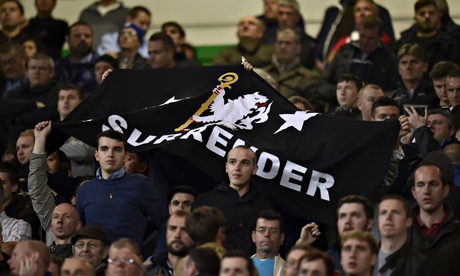
Questions will be posed about why some English football fans – Chelsea fans have done much the same on visits to Ibrox – sometimes choose express themselves by chanting in opposition to the IRA, singing Rule Britannia and unfurling No Surrender flags. Thoughts will inevitably turn to the Aviva stadium in Dublin in June next year. On England’s last visit in 1995 there was serious disorder and the match had to be abandoned. Although there is nothing to suggest hostility will reach those levels, it also seems unlikely the recent reconciliation between the UK and Irish states will be reflected. Some football fans dearly love their stereotypes: the so-called modern game can still be infected by fans’ fondness for the old battles.