
A model, 23-year-old Charli Howard, sparked controversy by posting on Facebook her experience with a modelling agency. Howard says that at size six-eight, she was told she was “too big” and “out of shape”. Howard responded that although she wanted to model, she would no longer subscribe to the industry’s “unobtainable” standards. Well, good for Ms Howard. Still, you’ve got to wonder if there is truly anyone left out there who has yet to realise that the fashion world forces models to be excessively thin?
The effect of marketing what could only be termed “normalised emaciation” to ordinary females is a complicated subject for another time. This is about the self-emaciation of young females in fashion that has persisted for decades, despite the scandal of widespread food disorders and in some cases deaths. The reason for this is simple – not just designers but most fashion professionals believe that clothes look best (and sell best) on mostly young, extremely skinny females. This perception has never been seriously shaken, despite the occasional foray on to the catwalk of plus-size ranges and models, which at best tend to be tokenistic.
Years ago, there was the fetishisation of the young, normally curvaceous Sophie Dahl, who was often portrayed as some kind of obese grotesque. Now, decades on, the same guff is directed at the likes of Lara Stone, who’s constantly described in awestruck tones as “curvy”, as if this means doors have to be widened for her to pass through.
The point being that very little changes. There’s an endless cycle of exploitation and dehumanisation followed by complaint and protest, and back again. The whole farce enabled by the fallacy that complaints such as those made by Howard are in any way “shocking” or “new”. Perhaps there are people out there who’re still amazed by the idea of models emaciating themselves to get work but, frankly, where have they been?
Perhaps it’s time to accept that a level of personal and (considering the youthful starting age of most models) parental responsibility needs to come into play. Some models, here and abroad, come from such impoverished backgrounds that even a stressful modelling existence is deemed an improvement. Akin to boxing for men, modelling is a traditional female route out of the “ghetto” for those with few other options.
However, there is no real reason why excited young girls shouldn’t be told the truth: they are entering an industry that, for all the lip service occasionally paid to “healthy body shapes”, will demand excessive thinness. Their effortless teenage skinniness may soon be tortuously difficult to retain. Not everyone gets to be Kate Moss or Cara Delevingne, so it’s best to embrace the short-termism – travel, make money, have fun and experiences – but also have a plan B, so that once the criticism starts and you feel your self-esteem evaporating, you can get the hell out.
Of course, models can also be too “black”, “old”, “last year” (“last month”). In this context, “too thin” is just another demand from an impossibly demanding, unfair industry. Indeed, again in common with boxing, modelling still too often seems to be about taking grisly weighted gambles on health and wellbeing in order to succeed. With this in mind, let’s stop pretending that any of this is shocking and new, when the only thing that’s truly shocking is that it’s far from new.
Some might say, reasonably enough, that it’s the industry that needs to change, not the mindset of the models. I agree, but good luck making that happen, because it hasn’t after decades of outrage. Unfortunately, models exposing how they are treated, however horribly, sadly isn’t revelatory. In fact, it’s in danger of becoming cultural white noise.
Clearly Brian isn’t such a naughty boy any more
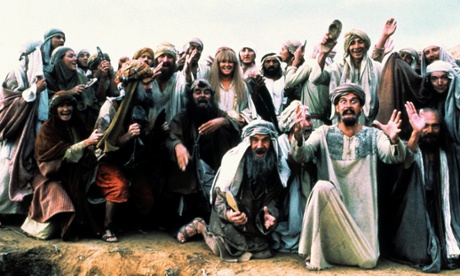
Monty Python’s Life of Brian is finally going to be shown in Bournemouth.
It received an X-rating on its release because its plot (an ordinary man being mistaken for Jesus Christ) was considered blasphemous.
A local man, Adrian Cox, asked for it to be reclassified and hired a cinema to show it on his birthday (I hope the People’s Front of Judea and the Judean People’s Front were invited).
It will be also be shown publicly later this month.
For my money, Life of Brian is by far the funniest thing the Pythons ever did (“You’re all individuals!” “I’m not”).The fuss around it now seems anachronistic to the point of being charming, but there’s poignancy here too.
It’s not just the idea that anyone could possibly be offended, it’s the fact that, even though a great number of people were genuinely offended, it didn’t end in violence or a virulent Twitter storm or an online petition.
Even today, Life of Brian seems very fresh as a film, and as a concept, but the controversy surrounding it is definitely historic.
Bags, pah! I pull my trolley with pride
Where the 5p plastic bag charge is concerned, I’ve been ahead of the curve, whether I like it or not. I can’t drive (too thick, with the spatial awareness of a bat in daylight), so for some time, I’ve been carting a shopping trolley around, to much general derision and the mortification of my family. Once, I left my (filthy, dilapidated) trolley in the school playground by mistake and my daughter had to leave her classroom and rescue it, mournfully dragging it away, in front of her amazed, horrified peers, an experience she may one day choose to lie on a therapist’s couch and talk about.
Shopping trolleys are very ageing – sometimes I honestly think I’d be less conspicuous sitting on a commode. At one point, people such as Claudia Schiffer were spotted wheeling a trolley and I thought for a glorious moment trolleys would become chic. It was not to be. Small children and their ill-mannered parents (they know who they are) continued to mock, even when I purchased a snappy deluxe model with wheels that climbed stairs.
I found myself exchanging knowing looks with trolley-wielding pensioners (my people, my tribe) in the street, akin to when people admire each other’s cars or motorbikes. My look said: “Nice set of wheels, but do they climb stairs? Because mine do, so nerrr!” (It’s competitive out there in the trolley world).
Now, with the plastic bag charge, I predict a sharp increase in interest in the humble shopping trolley. All these newbies buying the wrong type (you can’t go too cheap with the wheel quality and try to avoid designs that remind you of psychedelic hippy-vomit). Let’s hope, in this new era, that there’s a modicum of belated respect for courageous trolley trailblazers such as myself.


.png?w=600)