I saw this man getting nervous for the first time. As the leader of the JAM (Japan Animationsong Makers) Project, he has brought success to many concerts at Nippon Budokan hall and has sung in front of huge crowds all over the world, from Asia and America to Europe and the Middle East.
And there he was, wearing an expression I had never seen before.
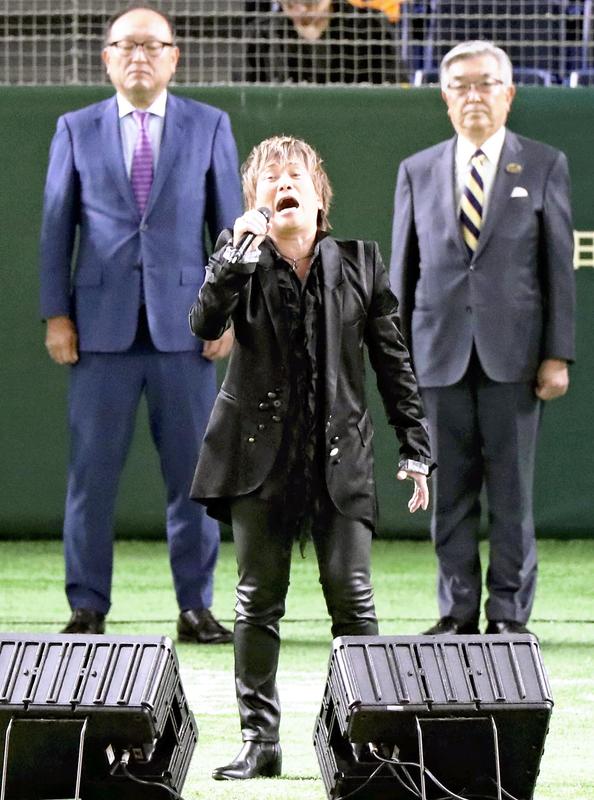
Anison (anime song) singer Hironobu Kageyama sang the national anthem before the start of Game 3 of the Japan Series between the Yomiuri Giants and the Fukuoka SoftBank Hawks on Oct. 22 at Tokyo Dome.
"Anison singer Hironobu Kageyama!"
The baseball stadium erupted as his name was called out and shown on a huge LED display. It was a very moving experience to watch him slowly walk onto the field.
I grew up listening to Kageyama singing theme songs from superhero shows. I met him for the first time in the first half of 2008, shortly before JAM members began their first world tour, which they named "No Border."
I felt connected to Kageyama's enthusiastic desire to bring the world together with anison and touched by his missionary-like readiness to dash to anywhere in the world. And I found myself shouting, "I'm going to report about your concerts in Brazil!"
At that time, I did hear that Japanese anison was very popular in Brazil, but I knew of no Japanese media covering it, so it seemed to be just a rumor. According to Kageyama, people in Brazil were chanting theme songs from "Dragon Ball Z" and "Dengeki Sentai Changeman" in Japanese. I remember thinking I must see such a wonderful scene with my eyes and write about it.
So, I went to Brazil, was amazed at the immense popularity of anison that defied my imagination, and wrote many stories. It was not a business trip, though. I took paid holidays and paid for the whole trip. When I applied for permission to go on a business trip to cover the tour, the request was dismissed, and I heard that one executive said, "Anison? That's only her hobby, isn't it?"
It's not that the person was pigheaded. Back in those days, that was the way many people looked at anison. The overwhelming atmosphere was that people called anison "manga no uta" (cartoon songs) and looked down on them, believing only children would listen to those songs.
Eleven years have passed since then, and circumstances have changed dramatically. Today, people who refuse to recognize anison as a musical genre are probably in the minority. And there was Kageyama singing the national anthem on that day. Incidentally, he -- a singer of anison, not classical music, nursery rhymes, enka old-fashioned pop songs or kayokyoku pop songs -- was chosen to sing the national anthem at the Japan Series game on the same day as the Emperor's enthronement ceremony.
Holding a microphone and looking tense, Kageyama gave a dignified and heartfelt rendition of "Kimigayo" in the quintessential Kageyama style. It was beyond discussion that the artist was an anison singer. His impassioned singing moved the hearts of the spectators who packed the venue.
I became a little teary-eyed as I stood on the same ground as Kageyama, watching his back during the performance. I think a new entry was added that day to the history of anison and the history of Japanese music.
Suzuki is a Yomiuri Shimbun senior specialist and an expert on tokusatsu superhero films and dramas.
Read more from The Japan News at https://japannews.yomiuri.co.jp/