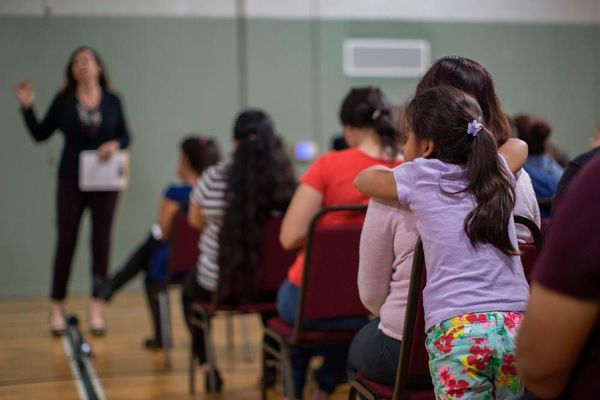
May 25--Maija Burnett scanned her California Institute of the Arts classroom as nearly 60 new students filtered in, empty notebooks in hand. It was the start of the 2014-15 school year, and Burnett, director of CalArts' character animation program, was meeting this crop of freshmen for the first time in her largest classroom, nicknamed "the palace."
Surrounded by walls painted entirely black -- more conducive to drawing -- the students stood up, one by one, to introduce themselves. That's when it hit Burnett that almost all of them were women.
"Where are all the guys?" she recalls thinking.
CalArts' blind admissions process meant administrators had reviewed portfolios without considering names or gender. "We were shocked to see so many women," Burnett says.
College animation programs in the U.S. have historically skewed male, like the industry itself. But female enrollment at top schools has surged nationwide, especially in the last five years, according to interviews with administrators at top schools.
When CalArts debuted its character animation program in 1975, it had just two female students. Today women make up 71% of its animation student body, and this month 16 women and 10 men graduated from the program. USC's John C. Hench Division of Animation Digital Arts is now 65% women.
UCLA's master's program in animation is estimated to be 68% women, and Florida's Ringling College of Art and Design's computer animation program is nearly 70% women.
That swell of young women studying the craft is generally not mirrored in the workforce. Women make up 21% of the artists, writers and technicians employed under an Animation Guild contract this year, according to the organization, which tracks hiring records for guild animation studios in Los Angeles County.
"They come out of art school and aren't hired for the creative jobs," said Marge Dean, co-president of the nonprofit advocacy group Women in Animation. "They end up being PAs [production assistants] or on the production management track, the housekeepers and the organizers as opposed to the creators."
Even so, women have increasingly been shaping high-profile animation projects in Hollywood.
Bonnie Arnold and Mireille Soria were named co-presidents of DreamWorks feature animation in January, replacing Chief Creative Officer Bill Damaschke. Disney Television Animation recently produced "Star vs. the Forces of Evil," its second series created by a woman, Daron Nefcy. The story of the Star Butterfly, a princess from another planet who finds her voice on Earth, premiered March 30 and was the No. 1 animated series debut in Disney XD history.
"Traditionally, a lot of comics and graphic novels -- a predecessor to animation -- were more geared to boys," says Bret Parker, Pixar animator and professor at the Bay Area's California College of the Arts. "That's shifted. Now young women are realizing animation is an accessible thing they can go into."
No one organization tracks gender demographics for college animation programs, but the trend is consistent across many undergraduate and master's programs across the country.
Valencia-based CalArts, co-founded by Walt Disney, has seen the gender divide widen in women's favor every year since 2010. The Savannah College of Art and Design in Georgia grew its female animation student body by 82% between 2010 and 2014, whereas the number of male students grew by 11%. At California College of the Arts in San Francisco, female enrollment in animation grew by about 20% during the same period.
"I noticed the shift about three or four years ago. It was striking -- and it's held steady," says Tom Klein, chairman of the animation program at L.A.'s Loyola Marymount University, now 55% female.
What accounts for the increase in female enrollment?
One factor may be that more women in general are entering college. Tom Sito, chairman of USC's animation division, also thinks that successful animated films with strong female characters, such as "Frozen" and "Brave," have played a role.
Others credit technology. Disney TV's animation talent development director, Brooke Keesling, who teaches at CalArts, says the gender-neutral Internet -- where users on social media often go by androgynous handles -- has had a major effect on young women's ambitions.
"People can share their artwork on Tumblr and Vimeo and YouTube and DeviantArt," she says, "and see that it's actually a thing that a lot of people are interested in, not just men."
TV shows like Cartoon Network's "Steven Universe," created by Rebecca Sugar, the company's first female solo series creator, have propelled the proliferation of fan art online, CalArts' Burnett says. "Young women can not only interact together online in ways they couldn't before, but they can contribute and post their own fan art ... and then network and talk to each other about it."
Women have long worked in animation, but for decades they primarily worked as inkers and painters, tracing the lines of other artists' work onto sheets of acetate cells rather than creating the characters and stories.
Exceptions were few: Disney's Retta Scott drew scenes for "Bambi" in the early 1940s, and Mary Blair worked on "Peter Pan" and "Cinderella" at Disney in the late '40s.
In the 1960s and '70s, inking and painting positions dwindled as animation work was sent overseas, where labor was cheaper. With the growth of computer graphics for features in the '90s, traditional ink and paint jobs nearly disappeared.
Today, the realms of TV, film and the Web provide more outlets. Women, however, aren't frequently seen in roles of film director or TV show creator, conceiving and green-lighting new content, animation historian Maureen Furniss says.
"Women tend to be working in development or preschool programming or in producing, and the males tend to be in more creative roles like directing and heads of studios," says Furniss, who wrote the forthcoming book "Animation in History" and teaches at CalArts.
"We can't generalize, but -- and this is true of live action and gaming too -- it's still dominated by men," she says. "It's starting to change, but not that much."
The scarcity of women in creative leadership roles may simply come down to a Mars-Venus disconnect between how men and women communicate, "Brave" co-director Brenda Chapman says.
"I think the issue is that women bring a different sensibility into the mix," Chapman says. "And I think the majority of male studio executives and producers are still expecting what they're used to -- the traditional, male-driven, comedy-heavy stories."