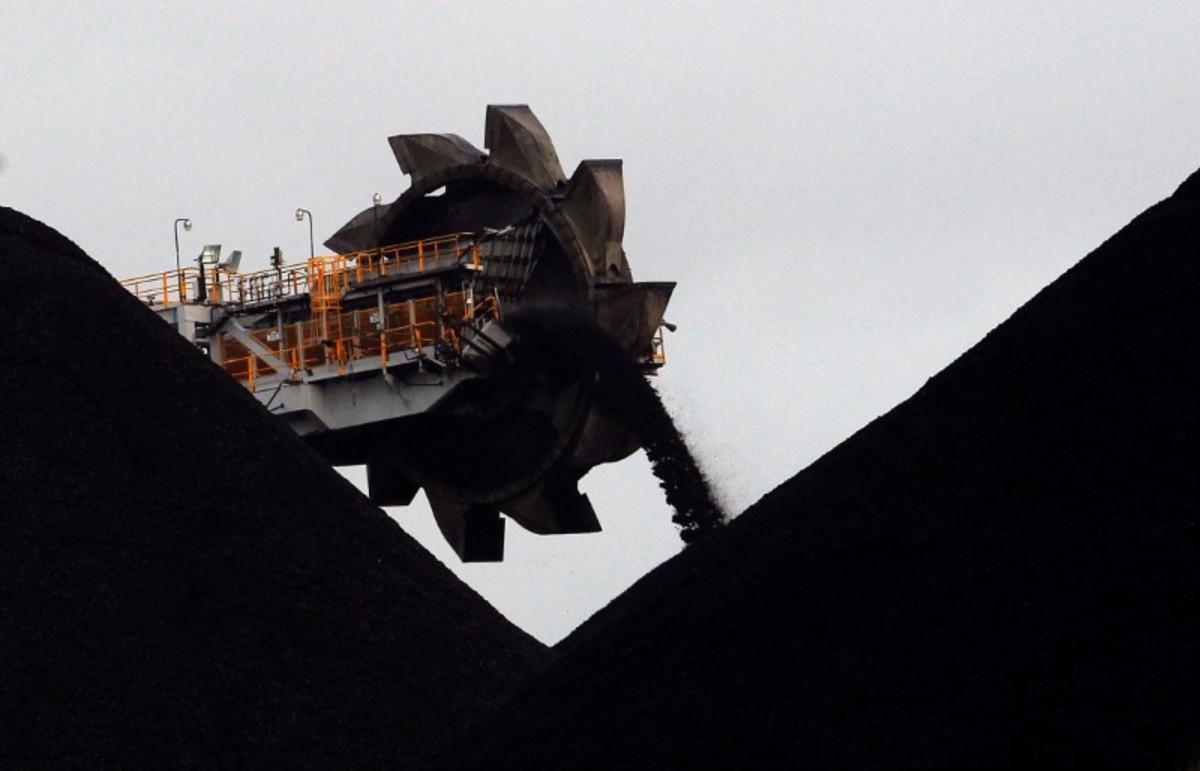
LONDON (Reuters) - A global lack of investment in coal helped to create a record full-year profit for mining royalty company Anglo Pacific <APF.L> and is likely to continue to boost its earnings as many funds shun the sector, its CEO said on Wednesday.
Anglo Pacific said on Wednesday its income from mining royalties had risen 90 percent last year and its free cash flow more than tripled.
Its flagship royalty is for the Kestrel mine in Australia, which Rio Tinto <RIO.L> <RIO.AX> said on Wednesday it had sold for $2.25 billion. The sale does not affect Anglo Pacific's ownership of the royalty.
A mining royalty provides the holder with the right to a share of revenue, profit or production. Historically, royalties resulted from the sale of a mineral property, but increasingly they are created by operators or developers as a source of finance.
Anglo Pacific CEO Julian Treger said the sale's value, at about twice the level some analysts expected, also meant the royalty was worth more than thought.
"Paradoxically, we're creating a situation where existing (coal) producers are going to be rewarded on an ongoing basis," he said. Coal has felt most acutely the lack of new investment, while absolute demand is rising, driven by emerging economies.
The Kestrel royalty deal kicked off Anglo Pacific's business model. It bought the rights in the 1980s for A$180,000 ($137,970) when coal was discovered on land it owned. Since then, the royalty has delivered more than A$400 million.
Treger said Anglo Pacific aimed to diversify and increase exposure to minerals such as copper, nickel and zinc, as well as metals used for alloys to help make vehicles lighter and reduce emissions. Coal, however, may be too good an opportunity to ignore.
"If we get offers that are hard to resist we have a responsibility to look at these for the shareholders," he said.
As one of the most capital intensive sectors, mining suffers particularly from the shift to indexation and away from specialist mining funds that were hit by the commodity price crash of 2015-16.
Coal investment has been further squeezed by concerns about planet-warming emissions.
The indexation trend means generalist investors favour the already cash-rich majors, whose shares they can easily sell if need be, leaving junior miners scrambling to sell royalties as a way to raise cash.
"The result of indexation is that people want to go into large caps. They're drawn by liquidity. That's good for Anglo Pacific. We are seeing tremendous interest for development royalties," Treger said.
Anglo Pacific's share price fell around 4 percent by 1100 GMT and is down by nearly 3 percent since the start of the year. The broader sector <.FTNMX1770>, which last year extended a strong recovery from the commodity markets crash of 2015-16, has also fallen.
($1 = 1.3046 Australian dollars)
(Reporting by Barbara Lewis, editing by David Evans)