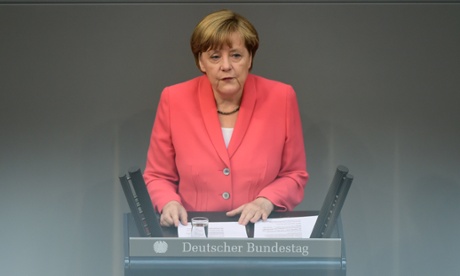
Angela Merkel has urged Britain to remain an active member of the European Union, but said it also needed to consider the future role it wanted to play.
In an address to the Bundestag, the German chancellor stressed that Brussels politicians would be paying ever closer attention to the question of Britain’s doubts over the union. While next week’s summit of EU leaders in Brussels would not focus on the Brexit issue, Donald Tusk, the president of the European council, would be tasked with examining Britain’s demands for reforms.
But she repeated her insistence that the basic principles such as freedom of movement for workers from other EU countries, and anti-discrimination legislation, were not up for negotiation.
Merkel said it was not the first time that a member state had wanted clarification about its role in the union, citing the cases of Denmark in 1992 and Ireland in 2008, for whom “compromises were found”.
She said she was therefore hopeful that Britain could be kept in.
“I’m confident we can achieve this this time,” she added.
Expressing her hopes that Britain would decide to stay, calling it a “natural partner” in many issues, including how to improve Europe’s competitiveness, she said at the same time it needed to clarify its own position towards the club. “Britain obviously needs to work out itself what role it would like to play in Europe,” she said.
Cameron’s demands for renegotiation suffered a setback on Wednesday when the president of the European parliament, Martin Schulz, told the Guardian ahead of talks in London that the UK would fail to get an exception from “ever closer union” and said there was a “more or less unanimous” view among other EU leaders that the Lisbon treaty would not be reopened.
Schulz held out the prospect of compromise after an hour-long working breakfast at Downing Street on Thursday but said some of Cameron’s demands were controversial. He said there were different views among member states on Britain’s proposals but that there were also areas of common ground.
“Dialogue is necessary. Solutions are always coming via dialogue and at the end via compromise,” he said.
“There is a long list of common interests and I think common ground could be found by analysing and discussing content. That is what we did.
“There were some controversial items and it is not surprising that in the European parliament some views are different than here in London.”
Cameron said the discussions got got off to a good start but added: “We have got a long way to go in this reform and renegotiation, a lot of difficult issues to discuss, things that I believe fundamentally need to change, but it has been good to start these discussions today.”
The prime minister’s official spokeswoman claimed Schulz had expressed a desire to work with Cameron on the renegotiation during their breakfast meeting. Asked whether Schulz had repeated in the meeting his view that treaty change was unrealistic, she said: “President Schulz’s approach was: let’s work through these issues and look at what the solutions might be.”
On Schulz’s comments about the UK belonging to the EU, the spokeswoman suggested Schulz’s meaning may have been lost in translation as he was not speaking in his first language.