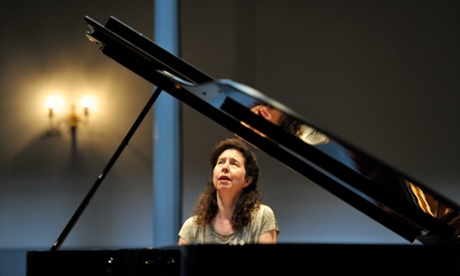
In this St George’s recital, Angela Hewitt chose to balance Liszt’s single massive sonata with two by Beethoven. Over the course of the evening, Hewitt worked the gamut of dynamics, astonishing those who know her primarily as an interpreter of Bach with the ferocity of her power in the Liszt.
It’s the clarity Hewitt brings to any contrapuntal writing – plenty in both composers in these works – that sets her apart. Yet in both the Beethoven sonatas – Op 10 No 1 in E major and Op 31, No1 in G major – against a wealth of clean, fluid playing, the mannered lingering over niceties that could have done with less sentimentality created an odd imbalance. Hewitt’s tendency to strike poses, albeit only momentarily, by way of emphatic punctuation of phrases, was also a distraction.
Much the same could also be said of her delivery of the Liszt sonata, but here the exaggeration was not out of place. The almost primeval darkness of the opening phrase set up a mood of expectation that took on new significance on its return, and ultimately a sense of the work turning full circle as the same phrase finally died to nothing. As in the Beethoven, the sonata’s slow cantilena melodies had a slightly cloying quality, so it was the strength of the volcanic eruptions that made the strongest impact. If Hewitt was suggesting that Liszt is more convincing when approaching the diabolic than in the moments of saccharine religiosity, it was a point forcibly made.