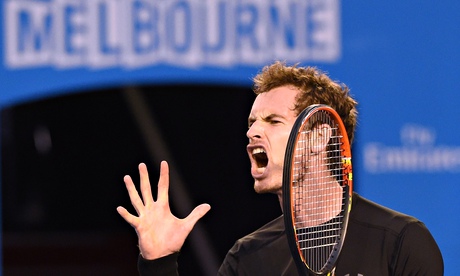
In the end it was a bridge too far for Andy Murray in Melbourne – possibly even a bridge-and-a-half judging by that stroppily decelerating final set of the championship. And, as ever with one of Britain’s most inexplicably under-cherished sporting stars, there will be those who react as though personally let down by Murray’s inability to push the world No1, Novak Djokovic, to the very limits in losing 7–6, 6–7, 6–3, 6–0 in the final of the Australian Open.
Better surely to conclude that Murray had done enough just by walking out once again with a racket in his hand on the final Sunday. If this sounds a little too British, a little too Pimms-on-Henman Hill, then it is sometimes necessary to keep perspective. There is no disgrace in losing to Djokovic. He is, by some distance, the most relentlessly creative, physically irrepressible player around. Sometimes all-time greats just need to be allowed to win like all-time greats.
For Murray, meanwhile, there is a huge personal significance in simply being in the position to notch up a sixth losing major final, and his first in five convalescent grand slam events since the 2013 US Open. The last 18 months have seen an extended process of retrenchment and reconditioning at the end of which the Scot can at least now be sure his post-surgery physique, pared-down coaching staff and minutely evolving game – a combined entity we might call Murray 3.0 – is fit for purpose as he enters the final third of his career.
Hence the extended celebrations after the semi-final win against Tomas Berdych, Murray taking the applause with a look of relief as much as triumph. This time next year Murray will be 28 and creeping up on a decade as British No1, a feat of longevity some might suggest is right up there with being crowned the tallest smurf in the forest but one that conceals within its decade of sustained excellence three separate Murray incarnations.
Murray Mark 1 seems an intriguingly distant figure now, the quirky kid who made his professional debut in 2005, slipping in without a ripple as the World No405 and the same year reaching the third round at Wimbledon. Reporters at his early press conferences recall a vague sense of bafflement at this angular, shy teenager with the skinny legs, a Murray-in-progress that was soon to receive a thorough and transformative overhaul.
By the start of 2008 Murray had already begun to mass his armies, the split with Brad Gilbert leading into the Rat Pack years, with a revolving team of attendants, fluffers and micro-specialists employed to break down his presence on court into separate, perfectible compartments. There was still the odd levelling off, the lurking note of whimsy – those terrible drop shots, the sudden dips in intensity – before Ivan Lendl brought a final veneer of orneriness to go with the muscles and ignite the golden spell that culminated in grand slam victories in New York and London.
And so here we are. Sunday’sfinal in Melbourne provides a note of closure on the doldrum period of this latest Murray Mk3. Quite what he can still achieve from here remains uncertain. But there is at least a sense of progress towards a fresh competitive peak as Murray becomes the last member of the old Big Four to reassemble once again at the top of the world rankings.
There is also a slight but significant sense of evolution, of a slightly different Murray to come. With the backroom boys dispersed he has reached a stage in his career where Amélie Mauresmo’s light-touch approach is perhaps exactly what he needs, leaving that champion tennis brain less cluttered. The stamina and defensive mobility remain but in his best moments in Australia, Murray played a senior statesman’s game, the slice ever thicker, the angles acute, the promptings of his own in-game intelligence given full rein, so much so that against Berdych and Nick Kyrgios his opponent was often left looking like a precocious 10-year-old having an argument with an older brother who is always right.
Perhaps Murray can even hope for a little wider credit outside his immediate fan base.
If Murray’s career tells us anything, it is that the best way to succeed as a British tennis player is to get out of British tennis, just as Murray extricated himself aged 16 to train at the Sánchez-Casal academy in Barcelona (the final straw was learning that his pal Rafael Nadal was training with Carlos Moya while Murray was still knocking around with his mum).
Britain’s greatest modern player has, in effect, been in a state of constant evolution ever since. The question now is whether Murray has what it takes actually to win another grand slam as the big four of his golden years enters its own final phase.
It has always been Murray’s way to leave no aspect of his abilities unexplored, to wring everything from that angular talent. Third time around we can at the very least be sure of more of the same.