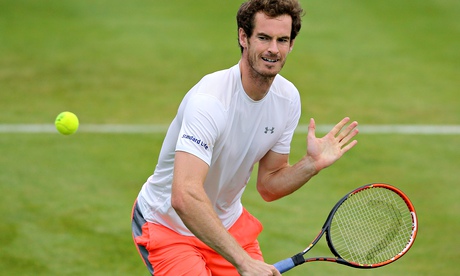
The smell of freshly cut and manicured grass always puts a spring in Andy Murray’s well-muscled step, although he begins his home campaign armed with a game he has brought to near perfection on the clay of Europe.
He is top seed at Queen’s, where he has won the title three times, and starts against a qualifier on Tuesday, along with the other leading players, Rafael Nadal, who returns for the first time since 2011, and the new French Open champion Stan Wawrinka, who probably has finished celebrating by now.
Murray was in upbeat mood on Saturday, confirming that Amélie Mauresmo will be with him at Wimbledon, although she will leave the coaching duties to the Scot’s new assistant, Jonas Bjorkman. It is an arrangement that he seems to have embraced enthusiastically since the Swede came on board after competing in his country’s version of Strictly Come Dancing.
“I don’t know if this year is more my time than others,” he said after the draw and a short practice session. “I go into all parts of the season with the same attitude. Last year was definitely a very difficult year. The first six months were especially hard. Coming off the surgery I found difficult. I maybe didn’t expect it to be that hard, whereas from the beginning of this year I felt ready to win major competitions again.
“It’s been huge, huge progress from where I was at this stage last year. I have played extremely well this year, so I have to be happy about that. Obviously the grass courts suit my game better than the clay. If I can take some of the form from the clay over to the grass and the confidence I’ve built up there, I’m sure I can have some good results.” That is Murray at his understated best, refusing to overload on expectation, the default position of the modern athlete.
No such restrictions impinge Nick Kyrgios’s world view, although he left Roland Garros nursing a chronically sore elbow after losing to Murray in straight sets (his third loss in three matches against him). They could only meet here in the final and the young Australian has the small matter of getting past Wawrinka in the first round.
Nevertheless, Kyrgios declared on Saturday: “To have an opportunity to play Wawrinka after he’s won the French Open at some of the best grass courts in the world, it’s exciting and I’m feeling really confident. But we’ll see how it goes. I’m just going to go out there, play my game, have fun. If I lose, I lose. If I win, I win.”
It helps to be 20 to retain such freedom of ambition in sport, and Kyrgios is gathering recognition as one of the most dangerous of the young free hitters on the Tour. Wawrinka will need to be on his game to beat him.
Murray sees his year opening up nicely after 15 straight wins on clay before losing in five sets to Novak Djokovic in the semi-finals of the French. He revealed on Saturday that he had been ill in Paris, although not debilitatingly so and would have been fit to go had Queen’s been in its old post-French schedule of the week immediately after the final.
“I felt OK the first few days [in Paris]. When I got on court and started running around it was fine. But then when I got back [to London] my left eyelid closed up and I was just ill, had a bad cough for a couple of days after that as well. I don’t know if I was just run down or tired, or whatever. It had obviously been a long few weeks but I feel fine now.”
He is especially glad that Mauresmo can be with him for Wimbledon. Theirs is a partnership that has gelled pleasingly since she joined him here a year ago. “I like having her around the tournaments. It’s been, for me, a very good start to the year. It’s good as well that before she is away for a few months from the team that she and Jonas can spend some time together.
“I would imagine that during Wimbledon Amélie will take the lead and Jonas can see how we operate a bit more as a team. It’s good that she’s going to be there. We know each other a lot better than we did at this time last year. So she’ll be able to help more this year.”
He appreciates the longer gap between the French and Wimbledon, as well, an innovation that coincides with the improved status of Queen’s as an ATP 500 event. “It definitely helps,” he said. “You get the chance to practise and do some movement work and give your body time to get used to playing on a completely different surface. It puts totally different stresses through the body. Different parts of the body get stiff and sore playing on grass compared with playing on the clay.
“I still think [the lead-in time to Wimbledon] should be longer. There should be more grass-court tennis, and there should be a Masters 1000 on the grass – but it’s a good start and it’s definitely healthy for the tour and for all of the players because you so see guys slipping and falling over.
“Sometimes people say: ‘Oh, the grass, it’s too good or too lush,’ and the grass is a bit slippy at the beginning [two years ago at Wimbledon players were falling over with worrying regularity during the first week]. But also, for three months in the buildup, you’re moving in a completely different way, so to expect guys to just be able to change their movement patterns in a matter of days is very hard. At least now there is a little bit more time for players to adjust.”