In the end Andy Murray was predictably untroubled on a scalding Centre Court transformed by the mid-afternoon glare into a suntrap of Death Valley proportions. This was an agreeably low key straight-sets first-round defeat of Mikhail Kukushkin by the No3 seed, on an afternoon when there was if anything an absence of other more familiar kinds of heat.
Murray performed well enough against an opponent who came here to play, offering in glimpses the full range of his deep defence and well-timed attack. Perhaps the most interesting part of a fairly routine 6-4, 7-6, 6-4 victory, however, was the lack of intrusion from the fringes.
The only union flags in evidence throughout were the odd flutter in the seats behind the umpire’s chair, always the last stronghold of the face-painted hardcore, an armpit of ingrained Timwittery. There were precious few gurgles and shrieks and come on Andys. Instead, this was Centre Court in its grownup guise, the mood serene and quietly appreciative, perhaps even significantly so in the cycle of Wimbledon’s modern history.
The match also brought with it the 20-year anniversary of a rather overlooked event back at the start of what we might call The Henman Revolution. The summer of 1995 was probably the last of the pre-modern Wimbledons, two years into the tournament’s fevered commercial revolution and 12 months before the first of those flushed and oddly revelatory Tim Henman quarter-finals.
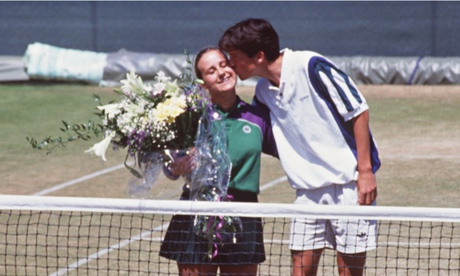
Twenty years ago a distinctly pre-celebrity Henman had just been ejected from the tournament for whacking a ball into a ballgirl’s head while playing doubles with Jeremy Bates, a bizarre end to an event that had also brought him a first major tournament win.
It was, in many ways, the last breath of something and a moment from which the ongoing, expertly monetised Henman-Murray two-hander would spring into being. Henman was terribly chastened by the incident.
A year later, though, he returned and some stirring performances were greeted with a bizarrely overwrought and unbuttoned display of slightly squiffy mid-afternoon hysteria.
Fast forward 20 years and Wimbledon has ridden that wave with expert commercial opportunism. The Henman Years resulted in a rapacious growth in revenues, driven by capacity expansion and the decision in 1993 to create a separate arm devoted entirely to exploiting the commercial possibilities of the Wimbledon brand. In 1994 Wimbledon’s commercial surplus had leapt from £16m to £27m as the tournament was geared up as a jewel of the new sporting economy.
Wimbledon was lucky, too. It needed a star. In Henman, and then Murray, it lucked out, gifted a pair of ready-made standard-bearers; muster points for the two-week beano around which British tennis’s considerable wealth is now based.
The issue of Wimbledon’s initially rather awkward embrace of the best British player since Fred Perry has already been done to death, a slight chilliness that has in reality nothing to do with Scotland per se and much to do with that certain Surrey-inflected Englishness that tends to set the emotional barometer on the show courts of SW19.
Not that it matters. Murray’s interest is in winning titles. Those who care about the sport see only his supreme intelligence, his angles, his returns, his champion nerve. In his maturity he is simply a thrillingly good tennis player and a brilliant role model for reasons unrelated to anything but sport. There is currently no finer British sports person, a rare combination of hard work and intelligence that has no edge, no sense of anything left behind, no outer fringe of his talent unexplored.
Here Murray looked utterly relaxed, a British No1 playing without the weight of anything other than a champion’s natural expectations and freed now from the attentions of the hand-stitched tea towel brigade, the Princess Diana memorial porcelain plate collectors, the swivel-eyed fuzzy ball ultras.
The greatest roar of the opening 45 minutes was for the superb running backhand pass that took Murray to 15-0 on his own serve at one set and two games up. The first set had been sealed with an extended rally that featured five or six different types of forehand alone, from block to chip to whipped, drawing not so much an error from Kukushkin as a tangling of the brain, the sense of man finally giving up and tossing the cryptic crossword into the fire.
There was a slight wobble in the second set as Kukushkin broke serve. Murray remains, however, the great passive aggressive powerhouse of the men’s game, a player whose defence is a powerful attacking weapon at such moments. He responded with a sustained back-court drive, forcing Kukushkin to hit wildly in search of winners. Before long Murray was two sets up and there was a pleasant sense of sleepiness around Centre Court as the sun dipped and afternoon began to congeal into early evening.
Murray will need to improve for the later rounds but he will be encouraged by his best moments here. Wimbledon, meanwhile, has the chance simply to enjoy him this time around: not so much a great British champion as just a wonderfully engaging tennis player, and a gift to this venerable old domestic powerhouse of a tournament