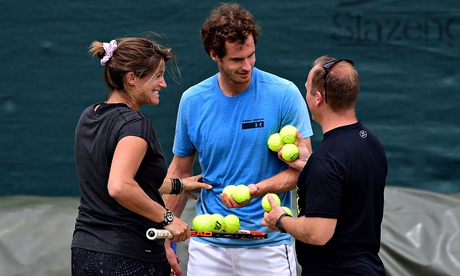
When asked how her husband Mikhail might beat Andy Murray on Centre Court on Tuesday, Anastasia Kukushkina giggles and turns to the man from whom she has taken her married name (with the “a” the customary appendage in Russian), and says: “I don’t know. I think he must relax and try to do something good.”
Indeed he must, probably over five sets, and their respective and mutual histories do not suggest that is likely. They are worlds apart in achievement, money and prospects, with Murray, the world No3, many people’s favourite to win his second Wimbledon title, and Kukushkin, ranked at 59, probably grateful to be picking up £29,000 as his first-round cheque.
Murray has won their only two encounters fairly easily. However, where Kukushkin and Murray have common ground is more obvious: both are coached by women, as is Denis Istomin (uniquely tutored by his mother, Klaudiya), who is on their side of the draw. It is a trio unique in the ATP top 100, rarely in the whole of the game.
Anastasia played until she was 16 and was a coach at the famous Moscow club, Spartak. “She was working there for a couple of years,” Kukushkin says. “When we met and she started to help me, then she start to go full-time with me. She had to quit [the club] because there was not time enough for that.”
While Murray has been hailed as a pioneer for hiring Amélie Mauresmo a year ago to succeed Ivan Lendl and lauded as a feminist for his stalwart defence of her, as well as the protective sentiments he has expressed as she approaches the delivery of her first child in August, the Kazakh of Russian origin has been allowed to tour with his wife without much fuss.
His ranking probably explains why – although he is a clever player with a fine tennis brain. And he does not lack for ambition.
“To get a draw with Andy Murray at his home, one of his favourite tournaments, it’s tough for sure,” he says. “But it’s one of the challenges that I met a lot in my career. I played twice here in the Centre Court against Roger [Federer] and Rafa [Nadal]. I won one set last year against Rafa – I play good in the first set and after that … not really.”
Murray beat him in Brisbane then Melbourne two years ago but Kukushkin says: “It is different to the Australian Open. It was fourth round, I played already a couple of matches before so it felt inside the tournament. Now it’s the first round, just preparing, waiting for your match. It’s a bit different but I’m not that nervous.”
For Anastasia, it has not always been an anxiety-free experience, watching her husband play, week in week out, often on outside courts away from the glamour and noise of the Tour.
“But I’m not so nervous, like three or four years ago,” she says. “Now I’m just relaxing and try to give him some more …power?” She laughs again.
“Confidence,” he smiles.
Kukushkin is not surprised there are few women coaching men on the Tour. “All of us [Murray, Istomin and himself], we are happy with it but I believe most other tennis players, they don’t support it. A lot of people around tennis, they think that it’s not good.”
“Not professional,” offers Anastasia. They have what she calls, “sceptic vision”. She adds: “In my opinion it doesn’t matter with whom you are coaching. If you have a result, it doesn’t matter if it is a female or a male.”
There is a level of irritation emerging, although Mr and Mrs K are impeccably polite. Still, Anastasia does not like the fact she is not allowed near the locker room – as well as other manifestations of exclusion. “I don’t have access,” she says. “Maybe I can go in but not everywhere.”
Kukushkin reveals his wife has even had trouble getting accreditation as a coach, as tournament organisers regard her as just his girlfriend. “There are always problems.”
He explains also why he switched his allegiance from Russia to Kazakhstan in 2008. “As I remember, I was about 150 in the rankings and everyone, all the coaches, thought I could be a top-100 player but there were a lot of good Russian players [ahead of him] back then.
“I knew I had to do something to break through. The Kazakhstan federation came to me with good support, the kind of support which I believe is important to every player. I think it was a good decision to move to Kazakhstan and I have lived there seven years. I have had good results in the Davis Cup as well as my own good results on the tour. I believe it has helped me a lot – to become a better player.”
Kukushkin regards himself – as do many players – as an “internationalist”. “I feel more international,” he says, “because for 51 out of the 52 weeks of the year I travel and stay in hotels. When I have a week out of a tournament [when losing early], now I just go to practise somewhere. If I have time during the off season, I go on holiday, so I am never at home. I don’t feel like I belong to one country.”