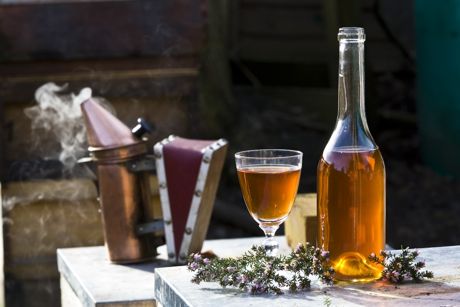
Heather likes to grow on acidic soils, often in moorland and on marshy ground where it can dominate. It is best picked when in flower when it is at its most flavoursome. Although heather generally flowers in autumn, in isolated, sheltered areas you can sometimes find flowers clinging on throughout the winter.
Earthy peaty flavours reminiscent of the best whiskies are evident in this mead. The recipe below is from Alex Hughes, a member of the Bristol Brewing Circle and can be adapted for other edible flowers such as lavender or gorse.
Heather mead
1.5kg runny delicately flavoured honey
Half a cup dried heather flowers
1.5 litres of boiling water
Sweet mead yeast
1 tsp yeast nutrient
Put the jars of honey into a bowl of hot water so that they are easier to pour. Put honey into fermentation bin, pour boiling water over the top and stir.
Place the heather into the bottom of a demijohn and pour over the honey mixture. If needs be, top up with cold water to one gallon. Add yeast and yeast nutrient, attach solid rubber bung and shake demijohn. Remove bung and attach airlock.
After two months, remove heather and siphon the liquid off the sediment into another demijohn – a process known as racking. Repeat the process again after about six months. Allow to fully ferment before bottling.
Mead will vastly improve if left to condition in the bottle for at least a year.