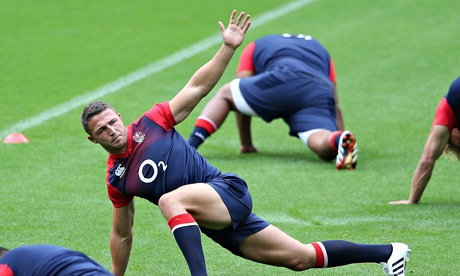
Sam Burgess is not “just a battering ram” and has all the necessary qualities to be an international union centre, according to the man who trod a similar path almost a decade ago. England’s backs coach, Andy Farrell, believes Burgess will confound his doubters and pose France assorted problems when he makes his 15-a-side Test debut on Saturday.
Several former Test centres, most notably the 2003 World Cup winner Mike Tindall, have cast doubt on Burgess’s ability to thrive in midfield at the highest level but Farrell, who featured for England at the 2007 World Cup after enjoying a distinguished league career, is backing the Bath player to make a positive impact.
“He’s obviously a big strong lad who can do some damage but there’s more subtlety in his game than just being a battering ram,” said Farrell, dismissing suggestions that the former South Sydney Rabbitoh has been promoted too hastily. “He runs his lines, he’s got good late footwork and he’s got some skill to back that up, like you would expect from an international centre. All the players in our squad are able to play the game in most ways.”
“I played all sorts of positions in league and union and you can only be what you can be. It is up to the coaches to see how that best fits. Sam can’t change himself, all he can do is be himself. From what we have seen he is very comfortable in our system, whether at 12 or 13.”
Farrell’s support, however, cannot mask that Stuart Lancaster has taken a leap of faith by handing Burgess what will be the most scrutinised international debut in recent memory. From outside the England camp, another former cross-code convert, Joel Tomkins, has a different perspective. Like Farrell, he swapped Wigan Warriors for Saracens, and then England, winning three caps in the 2013 autumn campaign that yielded uninspiring victories over Australia and Argentina before defeat by New Zealand. Unlike Farrell, Tomkins did not stay in union, returning to Wigan last summer.
Deployed at outside centre, Tomkins had 18 months – twice as long as Burgess – to learn union before his Twickenham debut, but it was not enough. “I felt ready at the time but when I look back now I think ‘no’,” the former Saracen said. “It was a big achievement, I probably didn’t realise at the time what a big thing it was to be playing at Twickenham in three internationals.
“It’s a very proud moment but I was probably more nervous for those three games than I ever was in rugby league. To be honest in my whole time in rugby union I never felt 100% comfortable. When I play rugby league 50% of the game I don’t consciously think about what I’m doing.
“I found at first in rugby union I was thinking for the whole game and I was exhausted afterwards because you constantly question yourself, ‘am I doing the right thing? What should I be doing positionally?’. It’s the transition of trying to make an impact on the game, that’s the most difficult thing. In rugby union you can’t just go looking for the ball, you have to stay within the system and take your chances when they come along.”
A cautionary tale then for Burgess. Even though the most assured of Burgess’s 17 Bath appearance have come at flanker rather than the inside centre berth he will occupy against France, the 26-year-old Tomkins does believe he deserves a midfield role. However, while Farrell was keen to downplay the importance of Burgess’s strength, Tomkins believes that would be a significant asset in the context of England’s World Cup ambitions.
“If the World Cup were in 12 months’ time I’d be very confident he’d be involved. I think his presence would be needed. Whether he’ll make this one, I don’t know. Long-term he will be a very good back-rower but Sam would make the biggest impact in this side in midfield. Off set piece he can carry the ball like Manu Tuilagi can do. They’ve lost that strike power but he can fill that void.
“In rugby union, especially I found at 13, you’re in that outside channel and if the ball does come for one reason or another there isn’t really much you can do. If you go and look for the ball you’ll be out of position and you can be at fault. Twelve is more of a comfortable position, it’s a bit more of a rugby league position where you got a bit more of a roaming role. You can go and get involved a little bit more. “
That Burgess remains in contention to be one of England’s four centres is testament to the qualities Lancaster sees in him. Tomkins said: “He’s a very good talker, he’s an extremely confident bloke and going into a World Cup those are the kind of characters you want around.”
Midfield remains Lancaster’s biggest headache. Burgess and Henry Slade make debuts on Saturday – the last time England fielded two uncapped centres was Lancaster’s first game in charge – Luther Burrell had a poor Six Nations and while Brad Barritt and Jonathan Joseph are the expected pairing for the World Cup opener against Fiji, they have never started together.
Moreover, Joseph’s emergence during the Six Nations as the focal point of the attack was more by circumstance than design – Farrell places huge emphasis on defence and Burgess is unlikely to be there to bring the kind of abandon that lit up the Six Nations finale against France.
“The way Andy Farrell is trying to influence the England set-up is a lot like what we were doing at Saracens,” said Tomkins, coached by Farrell in his first year at the club. “It’s a very good game plan and in the big games that game plan works. It suited me. We kicked out of our own half and we only ever really played rugby when we in the other half of the pitch. Sam’s contacts are massive so if that’s the way they are going to play, there’s nobody better. If you want that heavyweight in the middle you’re looking at Burgess.”
The danger is that if Burgess is exposed by France as many fear he might be then he may begin a similar path to Tomkins, heading back to league earlier than expected. On the other hand, four years ago a 20-year-old Tuilagi made a try-scoring debut in a warm-up match against Wales when plenty felt he was not ready.
Should that prove the case, Burgess’s shortage of international union experience will not be a handicap when it comes to selecting England’s final World Cup squad of 31. “We will back our instincts over what we have seen over the last seven or eight weeks and what we see on the field in a pressure game environment,” said Farrell. “We would be stupid to send someone home just because he has only got one or two caps if he is the right man for the job.”