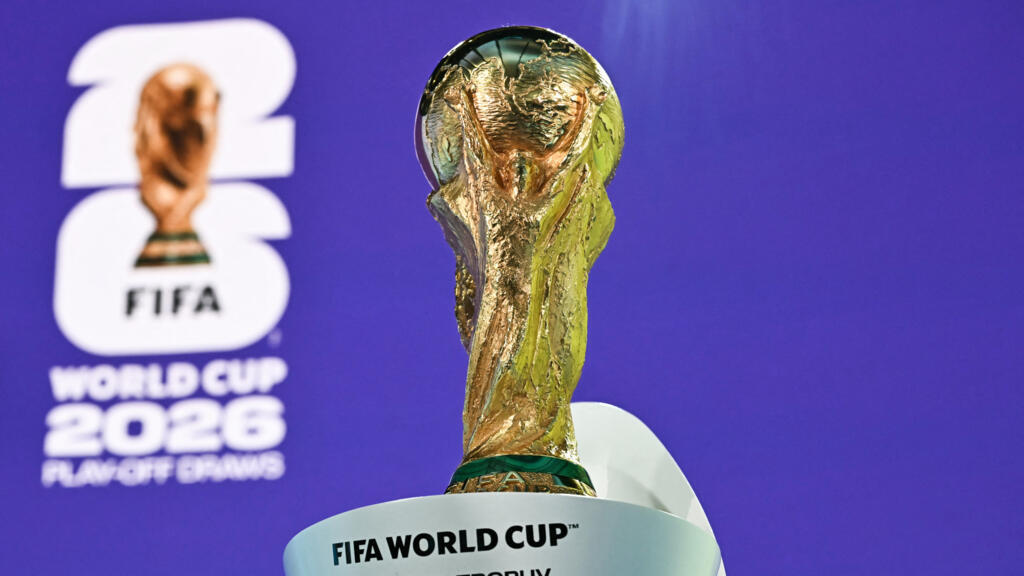
The first World Cup to boast 48 teams will explode into action on 11 June at the Estadio Azteca in Mexico City with a match between Mexico and South Africa. Over the following 39 days, 104 games will take place in 15 other cities in the United States, Mexico and Canada.
The football fest is expected to attract more than one million visitors to the countries while billions across the globe watch on an array of screens ranging from mobile phone and laptop to TV and giant inflatable.
It will be a far cry from the inaugural event in July 1930 in Uruguay where three stadiums in Montevideo provided the venues for 13 teams and 18 games over 17 days.
Whoever wins the 2026 World Cup trophy at the MetLife Stadium in New Jersey on 19 July will have battled through eight matches following the addition of a last-32 knockout round to cope with the new enlarged format.
In 1930, Uruguay played four times – twice in the pool stages as well as a semi and the final – on their way to claiming a tournament dreamed up by the Frenchman Jules Rimet less than a decade into his 33-year reign as boss of world football's governing body, the Fédération Internationale de Football Association (Fifa)
DRC and Iraq book 2026 World Cup spots after inter-confederation play-off wins
Though Fifa's World Cup is now an eagerly anticipated contest, Rimet's brainchild nearly failed to take off.
Following the vote at the 1928 Fifa congress to launch the tournament, all 41 of the affiliated national associations were invited to participate and given a deadline of 28 February 1930 to accept.
Uruguay, as back-to-back winners of the 1924 and 1928 Summer Olympic tournaments, were chosen at the 1929 Fifa congress in Barcelona as hosts.
Argentina, Brazil, Bolivia, Chile, Paraguay, Peru, Mexico and the United States snapped up the chance to join the show.
But there was little interest from European football associations.
France boss Deschamps tells World Cup hopefuls to stay humble after wins in US
With two months to go before the kick-off and no Europeans up for the cup, Rimet's world football extravaganza looked distinctly parochial.
Rimet pulled a few strings to persuade teams from France, Romania and Yugoslavia to make the voyage across the Atlantic Ocean while Rodolphe Seeldrayers, his German-Belgian deputy at Fifa, convinced the Belgians to compete.
Egypt would have made up numbers to 14 but the ship taking the players and coaches was held up by a storm in the Mediterranean and the connecting mail ship – The Florida – steamed away without them from Marseille.
Egypt were on board for the 1934 tournament in Italy which featured 16 teams in a straight knockout competition.
And with the same format, 16 teams should have appeared at the 1938 World Cup in June in France but Germany's annexation of Austria reduced the field to 15.
Sweden, who were drawn to play Austria, were given a bye into the quarter-finals where they thrashed debutants Cuba 8-0 before going down to Hungary in the semi-final.
Iranian football bosses 'in talks' over moving World Cup games from US to Mexico
In 1950 in Brazil, the first tournament after World War II, the World Cup was still a 16-team event but the sides were now playing for the Jules Rimet trophy.
Rimet, 77, handed the cup bearing his name to the Uruguay skipper Obdulio Varela after his side had beaten Brazil 2-1 in the final game of the second round robin stage to claim the competition.

Expansion to 24 teams
When the tournament expanded to 24 teams in 1982 in Spain, the rebrand offered six groups of four teams with the top two from each pool advancing to a second stage of four groups with three teams.
The winners from each of those second round pools contested the semi-finals.
Italy came through the format to lift its third title following a 3-1 victory over West Germany at the Santiago Bernabeu in Madrid.
There were also 24 teams at the 1986 competition in Mexico. But this time they were divided into six groups of four with the top two teams and the four best third-placed sides moving into the last-16 knockout stage.
The pattern remained until the 1998 World Cup in France which brought 32 nations to the party for the first time.
Eight groups of four teams were assembled with the top two advancing to the last-16 knockout round. France, skippered by Didier Deschamps, claimed the spoils for the first time.

Zinedine Zidane, who is tipped to succeed Deschamps as France boss after the 2026 tournament, scored twice in the 3-0 victory over Brazil.
Deschamps orchestrated France's surge to the 2018 title to become only the third man after Brazil's Mario Zagallo and Germany's Franz Beckenbauer to flaunt the World Cup as a player and a coach.
"Professionally, there’s nothing above winning the World Cup,” said Deschamps after his side outwitted Croatia 4-2 in the 2018 final at the Luzhniki Stadium in Moscow.
“I don’t want to undermine other titles, but when you are a professional footballer there’s nothing above the World Cup."
It's a view that would chime with a certain other Frenchman.