In one of those cost-saving measures that is immediately denounced by people who want the BBC somehow to shrink without its output suffering, the corporation has announced that it is to put its weather-forecasting contract out to tender after 93 years of Met Office bulletins.
The MO was surprised and “disappointed” by the news: it can and does claim to be the world’s best forecaster, so BBC viewers can expect a drop in service. But some have asked: why worry? Isn’t weather one of the many blasts of info we can efficiently pick up online now? We can, but surely most would rather not. Weather is uniquely suited to broadcasting.
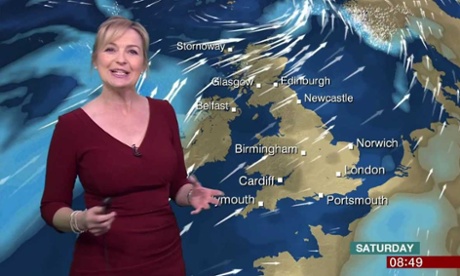
Weather is a perennial topic of light conversation. It is almost never a matter of life or death, so it is a soothing end to another bad-news update. “And now the weather,” the newsreader says, audibly relieved. We like it delivered by a cheery human such as BBC Breakfast’s Carol Kirkwood. What’s the weather like, Carol? Tsk, really? Thanks, Carol.
We also benefit in several ways from hearing the forecast from someone with more expertise than us. My phone informs me that it is going to pour solidly until Friday. But why? Interpreting the movements of air on a detailed online weather map is hard. Far better to have a scientist with a yen for mass communication to boil it down, their chatty explanation of bombogenesis or a Spanish plume masking a deep well of learning.
That forecasters are generally scientists having a go at presenting, not vice versa, means weather is a wild card: a live address to camera that is only half-scripted and leaves room for the messenger’s personality to run riot. There is always the chance that they will drop the button that brings up the next map, or be caught giving the news presenter the finger.
Tomasz Schafernaker, the man responsible for the finger incident in 2010, has become a cult hero, as has Kirkwood. The king of weather presenting as twisted TV gold is, however, ex-BBC man Dan Corbett, now plying his trade in New Zealand. His Stanley Unwin delivery won him huge affection from British viewers. “Nice day for the afternoon,” a typical Corbett bulletin would say, “maybe a picnic or so perhaps in Northern Ireland, into Scotland and 26 for Cardiff.” Only a tiny minority of point-missing viewers used to complain that Corbett left them confused about what the weather would be like.
We know forecasting is ultimately a mug’s game: the rain doesn’t care whether or not that nice lady promised it wouldn’t arrive. Keeping up the national delusion that we are forewarned requires our best experts to stay on TV – even if they didn’t see the current storm coming.