Alex Chinneck is not a man who makes life easy for himself. In fact, at any crossroads, the British sculptor admits he will always choose the path of most resistance, risk and challenge.
This way of working may have deprived him of sleep for the past five years, but it has led to works that push the boundaries of possibility more than most artists ever have. A master of illusion, Chinneck’s buildings have seemingly floated in mid-air, melted into the ground or been turned entirely upside down – all in the name of making “the everyday become extraordinary”. He even once identically smashed 312 windows of a dilapidated factory. But the 30-year-old insists his latest work trumps them all.
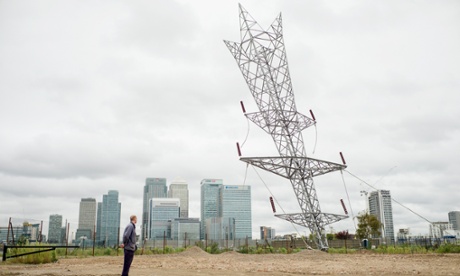
The sculpture, which stands in the industrial wasteland between the Millennium Dome and Canary Wharf in London, is a 35m electricity pylon. But unlike normal pylons, it is upside down, balancing on its point and leaning perilously over the road as if it had dropped from the sky.
“It was an extraordinarily complex industrial process – welding, drilling, bolting, more welding, sawing – but then all my work is,” says Chinneck. “The end result is quite whimsical and playful. There’s typically an illusion at play in my work, but the path to that result is one of brute industry.”
Indeed, while the pylon may look weightless, balancing on nothing but a tiny tip of metal, the amount of engineering that has gone into the spectacle took almost a year of work. To keep the pylon upright, 100 tonnes of concrete have been poured into a 20ft deep hole. Chinneck and his team also had to make an entirely new and advanced design for a pylon, made from 400m of steel and weighing 15 tonnes.
Wandering on to the ground where the sculpture will be erected (which currently resembles a muddy building site), Chinneck shakes his head.
“This is the chaos of my life – I come to the site every morning and just crap myself, basically,” he says, gesturing towards the bulldozers and men in hi-vis jackets. He laughs. “I’m overwhelmed by it all.”
After being given an open-ended commission for this year’s London Design Festival, the idea for the pylon came from Chinneck spending days wandering round the site and absorbing a landscape defined by metalwork and lattice, from the cranes to the gasworks nearby. Chinneck wanted to create an artwork that would be a “beacon”.
“I like the idea of making everyday situations, or objects, as exciting as possible,” he says. “In that sense, I take a complex path to show a simple moment. Even when I try to design simple things, it’s never easy – for some reason I always, always, always take the hardest path. I’m addicted to challenge, and I’m addicted to progress, but it is exhausting at times.”
As the son of PE and IT teachers, who went on to train as a painter at Goldsmiths, Chinneck admits his route to sculpture has been an unlikely one. It was inspired by his art teacher, whose two great loves were “God and printmaking”, and who took an interest in Chinneck’s teenage paintings. Yet pushing the possibilities of the physical world is something that has always interested him.
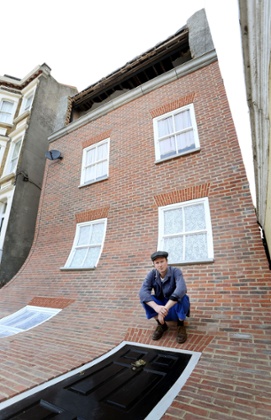
“I remember being at school at a bonfire and seeing wine bottles in the fire, where the glass had melted and warped, and I was obsessed with them in my paintings,” he says. “Ever since then, I’ve loved this idea of fluidity in an inflexible form – like my sliding house or the curling road. I try and defy logic by making things do what they shouldn’t – by making stone seem weightless, bricks melt or tarmac bend.”
Does he see himself an artist, an architect or an engineer? “Engineering solves my problems, art creates them,” he says, then adds: “Look, each work has to feel different from the last. I don’t want to build up too much of a visual identity, because I think it builds a cage around my practice.”
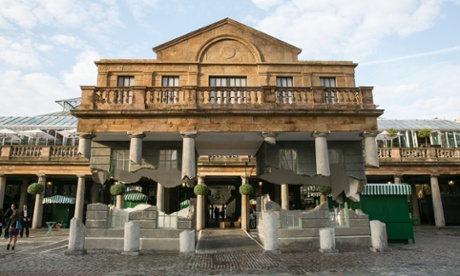
The fact that all of Chinneck’s works are temporary, from melting houses in Hackney to the floating building in Covent Garden and now the pylon, is fundamental to his practice; despite the year of planning and expertise that has gone into the work, it will only be up for a few months. Chinneck believes the restrictions around works intended to be permanent are what ruins public art.
“Most of the permanent sculptures around cities and towns are crap,” he says bluntly. “They are made of the same materials, they look the same, and the moment someone tries to do something risky or brave where they step away from the plinth or create a form that isn’t just a statue, it ages conceptually, and 10 years down the line it just looks knackered. Impermanent art avoids that danger.”
He says there is a great catharsis in removing all traces of his works from the landscape, so “they only exist in memory”.
“It’s liberating,” he adds. “I put it to bed and move on.”
Having based all of his past projects in the UK, Chinneck says he is ready to branch out. The landscape of America has a particular pull, and he dreams of making 20 works in 20 days across the US. Yet, even as his ambition grows, he is fearful about becoming dismissed as nothing more than a populist stunt artist.
“I’ve walked a very dangerous line in the last few years: my work is very theatrical, it’s very simple, it’s very playful, and those ingredients have somehow made it popular,” he says. “But the art world is quite suspicious of all of those things – so I want to find a way where you can have both. Something with great impact and accessibility that isn’t also void of intelligence.”
Chinneck smiles. “In that respect, I feel like I’m maturing as an artist and calming down as a showman.”
- A bullet from a shooting star launches 19 September in Greenwich Peninsula as part of London Design Festival