Earth’s journey through space may sound impossible to trace, but scientists now believe tiny particles trapped deep inside Antarctic ice are helping piece together that cosmic story. Researchers studying ancient ice cores have discovered traces of rare stardust that likely came from exploding stars millions of miles away. The findings are offering scientists a surprising look at how the Solar System has moved through the Milky Way over tens of thousands of years.
The research, led by nuclear astrophysicist Dominik Koll of Germany’s Helmholtz-Zentrum Dresden-Rossendorf, focused on unusual iron particles preserved inside Antarctica’s frozen layers.
The discovery centers around iron-60, also known as iron-60, a rare isotope that forms only under extreme cosmic conditions such as supernova explosions. Scientists say that makes it especially valuable when studying Earth’s relationship with the wider universe, as per a report by Science Alert.
Why Is Iron-60 So Important?
According to the researchers, iron-60 cannot naturally form on Earth in meaningful quantities. While some of it may have existed when Earth formed billions of years ago, its relatively short half-life means those original traces would have disappeared long ago.
That is why scientists believe any iron-60 found today must have arrived from outer space. The Antarctic ice sheet became the perfect place to search for it. Snow has been falling and freezing there layer by layer for around 35 million years, trapping tiny particles from the atmosphere in the process. Over time, the snow compressed into ice, creating what scientists describe as a frozen timeline of Earth’s atmospheric history.
What Did Scientists Discover In Antarctic Ice?
Back in 2019, Dominik Koll and his team detected small traces of iron-60 in fresh Antarctic snowfall. Wanting to know whether the material stretched further back in time, the researchers began examining much older ice cores collected through the European Project for Ice Coring in Antarctica, also known as EPICA.
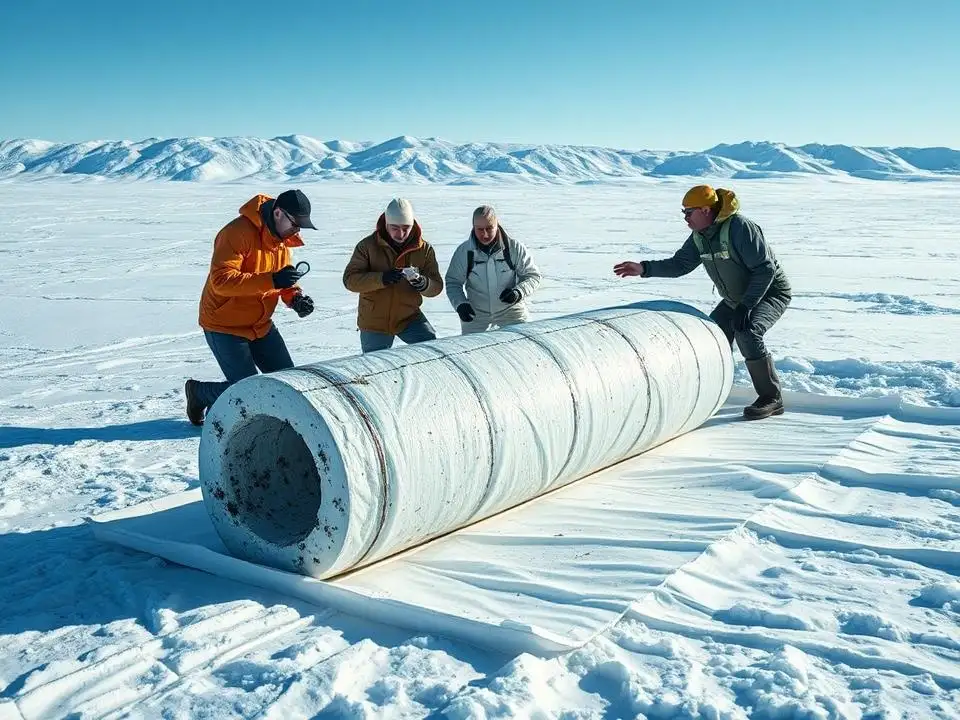
To carry out the study, the team processed nearly 295 kilograms of Antarctic ice. They melted the samples, isolated the remaining material, and searched for iron-60 atoms, as per a report by Science Alert.
The results showed iron-60 trapped in ice dating between 40,000 and 81,000 years ago. Researchers also found concentrations higher than what could be explained by cosmic rays alone, strongly suggesting the material came from interstellar space.
The findings point toward the Solar System moving through a region known as the Local Interstellar Cloud — an area filled with gas, dust, and plasma believed to have been shaped by ancient supernova explosions, as per a report by Science Alert.
Could Earth Still Be Moving Through Stardust Today?
One of the most striking parts of the study was the difference between older ice and modern snowfall. Scientists discovered that recent Antarctic snow contains noticeably higher concentrations of iron-60 than ancient ice layers.
Researchers believe that could mean Earth is currently passing through a denser section of the Local Interstellar Cloud.
The study suggests the Solar System may have spent at least 80,000 years traveling through this cloud, first crossing thinner regions before entering denser pockets filled with supernova dust. According to the researchers, the frozen particles preserved in Antarctica may effectively act as a flight record of Earth’s movement through space. By studying changes in iron-60 concentrations over time, scientists can potentially map the structure of the interstellar cloud itself.
The team described the discovery as evidence that the local cosmic environment around Earth has changed over thousands of years. “These results suggest that the Local Interstellar Cloud is a cosmic archive for supernova-produced iron-60,” the researchers wrote.
“The imprinted iron-60 time profile is evidence for a changing local interstellar environment over the last 80,000 years.”
The findings were published in Physical Review Letters and are already drawing attention because they connect tiny particles trapped in Antarctic ice to massive stellar explosions that happened far beyond our Solar System.
For scientists, the study offers a rare opportunity to understand not just Earth’s climate history, but also the path our planet has traveled through the galaxy itself.
FAQs
What did scientists find in Antarctic ice?
Researchers discovered traces of iron-60, a rare isotope linked to supernova explosions.
Why is iron-60 important?
Scientists say Earth cannot naturally produce meaningful amounts of it, meaning it likely arrived from space.