Research is underway that uses the power of science to "see through" valuable ruins without damaging them.
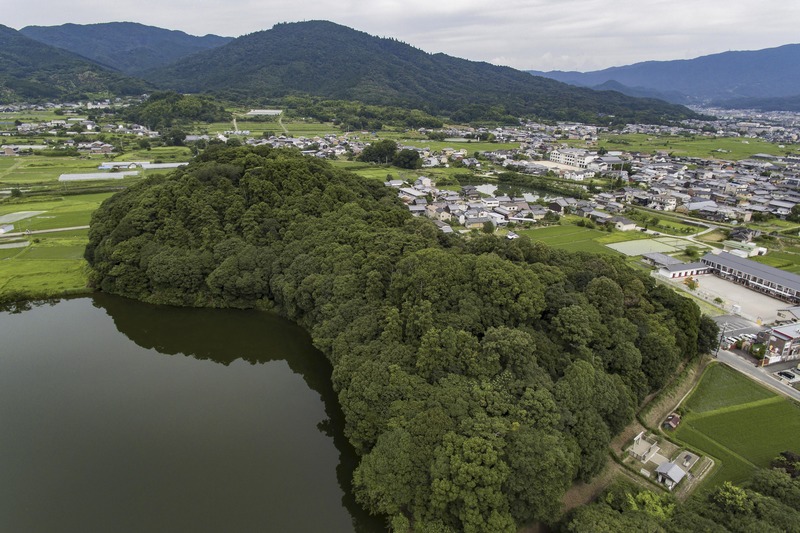
About 10 minutes by car from the center of Sakurai, Nara Prefecture, a giant burial mound comes into view. This is the Hashihaka kofun, or ancient burial mound, constructed from around the middle to the end of the third century and measuring 280 meters long.
Access to this ancient mound is severely restricted. Walking around it, the words "Now measuring" and cube-shaped equipment covered by a silver sheet are seen.
A team of researchers from the Nara prefectural Archaeological Institute of Kashihara and Nagoya University have been investigating the interior of the Hashihaka kofun since the end of 2018. The equipment measures invisible particles known as muon, of which one to three fall from space every second onto an area about the size of the palm of a person's hand.
Muon pass through the human body, but about half of them stop at about 10 meters of dirt and their number is reduced.
The particles that pass through the burial mound are captured on "nuclear emulsion plates" measuring 13 to 23 centimeters high by 30 centimeters wide and which act like film. Based on such factors as the number of particles and the track they took, the researchers examine such things as cavities inside the burial mound. The technology essentially takes an X-ray using natural particles.
The Hashihaka kofun has been said to be the imperial tomb of a daughter of the seventh emperor of Japan, Emperor Korei. However, based on such factors as the period of the burial mound's construction and its size, there is also a theory that it is the resting place of Himiko, the queen of an ancient country called Yamatai-koku in what is now Japan.
The research delves into a mystery of ancient Japanese history, and "this is a valuable method that lets us examine the interior without digging," said Kiyohide Saito, 66, former deputy head of the Archaeological Institute of Kashihara. "I hope we can shed some light, even just a little, on the actual state of the Hashihaka kofun."
Muons have been used in surveys of volcanos, nuclear reactors and Egyptian pyramids. At the about 30-meter-long Kasuga tomb in Ikarugacho, Nara Prefecture, which has not been excavated, they revealed the presence of a cavity believed to be a stone room about 6 meters long.
"If we increase the number of points where we take measurements, we might learn the three-dimensional structure of the interior," said team member Katsumi Ishiguro, 33, a researcher at Nagoya University.
Hiroyuki Kamei, a specially appointed professor at the museum of the Tokyo Institute of Technology, 66, uses radar in his investigation of historical artifacts. Kamei sends radar waves with frequencies of 200 to 500 megahertz toward the ground and moves around capturing reflected waves with an antenna.
When there are buildings and other kinds of remains underground, they reflect the waves differently than their surroundings, making it possible to infer their existence.
A survey was conducted in 2017-18 of the Subashiri area in Oyama, Shizuoka Prefecture, which was buried by ash in the massive Hoei eruption of Mt. Fuji that occurred in 1707, during the Edo period (1603-1867). Amid the volcanic ash, shapes like kamaboko fish cakes were discovered.
Based on the reflection data, Kamei surmised that fires occurred as a result of the eruption, and the shapes were the remains of wood from collapsed houses that had been carbonized.
Local records backed up this theory, stating that many houses near temple gates had been destroyed by fire.
According to Kamei, there is not enough fusion in Japan between scientific researchers and archaeologists, and the research methods are not systemized.
"In Europe, 'archaeological science' can be learned from one's student days. In Japan, it's hard to foster human resources who possess knowledge in both areas," Kamei said.
Read more from The Japan News at https://japannews.yomiuri.co.jp/