An Ancient Egyptian tomb has been resurrected using a 3D printer - 2,000 miles away in Switzerland.
A team of archaeologists and artists is working to create a perfect copy of the tomb of Pharaoh Seti I, one of the largest and most elaborate in Egypt's Valley of the Kings.
The eventual aim of the five-year project is to install the facsimile on a site close to the original, near Luxor.
For now, the two first two chambers have been reproduced and gone on display at a museum in Basel.
The Scanning Seti exhibition at the Swiss city's Antikenmuseum contains an exact copy of the pharoah's 3,300-year-old royal sarcophagus, in rooms adorned with intricate etchings and paintings.
It was created by Factum Foundation, a specialist art company which has previously worked on a facsimile of facsimile of Tutankhamen's tomb.
Founder Adam Lowe told CNN Seti's tomb was "the most important library of Pharaonic religion, philosophy, art, poetry and science" in existence.
His team used state-of-the-art 3D scanning and printing technology, as well as photogrammetry - the science of taking measurements from photographs - to resurrect the chambers.
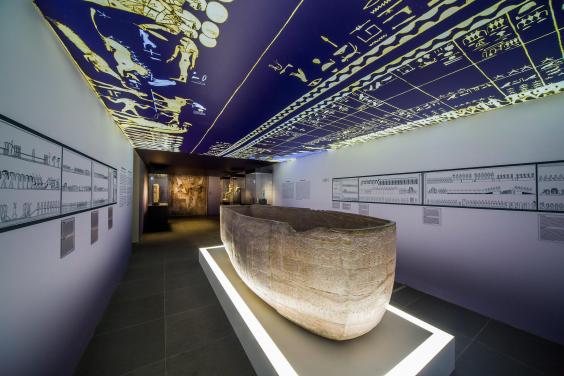
They conducted a 3D survey of the walls of the original tomb and worked from fragments removed from Seti's burial chamber in the 19th century, now displayed in museums including the Louvre in Paris, the British Museum in London, and the Pergamon Museum in Berlin.
They also studied watercolours created by Giovanni Belzoni, a former circus strongman who discovered the tomb in 1817 more than 3,000 years after Seti's death.
Belzoni found the tomb in immaculate condition, but years of improperly conducted excavations, looting, and tourism have since taken their toll.
Mr Lowe said facsimiles had an important role to play in the future of tourism and conversation.