I was recently on short notice to attend a concert at the Banyan Tree Hotel -- Ecco La Primavera: Love Songs Of The Renaissance by Siam Sinfonietta. The programme looked strange -- I didn't recognise any of the pieces.
Composers like Landini, Weelkes and Gesualdo were all new to me -- the only name I recognised was the infamous Mr "Anonymous". I decided to go anyway, thinking I might hear something fresh and new.
Upon arrival, I met the Sinfonietta's ubermeister National Artist Somtow Sucharitkul. His first words were that the songs selected were 500-700 years old, dating back to the Renaissance. This is the era of "rebirth" we studied in Civilisation classes -- a general education course my generation took as freshmen.
Somtow mentioned that these songs might sound "strange" to the ear; most Thai people have almost never heard them.
We discussed how regrettable it is that traditional Thai music was never historically recorded in notation. Thai musicians relied entirely on memory, miraculously memorising hundreds or thousands of songs. However, many songs died with the masters.
We have almost no idea what the traditional music of the Ayutthaya or Sukhothai periods truly sounded like.
I recalled that the effort to transcribe Thai music into scores began with Prince Damrong Rajanubhab at Varadis Palace. Many masters assisted, such as Prince Naris, but the driving force was Phra Chen Duriyanga (Piti Vadyakara) -- a Western professor obsessed with Thai music. His key assistant was Khru Eua Sunthornsanan.
Phra Chen even wrote the book Thai Music, recording the tonal ranges of an entire Thai ensemble for orchestration purposes.
Somtow noted that while Phra Chen's work was invaluable for preservation, his attempt to force Thai musical scales to match Western scales contradicted the nature of ethnomusicology.
Nowadays, we understand better that we should let the tones "clash" or fall slightly short of the Western pitch; it has its own unique beauty. Somtow holds a different perspective from Phra Chen on this.
Before the performance even started, I was already having a great time; the conversation was so rich.
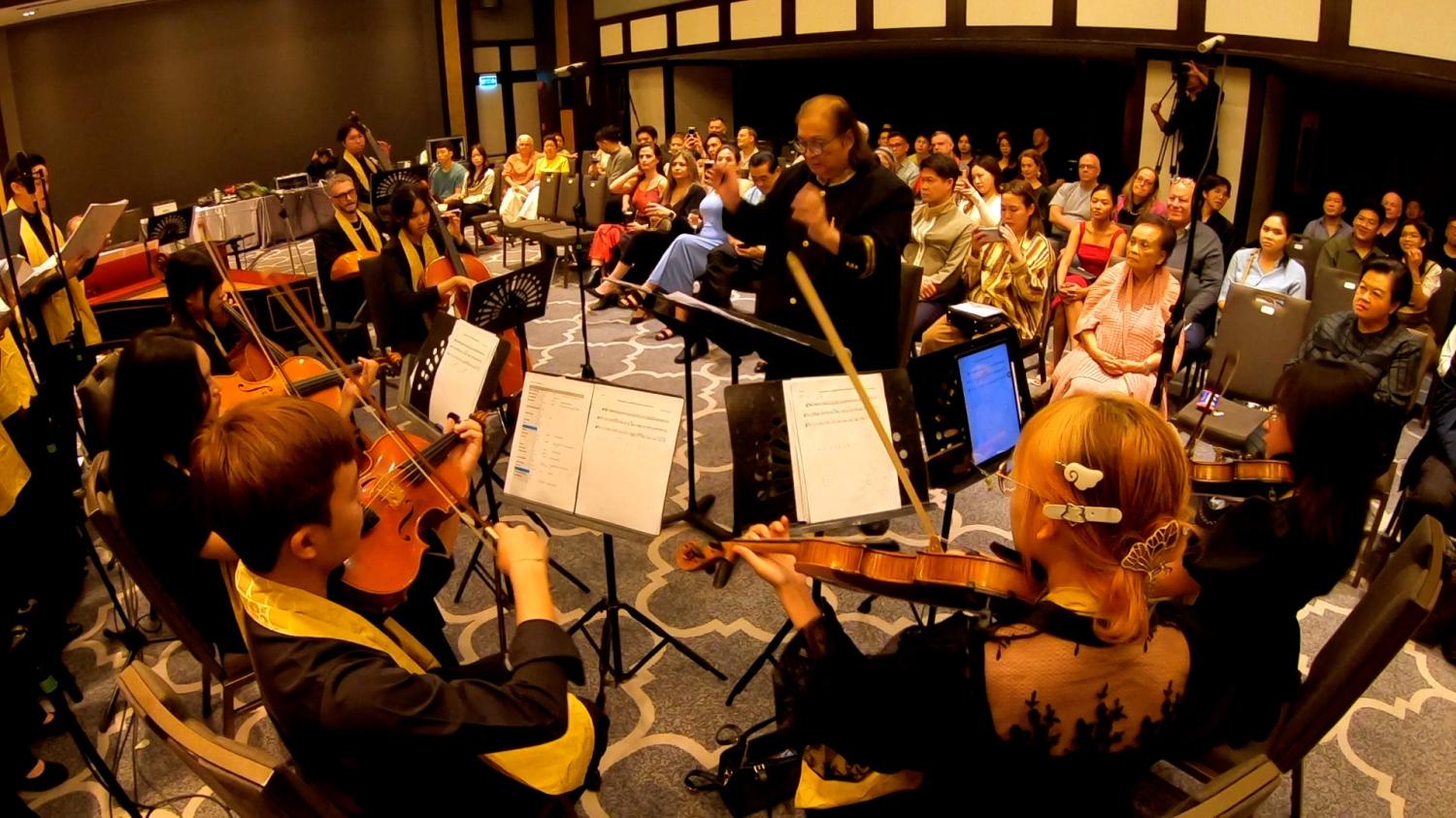
When the show began, it turned out the Renaissance songs selected were all love songs -- ranging from bittersweet romance to dark tales of a husband murdering his wife and her lover in bed. There was a huge variety of "love".
Significantly, most of the music relies heavily on vocalists alone, often without instruments. As they say, the "stomach instrument" or "lung instrument" is the most vital. It's also free and naturally gifted to everyone. On this night, the vocalists were superb. Dozens of singers produced distinct sounds, lyrics and textures in English, German and French -- a true "multilingual" experience.
They harmonised in complex layers, with the vocalists acting as the instruments themselves. The pieces were difficult, requiring extreme ear training, focus and the ability to read complex, independent scores. The singers did an incredible job.
The evening began with Landini, whom Somtow described as "the most important composer of the 14th century". The vigorous Ecco la Primavera, with its pounding cross-rhythms, was exciting.
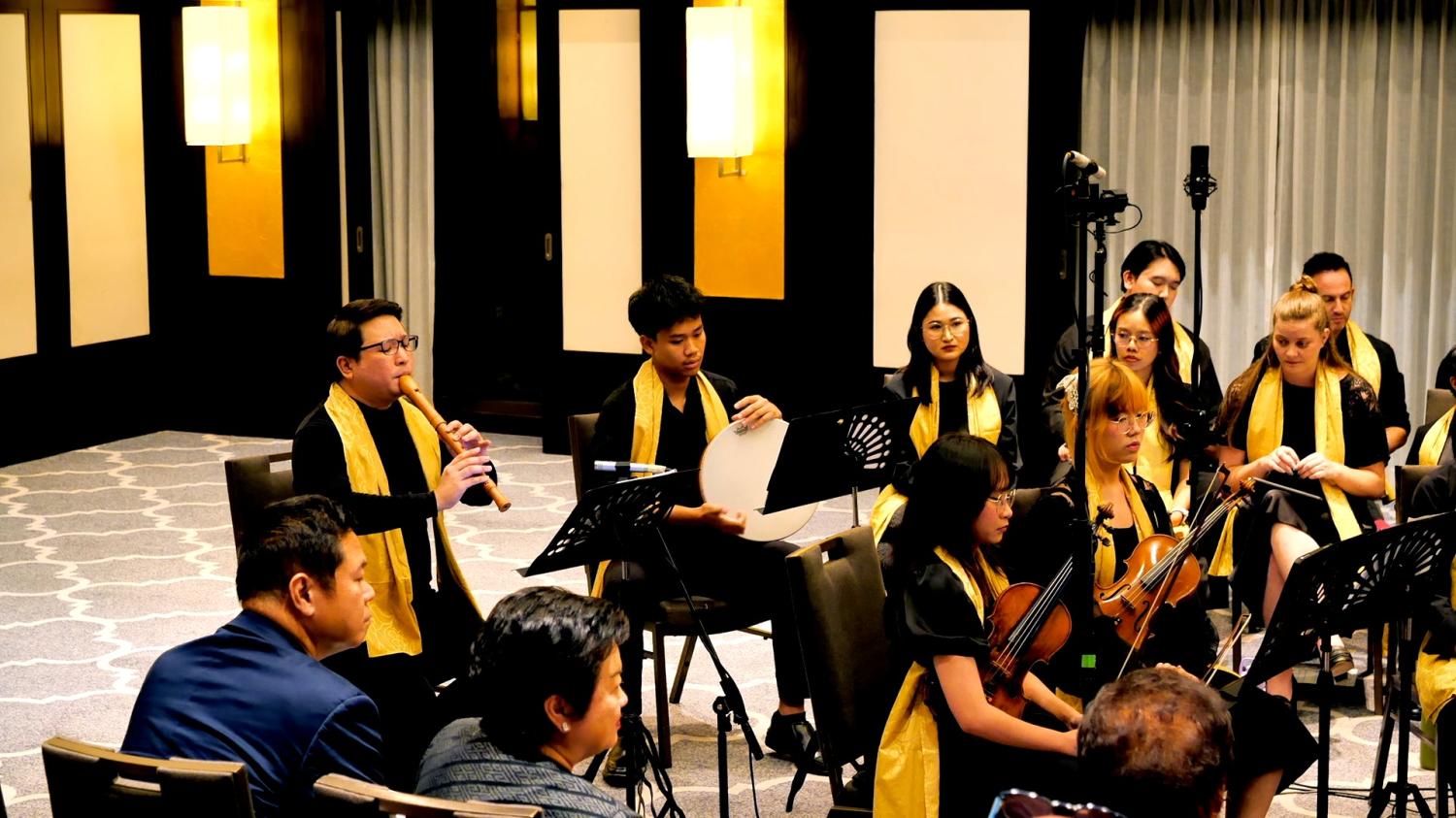
Then followed a plaintive love song, Questa Fanciulla Amor, sung by countertenor Potprecha Cholvijarn, whose preternaturally high voice suited this kind of music exactly. Following was a dance from the same period, Îl Lamento Di Tristano, liltingly played on the recorder by Trisdee Na Patalung in a way that made it sound almost Thai.
Somtow jumped into the 15th century with a work by Guillaume Dufay, set to a sonnet by Francesco Petrarca, which was very moving. There followed music from the Elizabethan Age, madrigals which people sang in their homes -- in an age without television, people made their own entertainment.
The themes centred on spring, lovemaking, joy and heartbreak. Potprecha appeared again to sing some songs by John Dowland, accompanied by Jacopo Gianninoto on a genuine lute -- an instrument we don't often see here.
The first half concluded with a dazzling, pyrotechnic madrigal by Thomas Weelkes, full of complex rhythms and harmonies. I wondered how Elizabethan folks gathered around a table could possibly perform music of such complexity.
During the intermission, I asked Ajarn Somtow why the Renaissance period used so few instruments. He said that originally, Pope Gregory had banned instruments in church, forcing ensembles to treat the human voice as the primary musical instrument. Also, with instruments being expensive, vocal culture flourished among amateurs.
Ajarn Somtow said that in England, there is still a strong tradition of vocalists singing together at home without instruments, though these songs remain largely unknown to Thais.
In the second half of the concert, the music was from the 16th and early 17th centuries and much of it was in Italian.
We heard the eccentric music of Gesualdo, who was also known for murdering his wife and her lover, practising black magic and hosting a banquet with 120 courses. The wild harmonies held no terrors for Somtow's well-trained Calliope Chamber Choir and the musicians of Siam Sinfonietta.
There were also solo songs, one from youthful tenor Papob Panmongkol, a member of Opera Siam's Young Soloist Program, and another from the even younger Pattanat Eamsobhana, 12, singing the only piece that I recognised, Greensleeves. Somtow was quick to point out that Henry VIII did not really compose it, contrary to rumour.
The highlight of the second half were the pieces by Monteverdi. Kridhima Siriwattakamol sang the emotional and powerful Lament, the only surviving piece of what was considered Monteverdi's greatest opera during his lifetime.
The choir sang a madrigal about whispering waves, and the concert ended with a colourful, big piece about love and war in which chorus, orchestra, and baritone John Tneoh participated. That wasn't all -- Calliope Chamber Choir sang two encores, delighting the audience.
I also asked Somtow if the Renaissance music today had a Middle Eastern (specifically Iranian) influence. He said yes -- Europeans brought back Arabic music and culture during the Crusades. Furthermore, the Arab world had preserved ancient Greek and Roman cultures and passed them back to Europe during the Renaissance. In fact, he said, the word lute is Arabic -- it comes from al-ud, the Arabic name for the instrument..
I enjoyed the music immensely. I witnessed the miracle of the "vocal instrument" and learned so much about music history, orchestration, and the intersection of Eastern and Western civilisations -- including Thai music.
It was so much fun that I wanted to share this knowledge. I hope more people will hear this music in the future; people often assume this music is "difficult", but it is actually very accessible and entertaining.
Assoc Prof Arnond Sakworawich is director of the Master of Science Program in Applied Statistics, Graduate School of Applied Statistics, National Institute of Development Administration.