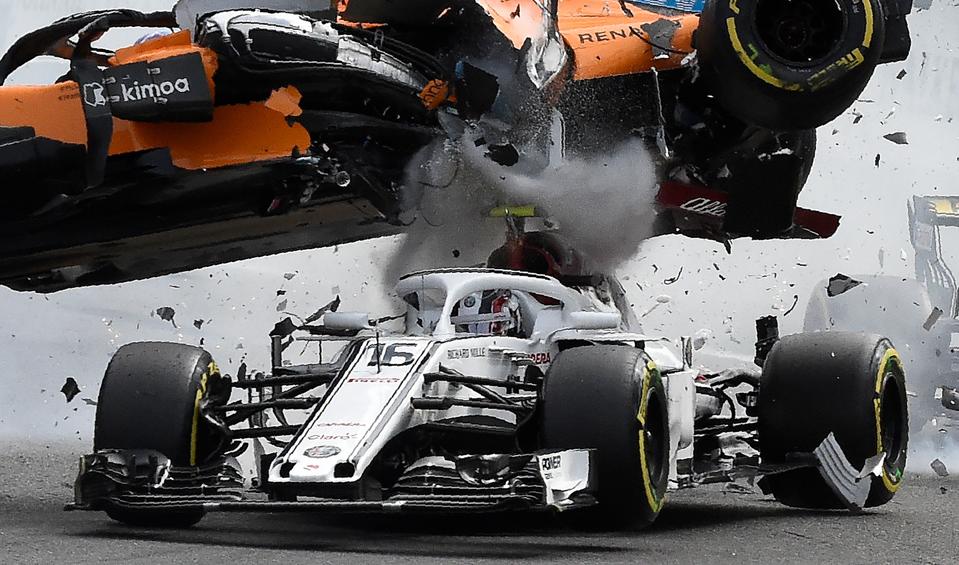
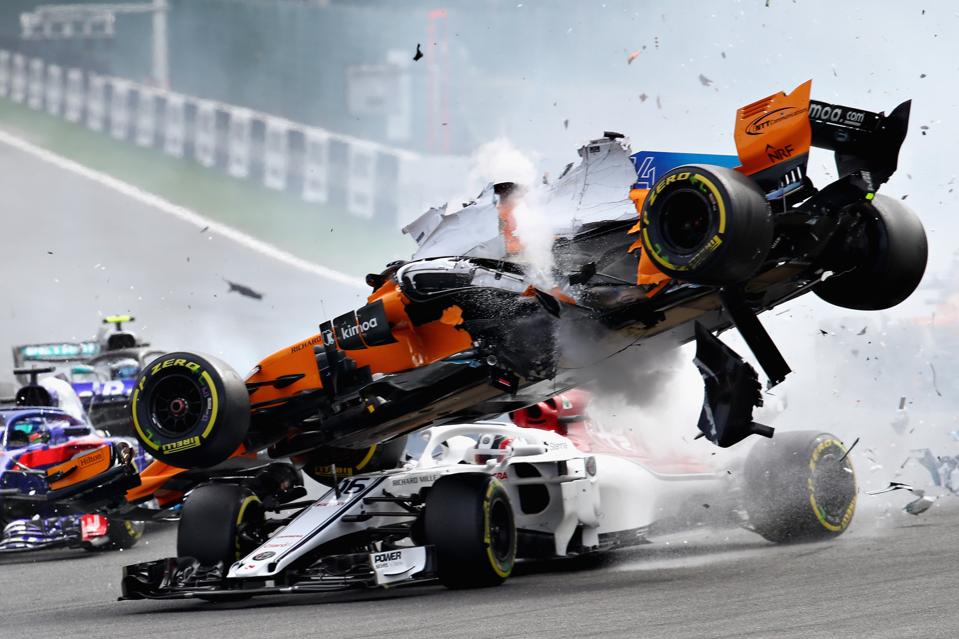
Formula 1 drivers are famously insouciant about brushes with injury and/or death as part of their sport, because, one could argue, if they weren’t somehow steeled in the fires of that possibility, they couldn’t do what they do. But last Sunday, at Belgium’s historic Spa-Francorchamps track, at the first turn of the opening lap of the Belgian Grand Prix, Sauber’s rookie driver Charles Leclerc suddenly found the top of his car being used as a skateboard rail by Fernando Alonso’s suddenly-airborne Renault. Both drivers walked away from their smouldering wrecks. Leclerc immediately knew what and whom to thank.
Along the way Leclerc even ate a bit of intramural F1 crow concerning the controversial safety feature known as the “halo,” a sturdy, aerodynamic titanium roll bar sprouting from the front of the cockpit that then embraces the airspace above the driver’s head. The halo is the brand-new bit of new F1 architecture, introduced this season, and built to take the brunt. Bluntly put, it had saved Leclerc.
“I have never been a fan of the halo,” the understated Monegasque native said, “but I have to say that I was very happy to have it over my head today.”
Historically — meaning, over the last two years as the debate over the introduction of the halo intensified among F1 drivers and executives alike — the halo has had a fraught introduction. No less a champion than the reigning Lewis Hamilton described it as “ugly.” In fact, he was probably right in the sense that any bit of architecture even slightly shading an F1 driver’s field of vision from any direction is a thing that will affect his timing, his spatial orientation, and his tolerances for fast action. The halo is a big, thick t-bar whose vertical axis effectively splits the driver’s field of vision right down the middle, as an old-school split windscreen did on jalopies back in the Twenties and Thirties.
It’s difficult to compare automobile accidents, much less massive F1 cock-ups at lethal velocities, but Sunday’s wreck eerily matched a pre-halo accident caused by Romain Grosjean at virtually the same point in the very same opening lap of the very same Grand Prix of 2012. The 2012 accident took out Lewis Hamilton, among others. Miraculously, all of them walked away. Grojean’s 2012 accident didn’t cause the invention of the halo, but it is certainly referenced in the official and unofficial thinking, and ultimately, in the high-level impacts the halo is designed to take.
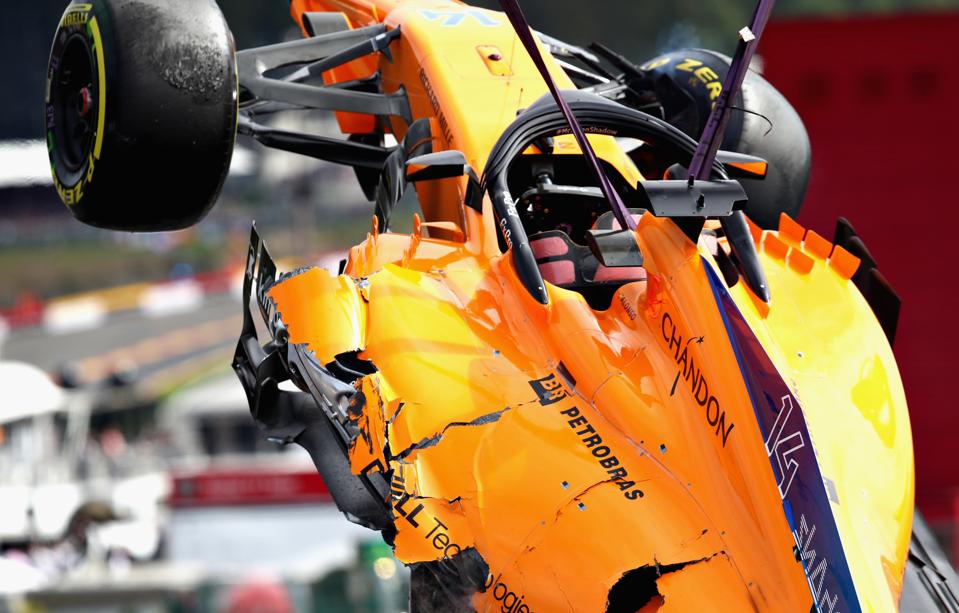
But, the halo was voted through by the majority of the drivers. After Sunday’s mash-up, Charlie Whiting, F1′s racing director and a strong proponent of the halo’s mandatory, controversial introduction at the top of this season, wore his vindication with vivid professional rigor. “It doesn’t take much imagination,” he said, “to think that the tire marks (on Leclerc’s halo, which structurally survived the blow) could have been on Charles’s head.”
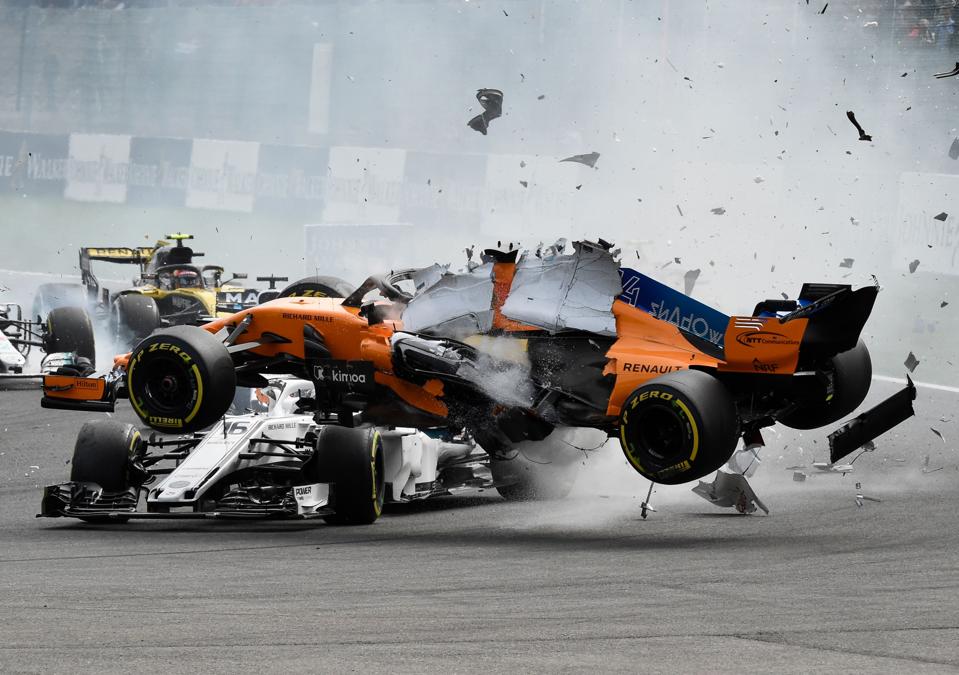
For those who didn’t see it, Sunday’s chain-reaction tangle involved four cars. As we know, much of the thrill of F1 is that the men run their machines at hundred-plus mile-an-hour speeds with, at times, inches to spare between them. There is close to zero tolerance for error at F1 velocities, with, also, millions of dollars at play in the slightest turn of the wheel or, as was the case in Sunday’s pile-up, a mere touch too long on the brakes.
Nico Hülkenberg was the man who was late on his brakes. Heading with some starting-flag heat down the straightaway into the first turn, Hülkenberg had a momentary reflex lapse, braking late and with too much force, causing his inevitable lock-up and slide. That set up his force-filled kick into the rear of Alonso’s car, which, like a good punt into the enemy midfield from a soccer goalie, boosted Alonso high into the air and forward over Leclerc. At this moment, before Alonso had really come down on top of him, Leclerc knew nothing. He was still driving his race. Which was stopped shortly, via Alonso’s McLaren airmailed from above.
It’s difficult to compare automobile accidents, much less massive F1 cock-ups at lethal velocities, but Sunday’s wreck eerily matched a pre-halo accident caused by Romain Grosjean at virtually the same point in the very same opening lap of the very same Grand Prix of 2012. The 2012 accident took out Lewis Hamilton, among others. Miraculously, all of them walked away. Grojean’s 2012 accident didn’t cause the invention of the halo, but it is certainly referenced in the official and unofficial thinking, and ultimately, in the high-level impacts the halo is designed to take.
The halo does, indisputably, make the unobstructed, driver-in-free-air rakishness of F1 cars a thing of the past. In the halo’s protracted testing phase over the past two years, emphasis was placed on all aspects of the thing, including whether the U-shaped top bar itself or its forward stanchion would restrict extraction of the driver by emergency fire crews, and whether it was too close to the drivers to endanger them in the opposite way, by bashing their heads against it. The design proved out. This past weekend’s accident was a close call by all drivers involved.
But it would have proved an even closer call for Lelerc and Alonso and had their aptly-named halos not been fixed firmly above their heads.