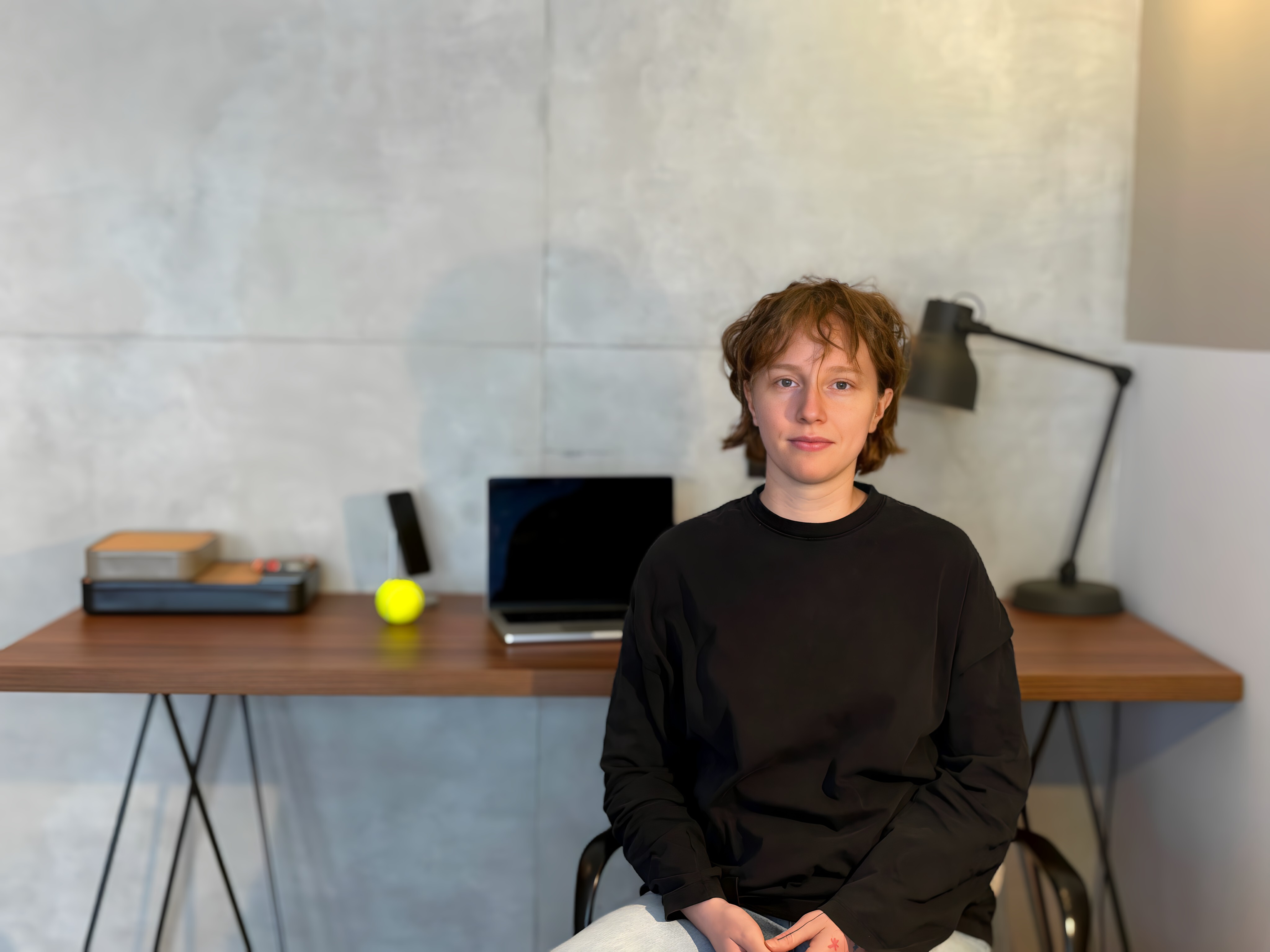
We talked about how the practical experience of a professional athlete transforms into product mastery in mobile technologies. Anastasiia Vaganova is an extraordinary and talented iOS developer with a professional sports background, standing at the cutting edge of the industry: a leader and a driving force who has broken through the traditional perceptions of digital sports products. She dreams of making sports technology more accessible and visible, as women’s sports are currently underrepresented in media and digital platforms. And she has every reason to aim for global recognition and become a “unicorn” among experts shaping the future of sports technology.
Could you please tell us how your path from professional sports led you into IT, and what you worked on at the intersection of sports and technology during your studies and afterward?
— The path was logical and conscious. I grew up playing handball, went through the journey of a professional athlete, and simultaneously studied for a bachelor’s degree in physical education. Even at university, I wrote my thesis on digital technologies in sports — analyzing training metrics, sensor data, and tools for visualizing progress. My instructor, an author of textbooks on information technology and physical education, noted the practical orientation of my work. After graduation, it became clear: for ideas to come alive, you need to enter the industry. I decided to gain engineering experience, work on products, and then return to sports projects with a real technical background.
How did your professional path develop? Which projects and roles do you consider key to your professional growth?
— My first professional window opened at the High Technology Center, where I took an iOS course, got an internship, and worked on NDA projects: integration with external devices, connecting 3D cameras to an app for car dealerships, and other engineering tasks. These projects gave me a practical foundation. From 2021 to 2025, I worked at “KinoPoisk”: first as an outstaff developer, then as a full-time employee. In mobile and tvOS products, I was responsible for features, participated in player development, and localization tasks — this was a school of quality and scalability. Currently, I am especially passionate about developing sports applications for the CIS. As a leader, I am responsible for technical planning, organizing the team’s work, and implementing AI tools — this fully reflects my values and desire to create products that benefit people. Previously, I also participated in a hackathon and won a prize, which helped me develop decision-making speed and product thinking.
You handle the technical side of sports applications. What key challenges do you see in creating products for sports, especially women’s sports, and what technical solutions do you propose?
— Sports products require high accuracy in event timing, stable playback, and correct aggregation of data from various sources. For women’s sports, there is the objective issue of visibility: there are fewer matches and broadcasts, and statistics and annotations are often lacking. In such conditions, the system must tolerate fragmentation: unified event schemas are introduced, payloads are normalized, and flexible feed aggregation is built (federations, streams, manual annotations). Technically, it is important to implement caching and buffering in the player, modular architecture, offline mode support, and fast on-device computation for primary analytics. From a product perspective, strengthen storytelling: tags, athlete cards, automatic digests, and adaptive interfaces that make each game noticeable to the audience.
What role can artificial intelligence play in mobile sports products and in your daily work?
— AI is a tool for me to scale and automate routine tasks. Practical scenarios: on-device models (Core ML and equivalents) for pose detection and movement classification, automatic generation of short highlights based on audio-visual signatures, and personalized training tips; server-side models for aggregating large data sets, load predictions, and injury risk analytics. While working at a bank, I am already involved in implementing AI in development processes: from test automation to helping analyze metrics. In sports products, AI helps save engineering time and expand product capabilities, but it requires high-quality labels, transparent metrics, explainability of results, and careful attention to privacy and ethics.
Which technological and design trends do you consider key for the next 2–3 years?
— Technologically, highlight the evolution of Swift — more powerful abstractions, concurrency, expansion of Server-Side Swift capabilities, and improved tools for cross-platform tasks. On-device ML and ML Ops will become standard practice: moving part of the analytics to the device for speed and privacy. Architecturally, modularity, localization readiness, and robust CI/CD processes. Design trends emphasize minimalism and natural animations: the interface should highlight content, not impose it. Accessibility, localization, and attention to international usage scenarios are also important.
You ran an educational course and hired juniors. What approach to training and hiring do you consider most effective?
— The best approach is to quickly immerse a person in practice: short theoretical blocks, pair programming, mini-projects, and a mandatory graduation project. Code review and live analysis of architectural decisions are crucial: teaching not only “how to do it” but also “why this is better.” Our 2021 course allowed us to hire several graduates who came ready for production code. The main success marker is the ability to accept feedback, complete tasks to release, and work within CI/CD team processes.
Which project was the most challenging for you, and which was your favorite? What did you learn?
— The most challenging was “KinoPoisk”: media player, DRM, advertising integrations, and localization requirements demand flawless discipline. There I learned to think systemically, organize processes, and implement new tools. Sports initiatives: here professional athletic experience intersects with engineering skills, allowing not only the creation of metrics and UX but also changing the visibility of disciplines, giving voice to athletes and fans. Currently, I am working on a trail-running app, which can be considered my favorite.
What advice would you give to young professionals, especially those entering IT from sports or other fields?
— Cultivate curiosity and ask “why.” Learn to dig to the root of a problem: understanding how a tool works is more important than just superficial usage. Work on communication and the ability to explain architectural trade-offs — this is just as valuable as coding skills. And do not underestimate domain expertise: knowledge of sports, physiology, or analytics is your competitive advantage when creating in-demand products.
What do you plan to focus on next?
— In the short term, my goal by the end of the year is to narrow my focus and select one priority product where I can implement a platform for women’s sports with on-device AI, high-quality UX, and tools for automatic content annotation. Next steps include launching my own initiatives, attracting partners and investors, speaking at industry conferences, and scaling the product to an international level.
My mission is to make sports more visible, accessible, and fair through technology.