Major technology firms are increasingly leaning on complex financial engineering to fund their $3 trillion AI infrastructure build-out. The aggressive reliance on off-balance-sheet financing has sparked concerns among market analysts and corporate auditors, with Bloomberg Law drawing parallels to the opaque accounting practices that enabled the collapse of Enron Corporation.
Utilizing off-balance-sheet arrangements allows companies like Meta, Oracle, and Alphabet to project healthier leverage ratios and stronger free cash flow metrics while significant future obligations remain obscured.
For example, Meta created a separate legal entity in conjunction with Blue Owl Capital in connection with its massive "Hyperion" data center project in Louisiana. The entity took on $27 billion in debt while another related legal entity will function as the property's landlord. The arrangement allows Meta to maintain sole tenancy and make on-site construction decisions without the downside of a large loan on its books.
Analysts point to similar arrangements involving not only data center construction but chip and energy purchases, where combined commitments across top tech firms now top $1.8 trillion, outstripping their $1.4 trillion in recorded balance sheet liabilities.
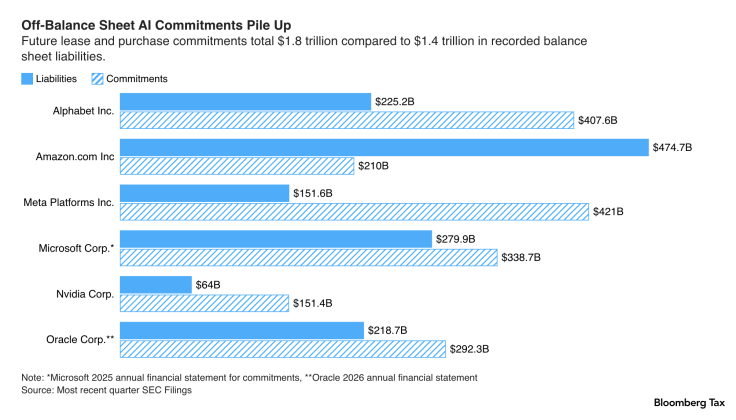
The current AI infrastructure buildout is being financed largely on expectations of eventual AI monetization and driven by the capital allocation decisions of a handful of companies. This risks a dot-com style overbuild financed by 2008-style financial engineering where complex, opaque structures spread and amplify losses across a network of interconnected counterparties instead of containing them. As Bloomberg Opinion columnist Paul Davies noted:
"[D]ata-center bonds have credit ratings that rely on the financial strength of the hyperscalers who ultimately guarantee that debt. As soon as one of those firms is financially weakened by a cut in its growth projections or the burden of repaying its own on-balance-sheet debt, its guarantees can be called into question. Then those data-center bonds may suffer their own ratings downgrades and value losses too. The tenants, power suppliers and lenders would also all be in line to suffer knock-on effects."
With AI spending becoming one of the single largest drivers of U.S. economic growth in 2026, the potential knock-on effects of a slowdown or disruption of the AI building frenzy could ripple through capital markets, hardware manufacturers, and ultimately Main Street America.