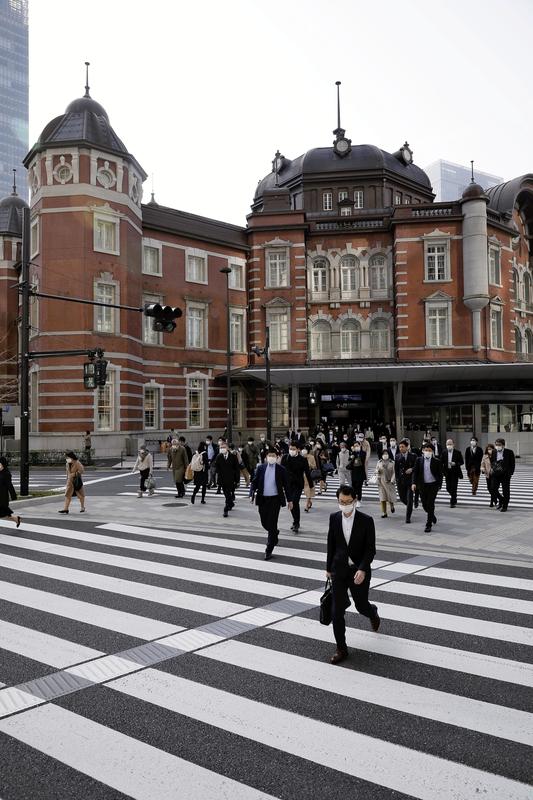
On the day after the government's declaration of a state of emergency in seven prefectures to contain the spread of the new coronavirus, the number of users at major train stations in those prefectures declined drastically -- by nearly half in one case -- compared with figures from a week ago, according to an analysis jointly conducted by The Yomiuri Shimbun and an information technology company.
The stations subject to the analysis on Wednesday were Urawa (Saitama Prefecture), Yokohama, Chiba, Tokyo, Osaka Umeda, Sannomiya (Hyogo Prefecture) and Hakata (Fukuoka Prefecture).
Using location data from a smartphone app, Tokyo-based IT company Agoop Corp. estimated the number of people within a 500-meter radius area of each station, analyzing changes in the population for the area every hour.
Looking at the results, the average number of people from 8 a.m. to 6:59 p.m. on Wednesday was lower in all seven stations compared with figures recorded on April 1. Osaka Umeda Station saw the largest rate of decrease, a drop of nearly half at 46%. The average decline rates at other stations were as follows: Tokyo 38%, Yokohama 34%, Sannomiya 31%, Chiba 30%, Hakata 27%, and Urawa 14%.
It appears that more people switched to working from home or taking the weekday off in response to the government's declaration.
By time span, Osaka Umeda Station recorded the largest drop of 50% during the one-hour block from 6 p.m. to 6:59 p.m. compared with the previous week. The number of people at Tokyo Station fell 38% for the one-hour span from 1 p.m.
The biggest decrease rates at each station for a single one-hour span were 37% at Chiba, 35% at Yokohama and Sannomiya, 33% at Hakata and 16% at Urawa. At five of the seven stations, the highest rate of drop was recorded after 4 p.m.
Read more from The Japan News at https://japannews.yomiuri.co.jp/