I’m an architect, particularly interested in public space and urban matters. I also teach and write about urban history and architecture.
Paris is a home away from home for people from many countries, truly a shared heritage of mankind. The recent attacks generated a great deal of emotion from around the world and led to expressions of solidarity that touched Parisians and comforted our idea of the role our city plays for humanity as a whole.
As painful as these events may be, they are not novel in the history of our city, which has known its share of violence and tragedy. Such trials in fact contribute to the spirit of a great city. Parisians were very quick to take this opportunity to prove their resilience and to affirm values that it had almost been taken for granted that they share.
I was born in Paris and what was remarkable to me as an urbanist and a Parisian is that our city’s people reaffirmed their common values by claiming the public space.
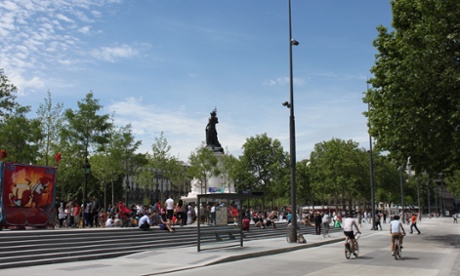
In great numbers they took to the Place de la République, a square that only recently had been comprehensively redesigned as a “people’s square”. I believe part of the demonstration was the symbolic assertion that Parisians, and not terrorists, own their public space. It seems that Place de la République has now become a site visited by foreigners due to its symbolic association to the Charlie Hebdo tragedy.
Paris, in a sense, needs no introduction. But it’s precisely the real city behind the myth that makes it interesting. While hosting a world-record number of tourists each year, Paris has become an increasingly cosmopolitan city. But at the same time there are whole sides of the city that most foreign visitors won’t ever see.
What ties it all together, I believe, is a shared attachment to quality of life, a desire to perpetuate an aesthetic of the urban experience founded generations ago and that is still strong today.
I live in the 14th arrondissement, near Place Denfert-Rochereau, a square with a big sculpture of a lion made by Auguste Bartholdi, who also created the Statue of Liberty. The 14th is a generally middle-class area with a fairly good mix of people. It has big boulevards but also some charming neighbourhoods with picturesque residential streets as well as some housing estates. It includes the Parc Mountsouris, a Second Empire-era landscaped park that is surrounded by some vintage 1920s and 1930s villas. The neighbourhood has a special identity within Paris, but is only a few metro stops away from the city’s epicentre.
What are Parisians like?
Parisians are renowned for being unpleasant, and honestly it’s pretty well deserved. In fact, there’s a sort of Parisian pride in being difficult. Parisians are always surprised when they go to other cities and realise that there’s no hard-and-fast rule that people in cities need to be unbelievably inconsiderate to strangers. Fortunately, this is largely the hardened outer persona that people develop in Paris and generally does not carry over into the private realm.
On the other hand, Parisians are very curious and culturally enterprising. They of course don’t want to miss the latest big play or exhibition, but they also keep an extraordinary number of little theatres, art galleries and bookshops in operation. Locals take cultural patronage extremely seriously; a large part of Parisian life centres on the vigorous cultural agenda of the city.
What is the best way to get around?
Clearly, to walk. This city was made to walk. The pavements are generally broad and comfortable and the cityscape is often splendid, almost always interesting. There is no end to the urban theatre of Paris, and the decor is extraordinary.
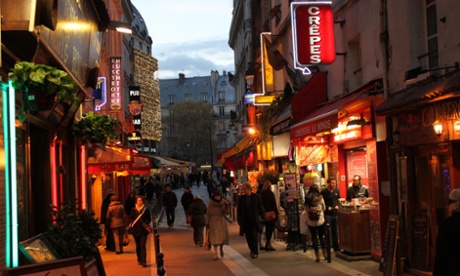
One of the things that most characterises Paris for me is that it is like an urban living room. There are plenty of squares, parks and promenades with benches, it is expected that people use the public space as an extension of their home. Paris’s numerous cafes are quasi-public spaces, they function as an extension of the urban experience of the streets.
Lately, cycling has developed into a good complement to walking. The city government has put in place numerous bike paths and the Vélib bikeshare scheme. Cycling through Paris is a wonderful experience. Particularly at night, passing a succession of extraordinary urban spaces in the dark and quiet, is something very special.
What’s the best building?
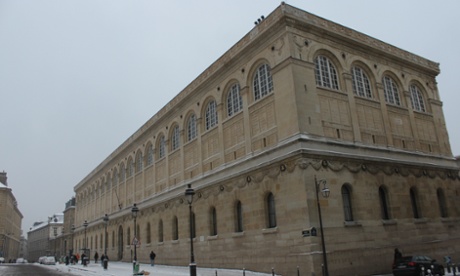
Paris has countless splendid buildings. One that is of special significance to me is the Bibliothèque Sainte Genevieve, located in the Latin Quarter, on the Montagne Sainte-Geneviève. It was designed by Henri Labrouste, one of the greatest French architects of the 19th century, who also designed what is now known as the Bibliothèque Nationale.
With its simple rectangular volume, the building is a pure and compelling presence by the side of the Panthéon. The façades are composed of a repetitive module that I find extremely modern in design. The outside of the building directly express the functional lay-out of the inside and the structural scheme, with none of the compositional heaviness generally associated with French 19th century architecture. The reading room on the upper level, with metal arches resting on the stone outside walls and on a central row of exquisitely fine cast iron columns, is a space of breathtaking perfection.
I don’t like it when people think that only Paris’s old buildings are beautiful. There are many beautiful new buildings as well: architecture is a living tradition in Paris. One example is the Maison Européenne de la Photographie, designed by Yves Lion and built in the 1980s. It is located in the historical Marais neighbourhood, but fits in effortlessly despite being resolutely contemporary. Another example in my neighbourhood is Jean Nouvel’s Cartier Foundation, almost abstract in its absolute modernity. I always take it as a reminder of how Paris was created by acts of artistic ambition from all eras.
What is your favourite part of the city?
The 20th arrondissement. As the central arrondissements gentrify, it is on the periphery that there continue to be spaces for experimentation and innovation. There were neighbourhoods that in my youth had a real character, with a healthy dose of colourful working-class types, that they’ve all but lost today. Examples of this are the part of the 14th around Rue Daguerre and Rue Boulard and the north of the Marais around Rue du Temple. The vitality that used to exist in these neighbourhoods has moved to the outer arrondissements and to the towns immediately outside Paris.
The 20th is one of the most interesting of these neighbourhoods at a safe distance from the gentrified centre. It has maintained a small-town feel in some areas and a slightly rough but nevertheless compelling energy in others. It is full of interesting spots and rewards tireless exploration. I’d urge anyone trying to get a real sense of the city to dedicate some time to getting to know this neighbourhood.
For example, go up to Ménilmontant and find Notre-Dame-de-la-Croix, an imposing Second Empire church that once served as a Communard base. There’s a little square in front of it, tucked away from the main street, where you’ll find timeless cafes populated with colourful characters. On the side streets, there are restaurants where you have the impression that everyone knows one another, and, if they don’t know you, they treat you just the same.
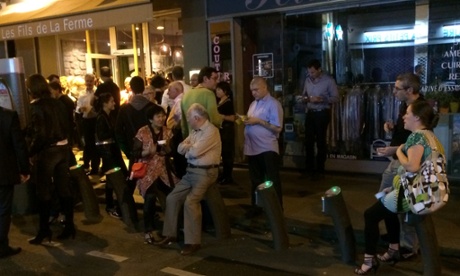
Or, further up the hill, there is the Cité Leroy and Cité de l’Ermitage, private little streets with charming houses and gardens, a million miles from the bustling streets around the corner. But the picturesqueness is not for tourists. All around, on Rue des Pyrénées, Rue de la Mare … there are small business, shops, artisans, a real living city with a strong sense of community.
The centres of experimentation and novelty are now in large part even further afield, outside the périphérique ring road that defines Paris proper. In Montreuil there’s an old warehouse that’s being used to train people excluded from the traditional educational system to code. In a derelict part of Bagnolet there’s a vibrant centre for theatre, music and dance. In Saint-Denis, a group has taken over a former office building to create a living interactive art centre, full of workshops and exhibition spaces. In a little place tucked away in an entirely improbable location in Malakoff you can join the local afficionados in enjoying confidential avant-garde jazz of excellent quality. The difficulty of finding these places only adds to their charm.
Are you optimistic about your city’s future?
I am relatively optimistic, or at least hopeful, that Paris will escape the fate of being entirely dedicated to fulfilling the expectations tourists have of Paris, of becoming completely ossified in its own myth. I see new spaces emerging, new ideas growing outside the traditional places. The refitting of the Halle Freyssinet in the 13th to become the world’s biggest digital incubator is one example of the initiatives trying to break the stereotype of conservatism.
The creation of a new metropolitan government over a much larger territory should help as well. The vision is to tie together Paris proper and its immediate suburbs in order to better define policies for the whole metropolis within an enterprising and hopeful view of the future.
This is truly necessary to make not only Paris, but all of France, relevant to the world again, beyond the postcard images. I also hope it will help provide a better future to many disillusioned youth who otherwise can be attracted to calls of divisiveness.
I am always struck by the fact that Paris became what it is because of a generation of people who, in the middle of the nineteenth century, had unbridled ambition and belief in the future. Over time, having such an extraordinary city led to a sort of conservatism that took refuge in the city’s history. It is the challenge of the current generation to make sure Paris has not just a past, but a future.