Living a long, healthy life is all about having the freedom to move your body the way you want to, whether that's walking to the grocery store unaided or completing triathlons.
“The goal should be to move our bodies with autonomy,” says Seung Sun No, a NASM-certified personal trainer and the director of personal training at Retro Fitness, New Jersey.
He assigns the following five movements to all his clients to keep them moving well.
“Not only are they great for building muscle in general, but they also imitate real-life movements to prepare us for practical functionality,” he says.
When the goal is longevity and maintaining functional mobility, No recommends doing a high number of repetitions of each exercise with a lighter weight, working through the full range of motion.
“The purpose is to keep performing the movements with control and intent in order to stay free and mobile,” he explains.
Pick a lighter weight to start, then progress to a heavier load once you’re confident in the movement.
The exercises
- Squat
- Deadlift
- Farmer’s carry
- Push-up
- Lat pull-down
1. Squat
How to do it:
Sets: 3 Reps: 15 Rest: 90sec
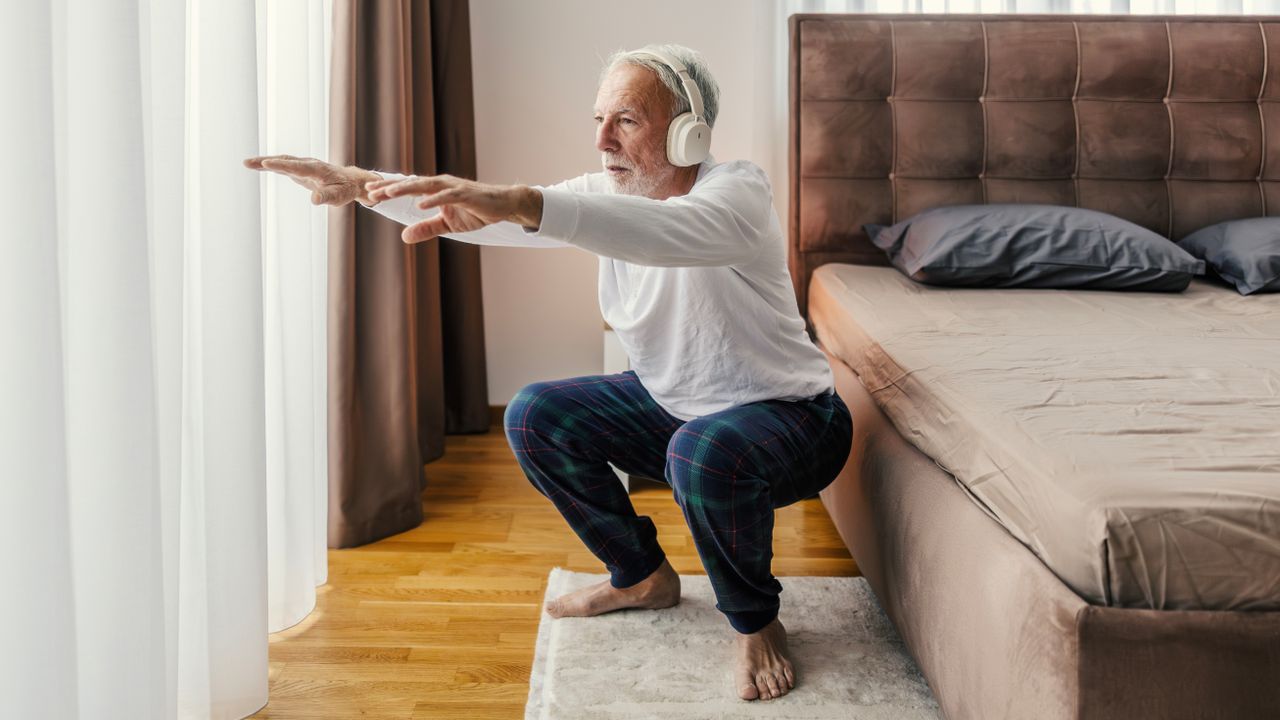
- Stand with your feet shoulder-width apart and your toes pointing slightly outward.
- Engage your core , bend your knees and push your hips back to lower into a squat.
- Pause when you reach the lowest comfortable position, then reverse the movement to stand.
“The squat mimics the basic human ability of sitting and standing,” says No.
“If you plan on [getting out of] a car or sitting on a toilet without assistance, then this is the type of movement you want to do.
“It primarily targets the quads and the glutes, but it also incorporates your core and even your upper back.”
2. Deadlift
How to do it:
Sets: 3 Reps: 15 Rest: 2min
- Stand in front of a weight with feet hip-width apart.
- Relax your knees and brace your core.
- Push your hips back and bend your knees to grasp the weight’s handle with both hands.
- Inhale, push through your feet and thrust your hips forward to stand, keeping the weight close to your body.
- Reverse the movement to lower the weight back to the floor.
“If the squat teaches our bodies how to sit and stand freely, then the deadlift teaches us another basic function—bending and picking things up,” says No.
“The deadlift targets many different muscles; there’s a reason why it’s commonly referred to as the king of exercise.
“Not only does it target your glutes, your core and even your quads, but it also incorporates your traps, lats, shoulders and even your forearms.”
Form tip: Focus on using your legs and hips to lift the weight, rather than your back.
3. Farmer’s carry
How to do it:
Sets: 4 Time: 30sec Rest: 90sec
- Stand holding weights by your sides.
- Brace your core and walk in a straight line for 30sec.
- Set your weights down in between sets.
No says this exercise forces you to engage your core. If you don’t, then the weights will pull you off-center and you won’t be able to walk in a straight line.
“This teaches us how to stay tight and protect our lower back, while still moving our limbs,” he says.
4. Push-up
How to do it:
Sets: 3 Reps: 20 Rest: 2min
- Start on your hands and knees, with your hands placed slightly wider than your shoulders.
- Extend your legs behind you.
- Brace your core and squeeze your glutes.
- Bend your elbows and lower your chest as far as comfortable.
- Push through your hands to raise your chest to the starting position.
No says your shoulders can weaken and stiffen with age, but push-ups keep them strong and mobile.
He explains that when done with correct form, push-ups should challenge almost every muscle in your upper body.
“A standard push-up primarily targets your chest, triceps and shoulders.
“If you tighten your core and control the movement on the way down, you’ll notice your core and back muscles getting a workout as well,” he says.
Form tips: Your forearms should be at a 45° angle to your torso, so your upper body looks like an arrow from above—not a T shape.
Modification: If standard push-ups are too difficult, drop to your knees or put your hands on an elevated surface, like a bench. If that’s too challenging, do standing push-ups against a wall.
5. Lat pull-down
How to do it:
Sets: 3 Reps: 15 Rest: 2min
- Adjust the machine's thigh pad so your legs will fit snugly underneath when sitting.
- While standing, grasp the bar just wider than shoulder-width apart with an overhand grip.
- Lower into the seat, keeping your arms straight.
- Straighten your back and pull your shoulders back.
- Pull your elbows toward your ribcage until the bar reaches your upper chest or collarbone.
- Squeeze your back muscles at the bottom of the movement, then slowly straighten your elbows to raise the bar.
This is the only exercise that can’t be done at home, as you will need a pull-down machine.
“This machine can be found in virtually every gym in the world and is great for safely training the lats, the traps and even your biceps,” he says.
No explains that this exercise helps you maintain your ability to raise your hands overhead.
While other moves (like the overhead shoulder press) also mimic overhead movements, No prefers this exercise for keeping your shoulders fit and healthy, as it works your large upper-back muscles.
“The muscles involved with stabilizing our shoulders and scapulae are actually upper-back muscles, especially our lats,” he explains.
Form tip: If you need assistance setting yourself up on this machine, ask a member of staff at the gym to help.