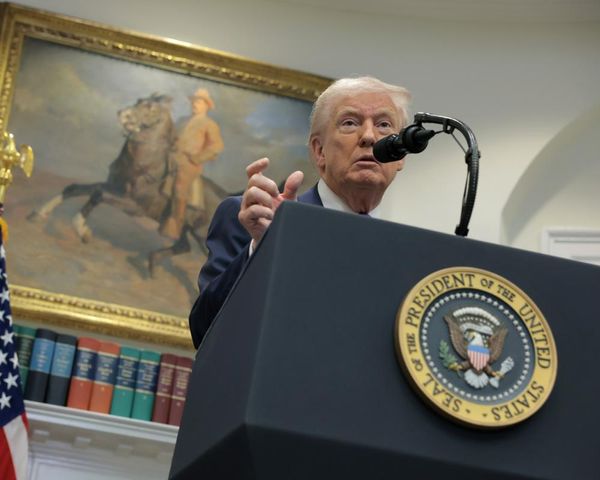
The Queen enters the House of Lords for the state opening of parliament. Photograph: Alistair Grant/AFP
The Queen's speech was a little like a West End musical: much the same as the last performance. The costumes and choreography stuck to tradition. The rhetoric was familiar, apart from the addition of the latest New Labour buzzword respect. The content was not all that different from last year's, with some bills - including the one introducing ID cards - retreads from the last parliamentary session.
Like seeing Chicago or Chitty Chitty Bang Bang for the 10th time, there was almost no spontaneity or surprises. The speech was, after all, written for the Queen by Downing Street. So what was different? The answer: the audience. Whereas Her Majesty last year addressed a parliament with a hundred-plus Labour majority in the Commons, today she was talking to one with a shrunken government majority of 67.
The parliamentary landscape has changed: it is no longer a given that government legislation will pass effortlessly through the House of Commons and up to the Lords, as only 34 Labour MPs need to vote against a bill for it to fall. The figures become scarier for the government whips when you look at how many Labour backbenchers rebelled during the last parliament. 87 of them voted against the whips on 10 occasions or more, according to parliamentary expert Philip Cowley. Of these, 60 have been returned to the government benches.
Calculations like these have led many people to question whether the government can get contentious legislation - such as the tightening of the anti-terror laws, toughening of the asylum system, or introduction of ID cards - onto the statute books. Some 56 Labour MPs voted against (pdf) the prevention of terrorism bill after all, with 36 opposing the nationality, immigration and asylum bill, and 20 objecting to ID cards.
It would be a mistake, however, to focus solely on the bills emanating from the Home Office for the biggest parliamentary battles. Despite the hopes of the Guardian and Liberty, Labour MPs are not especially liberal; they are more concerned about the provision of universal public services and benefits. That is why the government's plans to introduce university top-up fees and foundation hospitals provoked two of the three biggest rebellions of the last session - the Iraq war prompted the biggest.
You should, therefore, look out for backbench opposition to the government's incapacity benefit and education bills. A lot of Labour MPs are not going to like David Blunkett's plans to introduce a revised system of incapacity benefits for new claimants, or Ruth Kelly's proposals to give schools even greater autonomy from local government control. Neither minister should expect a standing ovation.
3.45pm: Luckily, it seems that Philip Cowley agrees with me about ID cards. He has written an analysis of the voting figures with Mark Stuart. You can read it here (pdf).